

.png)

Summary
Postural control software measures how a person keeps their body steady while standing, moving, or recovering balance. Tools range from motion capture systems and pressure mats to force plates that measure how pressure shifts under a person’s feet as they hold their balance.
The right tool depends on what you need, whether it’s a simple posture cue, a balance metric, or detailed movement data for research and performance decisions.
This article explains what to look for when evaluating postural control software, then surveys the leading options by category. We’ll start with professional posture and movement analysis tools, including Theia3D, our markerless motion capture system validated in independent peer-reviewed research.
Then we’ll move on to force plate and posturography systems for standing balance, and posture-monitoring tools for everyday posture cues, posture improvement, and corrective habits.
How to Assess Postural Control Software
Decide Whether You Need Static or Dynamic Postural Control
The first decision is whether you need to measure posture at rest or balance in motion. Static posture analysis captures a snapshot of how the body is aligned at rest, such as forward head carriage or pelvic tilt, usually from still images. Dynamic postural control analysis measures how a person keeps their balance over time and through movement, including sway, weight shifts, and the adjustments the body makes during a task.
The two answer different questions. A static snapshot flags a visible alignment issue, but only dynamic measurement shows how well someone stabilizes when challenged.
This is also where the buying decision starts. If you only need posture screening to document resting alignment, as many personal trainers, chiropractors, or fitness professionals do, the photo- and video-based end of professional posture and movement analysis software does the job with minimal setup.
If you need to measure how someone actually controls their balance, you move up to systems built for movement: force plate and posturography systems quantify sway and center of pressure during standing, while markerless and optical motion capture record how the whole body moves through a task.
Decide What Level of Measurement You Actually Need
The next decision is how precise your measurement needs to be. Observation-based tools let you record, annotate, and compare images or video, but the reading still depends on the practitioner's eye. Motion analysis software and other quantitative tools produce exportable data such as center of pressure path, sway velocity, and 3D joint kinematics.
The real question is whether a visual comparison is enough, or whether you need a number you can track over time and defend in a research or performance setting.
Consider Setup, Hardware, Operator Time, and Environment
Setup burden affects how many people you can assess in a day and whether a system works outside a controlled room. Photo-based and webcam tools are ready in minutes. Traditional marker-based capture, which researchers often rely on for measuring posture, needs a technician to place markers, calibrate cameras, and control lighting before any trial can begin.
Markerless motion capture removes the marker step, which speeds up collection, reduces participant burden, and lets people move naturally.
Environment matters too. A system confined to a darkened lab can't follow a participant into a hallway, gym, or outdoor setting where real-world perturbations occur.
Check Whether the Software Is Scientifically Validated for Postural Control
Validation is essential for high-stakes work. It’s also highly specific: gait analysis software validated for walking may not be validated for quiet-stance sway. The strongest evidence is independent, peer-reviewed comparison against accepted reference methods such as marker-based motion capture or force plates, not accuracy claims appearing in sales materials.
Be skeptical of tools that grade every person against a single template of "correct" posture, since natural variation isn't the same as dysfunction.
Evaluate Data Export, Integration, and Privacy
The software should synchronize cleanly with your other equipment and export raw data in standard formats such as .CSV, .C3D, or .JSON, so nothing is locked into a proprietary system.
Understand where computation and storage happen, because cloud-based processing can create data compliance challenges, while local, on-premises processing keeps video and participant data within your control.
Ask about retention policies before you accumulate months of data, since some lower-cost tools delete older files automatically.
Professional Posture and Movement Analysis Software
These tools are used by practitioners, researchers, and performance teams to assess posture, alignment, movement, or whole-body mechanics. Systems such as Theia3D, Vicon, and Qualisys use marker-based or markerless motion capture to produce detailed 3D movement data, capturing not just how the body is aligned at rest but how it moves and stabilizes during a task.
Theia3D (Theia Markerless)
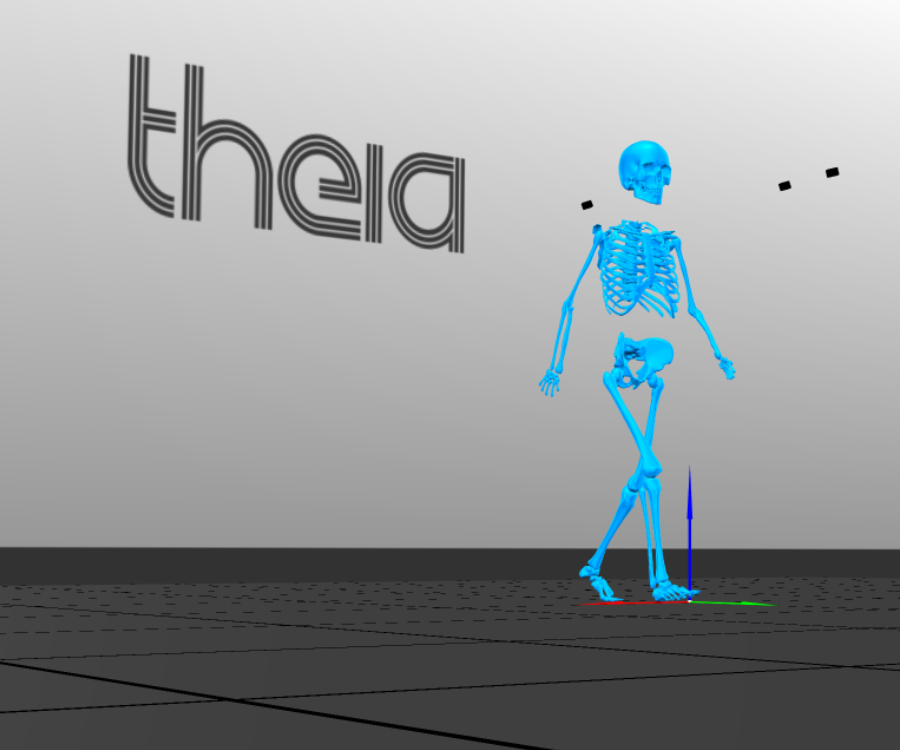
Theia3D is a markerless motion capture software that uses deep learning and synchronized multi-camera video to reconstruct 3D human movement, without requiring subjects to wear markers, sensors, or special clothing.
By eliminating the instrumentation step, Theia3D removes up to an hour of preparation time that a trained operator would otherwise spend applying markers, with one study reporting a reduction of over 80% compared with traditional optical motion capture.
The system converts natural movement recorded on video into standardized biomechanical data in formats including .C3D, .FBX, and .JSON, which export directly into downstream analysis environments such as Visual3D, Vicon Nexus, Qualisys Track Manager, Python, and MATLAB.
For postural control, Theia3D can quantify whole-body movement during quiet standing and during functional tasks, capturing continuous 3D movement data that static photo-based tools don’t record, providing an additional quantitative layer that can complement the observation and judgment of researchers and performance teams.
Efficient Markerless Setup and Data Collection
With Theia's markerless system, participants can relax and stand or move as they normally would, which produces a representative picture of their postural control.
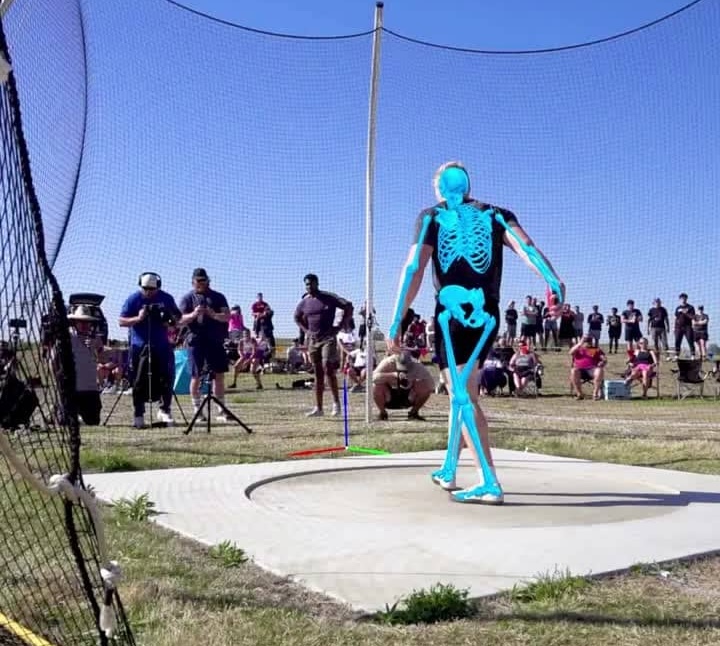
The system uses deep learning to automatically identify and track over 120 anatomical landmarks on a person in video, and those reference points are measured consistently across sessions, operators, and sites. This consistency supports repeatable measurement over time, which is important when reassessing the same participant across multiple measurement sessions or in repeated-measures research.
By contrast, marker-based systems depend on a technician placing markers in the same spot every time, and small placement differences introduce measurement errors that undermine session-to-session reliability.
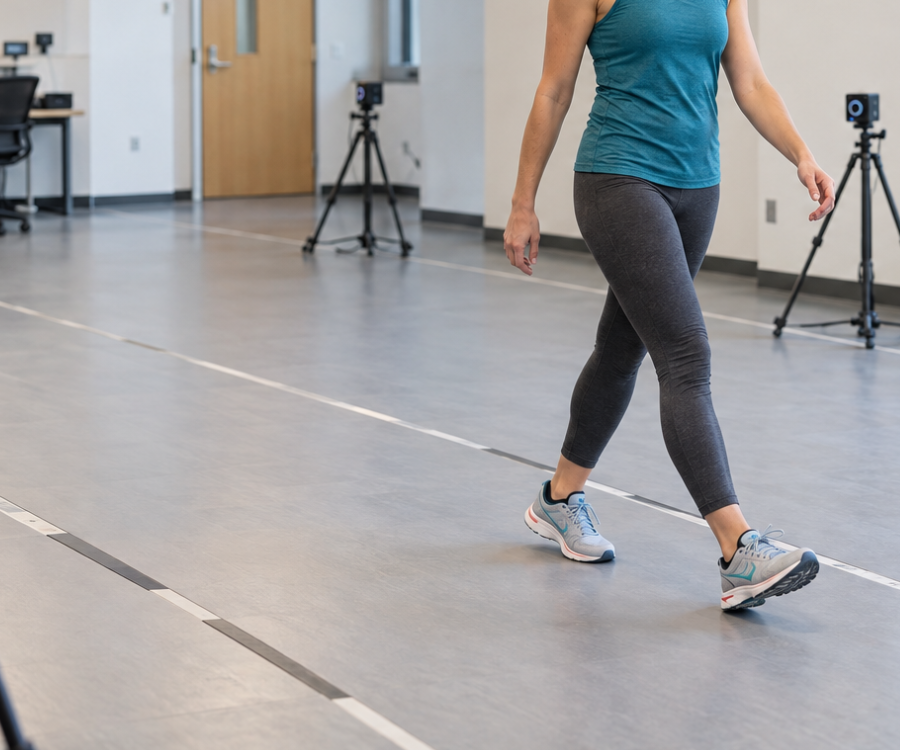
Setting up the system requires fully synchronized, high-quality video from eight or more well-placed cameras, positioned around the capture space so the subject is visible from multiple angles. Calibration is straightforward, beginning with a short recording of an operator waving a calibration wand or Theia's calibration board in the capture area to establish the position and orientation of every camera.

The subject then performs their task naturally, and the system can track multiple people at once as long as each is clearly visible in at least three camera views, with the option to specify a central person of interest.
Unlike infrared marker-based systems that need a darkened, instrumented lab, our software can be set up wherever cameras can be mounted, including hallways, gyms, training facilities, and outdoor settings.
Turning Synchronized Video Into Analysis-Ready Postural Data
Theia3D runs as a local, on-premises desktop application on consumer-grade NVIDIA GPUs, and no video, participant information, or analysis data is ever transmitted to Theia or any third-party cloud provider. This local-processing architecture is an advantage for organizations managing sensitive individual records and for teams that need to keep athlete data private.
The software uses camera calibration to triangulate 2D keypoint detections into precise 3D landmark positions, then fits those landmarks to a skeletal model of 17 rigid body segments representing the subject's complete 3D pose.

The underlying models were trained on over 100 million images spanning more than 1,000 different environments, which allows accurate landmark detection from standard video under real-world conditions. The resulting 3D skeleton lets users measure joint angles, movement patterns, sway, and whole-body center of mass, all of which are relevant to quantifying postural control.
When exporting to .C3D files, the software saves both raw unfiltered poses and smoothed filtered poses, giving users the option to work with either version, which is useful when subtle postural adjustments need careful filtering before analysis.
Validated in Peer-Reviewed Research Against the Gold Standard for Postural Control
Theia3D has been validated in more than 50 independent, peer-reviewed studies, including balance and postural control.
At the University of Innsbruck, researchers compared Theia3D with Vicon marker-based motion capture during eyes-open and eyes-closed quiet standing. The two systems agreed closely: Theia3D matched Vicon almost exactly on the dominant postural strategies, captured similar overall principal postural movements, and detected the expected increase in postural movement speed when participants closed their eyes.
The study concluded that Theia3D provides highly comparable results to Vicon for PCA-based postural control analysis, even in quiet standing, a subtle, low-amplitude task that poses a rigorous test for markerless motion capture.
A second Journal of Biomechanics study extended the evidence from quiet standing to dynamic balance tasks. Sixteen participants walked, recovered from a deliberate loss of balance, crossed a narrow beam, and performed countermovement jumps while being recorded with both Theia3D and a marker-based motion capture system.
Theia3D-derived estimates of center of mass and extrapolated center of mass showed only small differences from the marker-based reference, with bias on the order of a few millimeters and RMSD around 1 cm. Whole-body angular momentum also showed moderate to substantial agreement, with RMSD below 10% of total amplitude. That matters because center of mass behavior and related whole-body measures are central to understanding how people maintain balance during both steady movement and balance challenges.
During a lean-until-balance-loss task, a related study focused on margin of stability, which is the distance between a person’s extrapolated center of mass and the edge of their base of support. Theia3D-derived estimates of extrapolated center of mass and base of support were broadly consistent with a marker-based reference system, with XCoM differences close to 1 cm and strong overlap between markerless and marker-based base-of-support estimates.
The study concluded that markerless results were consistent with the reference system, while noting that margin-of-stability measures should be interpreted carefully during more dynamic phases of movement.
As with any biomechanical analysis software, Theia3D should be validated for the specific task, joint, and movement plane relevant to your work rather than assumed to be equally accurate in every use case.
Talk to our team to see how Theia3D supports research-grade postural control analysis without markers or wearables.
Vicon
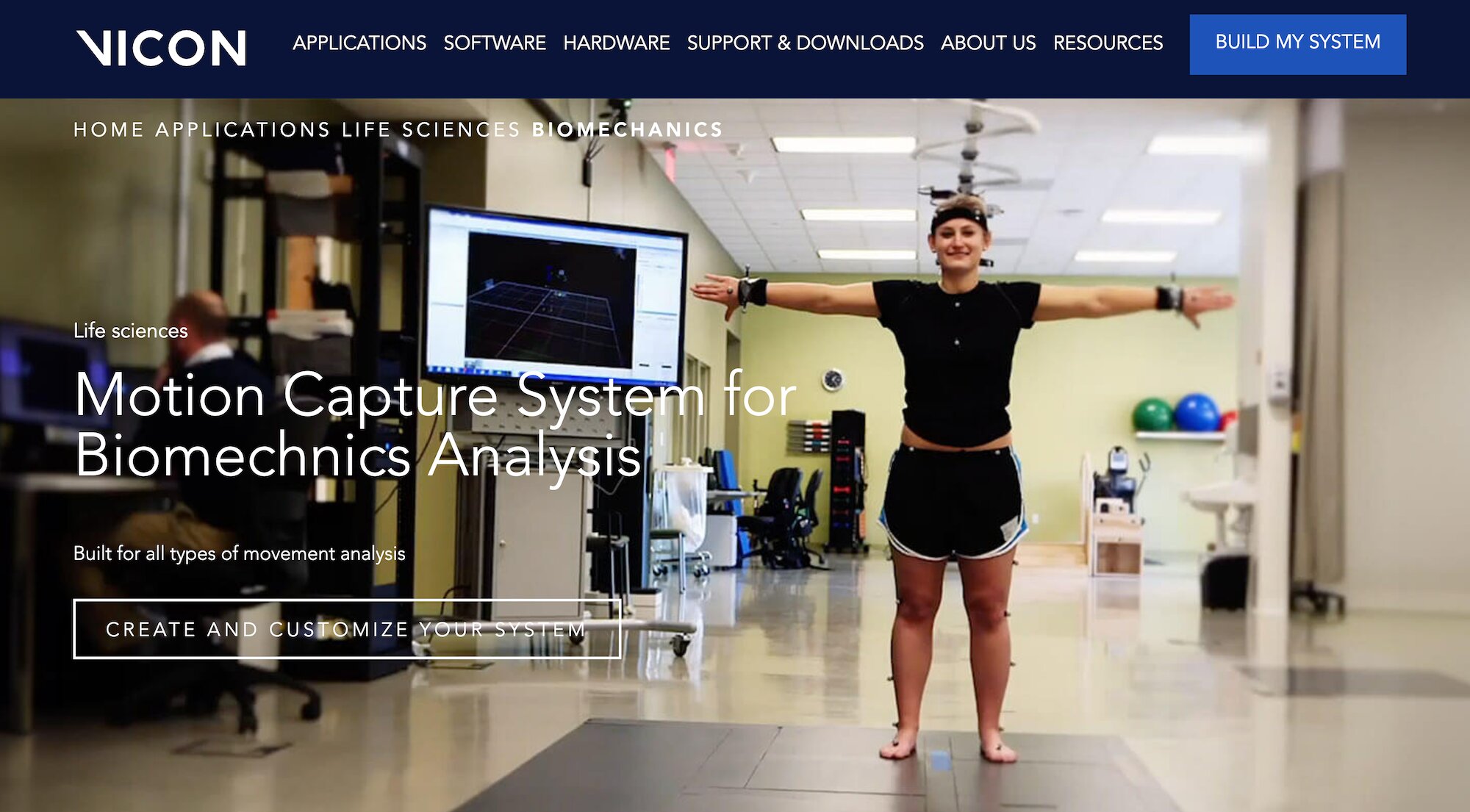
Vicon is a marker-based optical motion capture system widely used in biomechanics and related life-science research, where repeatable and precise laboratory measurement is needed.
In postural control studies, Vicon captures reflective marker trajectories from anatomical landmarks using infrared cameras, and researchers derive sway, whole-body kinematics, and movement deviations from those data, often together with force plates and other synchronized instruments.
Key Features
- Three-dimensional tracking of joint motion and whole-body sway using reflective markers and infrared cameras.
- Integration with force plates and other instruments for synchronized kinematic and force data.
- Established biomechanical models and reporting widely used in published research.
- Requires marker placement on the body and a controlled, low-light environment, which adds setup time and limits use to the lab.
Qualisys
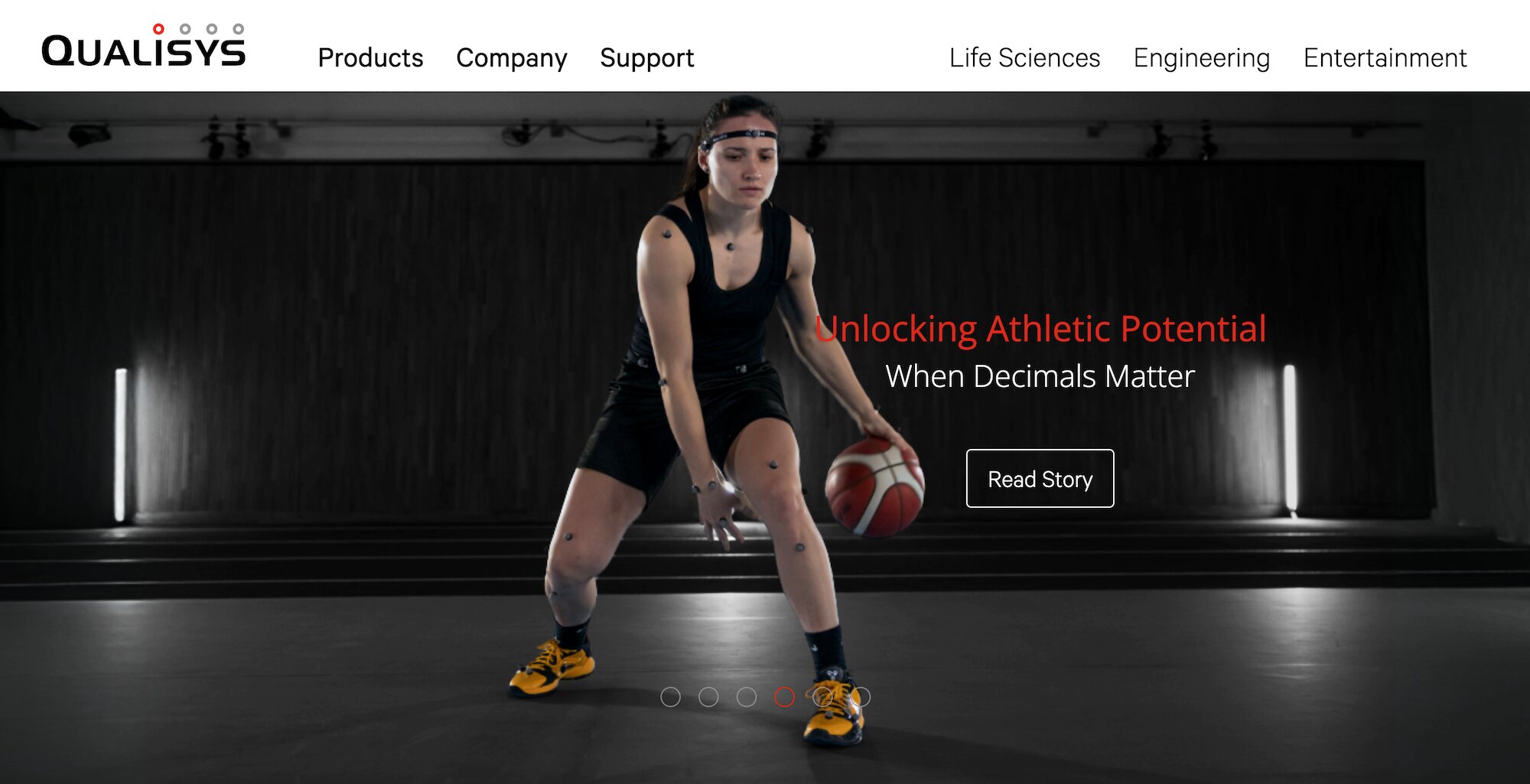
Qualisys is an optical motion-capture platform used in biomechanics, rehabilitation, sports science, and human movement research to collect precise 3D movement data. In postural control work, it can track body segment motion and whole-body sway in three dimensions, often alongside synchronized force plates, electromyography (EMG), eye-tracking, and other lab equipment.
This allows researchers to relate posture and movement to ground reaction forces, center of pressure, muscle activity, and timing data.
Key Features
- High-precision 2D, 3D, and 6DOF motion capture for analyzing body motion, sway, and movement strategies.
- Synchronization with force platforms, EMG systems, eye trackers, and other lab equipment for combined biomechanical analysis.
- Marker-based workflows, synchronized video, and markerless options on supported camera setups such as Miqus Hybrid.
- QTM software for capture, processing, review, visualization, charts, metrics, video, and reporting.
Best suited to biomechanics labs, research facilities, and performance environments that need precise, synchronized motion data and can support multi-camera setup, calibration, and instrumentation.
Force Plate and Posturography Systems
These systems measure the ground reaction forces and center of pressure that a person generates while standing, which is the traditional approach to quantifying balance.
Kistler Force Plates

Kistler's piezoelectric force plates are used in biomechanics, sports science, clinical analysis, and related research. For postural control, Kistler force plates measure ground reaction forces and center of pressure during quiet standing and balance tasks, helping researchers quantify sway and weight shifts under the feet.
Kistler’s BioWare software supports biomechanics workflows including posturography, balance, and microvibration analysis, and selected force plate systems can be synchronized with motion analysis systems and other instruments.
Key Features
- High-precision piezoelectric force plates for ground reaction forces, moments, and center of pressure.
- BioWare software for biomechanics, including posturography, balance, and microvibrations.
- Portable 3D force plate models with digital output and flexible installation options.
- Synchronization with common motion analysis systems and multi-plate time synchronization.
AMTI Balance Trainer
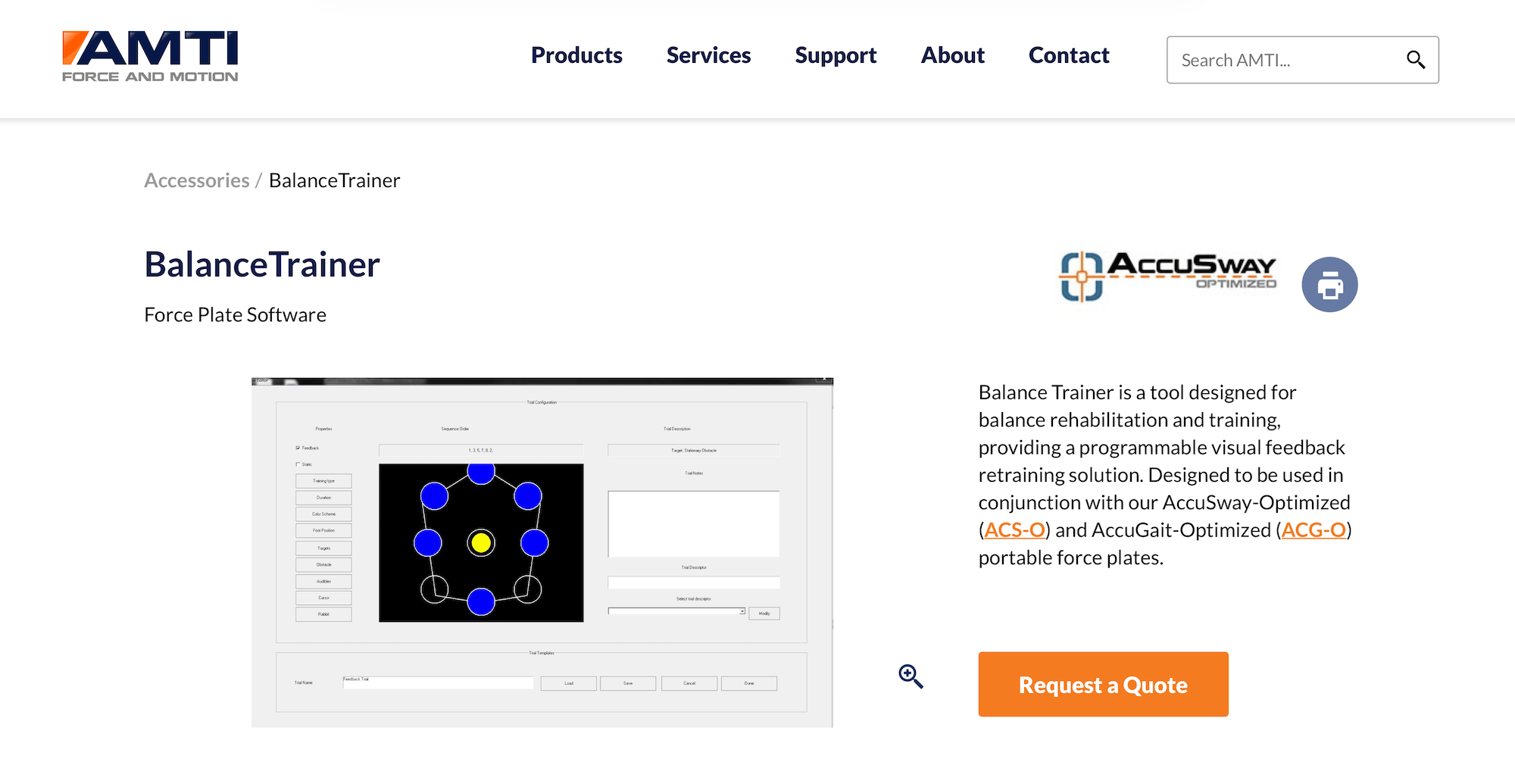
AMTI Balance Trainer is software for balance training, recovery research, and objective documentation of postural control using visual feedback. It works with AMTI's portable force plates and turns center-of-pressure data into interactive training and assessment tasks.
Clinicians and researchers can build individualized regimens aimed at specific balance deficits and musculoskeletal imbalances, then track progress over time.
Key Features
- Visual feedback–based balance training using center-of-pressure data from AMTI portable force plates.
- Programmable visual retraining tasks that can be customized for patient-specific weaknesses and rehabilitation goals.
- Designed for balance research, assessment, rehabilitation, and training in clinical and research settings.
- Economical, portable balance rehabilitation and training solution that pairs with AccuSway‑O (and AccuGait‑O) force plates.
Capture Postural Control the Way People Actually Balance
People stand, sway, and recover their balance differently when they’ve got markers attached or are working inside the constraints of a marker-based lab. Theia3D removes instrumentation entirely, so the movement you capture is closer to how the body naturally balances.
Contact us to see how Theia3D can add an objective, markerless layer of 3D movement data to the quiet-stance trials and balance tasks your research or performance program already runs.
Disclaimer: This article summarizes motion analysis approaches for research and performance applications. Theia3D is a motion analysis software platform and is not intended to diagnose or treat medical conditions. Interpretation and application of results are the responsibility of the user.