
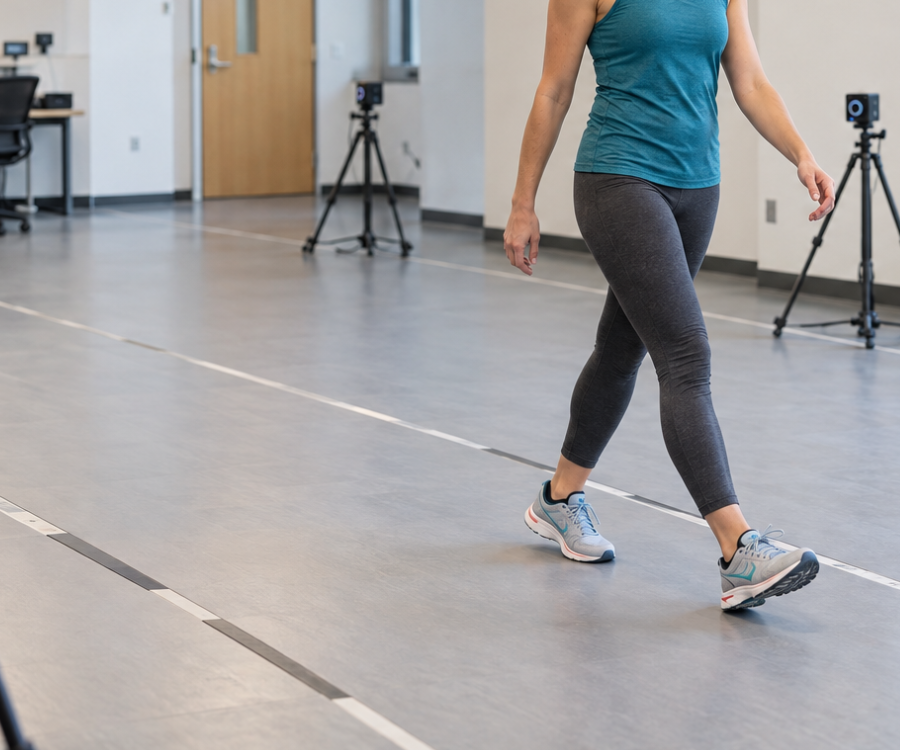

.png)


Summary
3D gait analysis measures how someone walks or runs by tracking joint angles, stride length, cadence, and speed in all three planes of movement. A 2D analysis captures a single flat view, either by eye or from one camera, so movement outside that plane goes unmeasured.
3D measurements fall into two main groups:
- Joint angles, which describe hip, knee, and ankle flexion and extension; abduction and adduction; and internal and external rotation at every moment of the stride. A 3D system also reports pelvis and trunk orientation as the person moves.
- Stride measurements, which describe the pattern of the walk or run itself, including cadence, speed, step length and width, and the time the foot spends on the ground.
A 3D system tracks the position and orientation of every body segment and resolves movement in all three planes: sagittal flexion and extension, frontal abduction and adduction, and transverse rotation.
In this article, we explain two 3D methods for measuring gait (marker-based and markerless motion capture), what a 3D gait analysis session involves (using Theia3D as an example), and what the research says about how accurate each method is.
Two Ways to Capture 3D Gait Data
Marker-Based Motion Capture
This method has a long-established record of accuracy, which is why marker-based capture remains an important reference method for evaluating other motion-capture approaches.
It comes with some well-documented costs, though, starting with the time required to prepare each participant. In a 2025 treadmill walking study, researchers took around 20 to 30 minutes to attach a full-body set of 39 markers to each participant in the marker-based group. The researchers describe optical motion capture as the current benchmark for movement data because of its high spatial and temporal accuracy.
The capture environment also has to be managed carefully. Passive markers reflect infrared light emitted by the motion-capture cameras, and strong sources of ambient infrared light, particularly sunlight, can interfere with marker detection. Labs therefore commonly control incoming light and unwanted reflections, although modern systems can mitigate these effects with filtering and other techniques.
Markerless Motion Capture
Markerless capture uses software that finds anatomical landmarks on participants directly in ordinary video, rather than using physical markers. Implementations of markerless capture methods differ, though some use deep learning pose estimation, while others fit a model to silhouettes or to body shape.
Subjects wear their own clothing and shoes, and the session can start once the cameras are placed and calibrated. That shorter preparation time makes it practical to add other movement tasks, such as a single leg squat assessment, to the same testing session.
Because the system works from high-speed, rather than infrared cameras, it doesn't need a darkened room, though it does need a reasonably well-lit area.
Agreement with marker-based capture has been tested directly. A systematic review of Theia3D by Varcin and Boocock pooled 16 studies covering 303 participants, where agreement varied by joint and by plane. They report reasonable accuracy across most sagittal and frontal plane lower limb movements, and less accuracy on hip flexion and extension, and transverse plane rotations of the lower limb joints.
But there’s no single accuracy figure that applies across the whole body. Agreement with marker-based capture also depends on the capture setup, not on the software alone. Understanding how markerless systems produce reliable 3D measurements therefore means looking at the conditions the capture setup has to satisfy: enough camera coverage to maintain landmark visibility, accurate synchronization between frames, and a high-quality calibration that defines each camera's position and orientation. The sections below examine each of these requirements.
How Markerless Capture Works
Recording From Several Cameras at Once
There’s no single camera count that guarantees adequate coverage. Theia3D recommends eight for most capture volumes, with additional cameras needed as the capture volume grows or the movement becomes more complex.
The reason is visibility. A landmark has to remain visible from multiple viewpoints as the person moves, including when one limb passes in front of another. Enough cameras therefore have to surround the capture volume to maintain the views needed to reconstruct each landmark in three-dimensional space.
Also, synchronization matters as much as the number of viewpoints. Triangulation assumes every camera recorded its frame at the same moment, so frame-level synchronization between cameras is a hard requirement. Practically speaking, this excludes cheaper camera systems that cannot guarantee precision synchronization. Someone walking covers more than a meter per second, which means even a few milliseconds of drift between cameras can create millimeters of positional mismatch between camera views.
The effect becomes much larger during fast movements. A pitcher’s hand can travel faster than 20 meters per second, so a few milliseconds of drift can move the landmark by several centimeters.
Also, triangulation only works if every camera is described in the same frame of reference. A camera seeing a landmark in its image knows which direction that landmark lies in, but not how far away it is; combining those directions into a single position in space requires knowing exactly where each camera sits and which way it points.
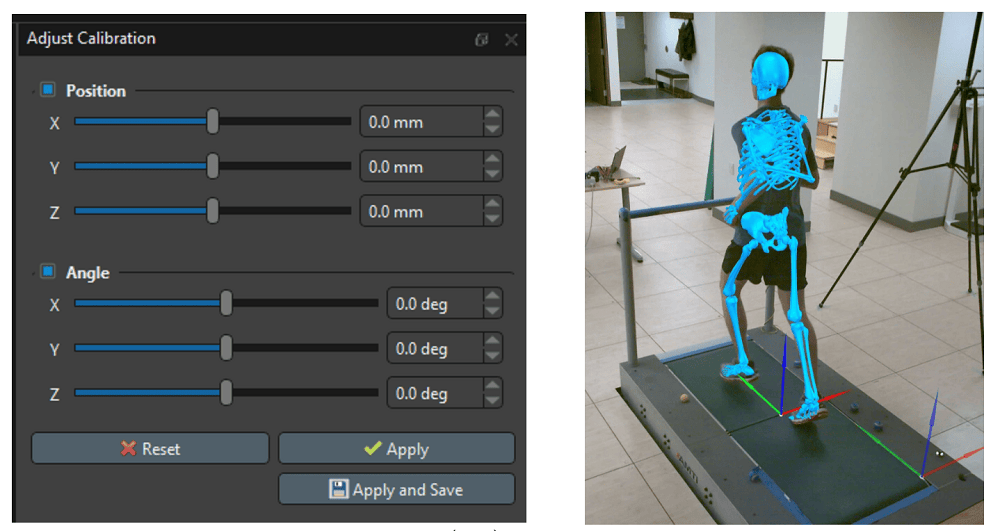
Simply placing the cameras around the capture area doesn’t give the software that information. It needs the precise position and orientation of every camera relative to the others, because even a small error can shift the calculated 3D position of a landmark. A robust calibration provides that information, and it has to be repeated whenever a camera is moved or bumped out of position.
In Theia3D, for example, an operator calibrates a camera system by recording a short video of someone moving a calibration board through the space, and the software calculates the position and orientation of every camera from that video automatically. Those initial positions can then be adjusted as needed.
Finding the Body in Each Frame
Theia3D's models were trained on over 100 million images spanning more than 1,000 different environments, and they identify over 120 anatomical landmarks on each visible person in every frame. The models can recognize those landmarks across different lighting, clothing, body shapes, and positions, including when one limb passes in front of another.
Because this step is automated, it doesn't depend on where an operator decides to place a marker, which removes this particular source of variation between sessions.
Building a Three-Dimensional Model
A scaled skeleton is then fitted to Theia3D’s model of 17 body segments, which is what the joint angles, stride measurements, and movement patterns are calculated from.
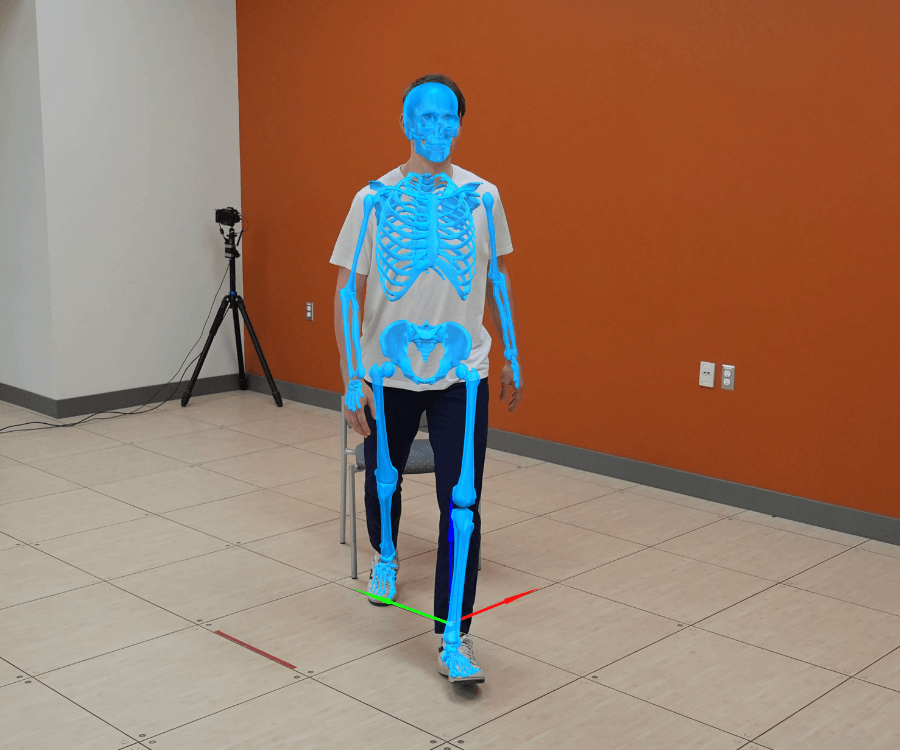
Brief moments where a limb is hidden from view, or when the data has small errors or tiny unstable jumps that aren't part of the person's real movement, can be digitally filled in and smoothed. For this, Theia3D offers an optional smoothing method called a Generalized Cross-Validation Spline (GCVSPL), which fills in the missing pieces and smooths out the motion so the final data is more complete and stable.
Theia3D can also track multiple people in the same session, as long as each person is visible from at least three camera views. This is useful for team sports screenings and assessments of group movement patterns where re-instrumenting subjects one at a time wouldn’t be practical.
How Accurate Is Marker-Based vs Markerless Motion Capture?
Accuracy in measuring human movement varies by joint, plane of movement, and the environment the system is used in. Below are several studies that have established agreement between both systems in terms of accuracy.
Comparing Markerless Against Marker-Based
- In a Journal of Biomechanics study comparing markerless and marker-based motion capture during the same treadmill-walking trials, the root mean square difference between corresponding joint centers was less than 2.5 centimeters for every joint except the hip, where it was 3.6 centimeters. Differences in lower-limb segment angles were less than 5.5 degrees except for rotations about the segments' long axes.
- In a study spanning eight different movements (including walking and running), markerless measurements relevant to running form, such as knee and ankle angle waveforms, correlated strongly with marker-based measurements. This included root mean square differences of no more than 5.9 degrees.
- Stride-related measurements have also been compared against equipment that measures them directly. During treadmill running, measures used to characterize running form, including cadence, stance time, and step length, showed excellent agreement between the markerless estimates and an instrumented pressure treadmill, with intraclass correlation coefficients ranging from approximately 0.982 to 1.000. Mean differences in stance time were less than 10 milliseconds.
- Against a pressure-sensitive walkway, markerless cadence, speed, step length, stride length, step time, and stride time agreed to within roughly 1 percent on average, with intraclass correlation coefficients of 0.997 to 0.999.
Overall, measurements of gait mechanics have shown the strongest agreement for flexion and extension, which is the movement most gait analysis depends on, and weakest for turning.
Repeatability Is a Separate Question
Agreement between both types of systems tells us how closely they measure the same movement patterns. But another question is whether the system gives a consistent result from one session to the next.
For anyone tracking changes in gait mechanics over time, repeatability matters more than single-session accuracy, because a measurement that drifts between sessions can't distinguish real change from measurement variation.
Markerless capture removes one source of that variation, because there are no physical markers to place slightly differently from one operator or session to the next.
Across three treadmill-running sessions with 21 runners, variability between sessions averaged approximately 1.2 degrees across the three movement planes. More tellingly, variation between sessions was smaller than the natural stride-to-stride variation within a session for every lower-extremity joint and movement plane. The authors concluded that repeating the assessment across multiple sessions introduced little additional variability beyond the normal variation in the participant’s running mechanics.
The authors also compared their repeatability results with published marker-based studies examining running mechanics using similar treadmill-running protocols. The values were broadly comparable, with markerless measurements showing lower between-session variability for several sagittal-plane flexion and extension measures.
A separate study assessed 21 people twice in community and clinic-adjacent settings rather than a dedicated motion capture laboratory. Sessions were separated by an average of 10 days, and participants received no instructions about what clothing or footwear to put on. Root mean square differences across the full gait cycle ranged from 0.96 to 3.71 degrees across the hip, knee, and ankle in all three movement planes.
Measuring Forces as Well as Movement
Measuring the forces involved in gait has traditionally meant combining 3D motion capture with force plates or other such measurement systems. While cameras measure how the body moves, force plates measure the force between the foot and the ground. Together, those measurements can be used to calculate joint moments and powers, which tell us about the forces acting around the joints and how mechanical energy is generated or absorbed during movement.
The calculation works backwards from the measured ground-reaction force and movement. Using information about the mass and motion of each body segment, the software calculates the net forces and moments that must have acted at each joint (a process called inverse dynamics).
For this to work, the force data and video have to be synchronized during the capture process. Camera systems that support external devices trigger the cameras and the force plates together, so both are recording against the same clock, and the same applies to muscle activity sensors and instrumented treadmills. The kinematics from Theia3D and the signals from those devices are then combined in motion analysis software like Visual3D.
Estimating Ground-Reaction Forces Without Force Plates
Force plates provide reliable data, but their small measurement areas can restrict the flexibility of where and how movement is assessed, keeping many kinetic analyses inside performance labs.
A 2024 study in the Journal of Biomechanics tested whether 3D ground-reaction forces could be estimated from markerless whole-body motion without using force-plate measurements as inputs. The method was evaluated during walking, running, jumping, and cutting by comparing its predictions with forces recorded simultaneously by an instrumented treadmill or in-ground force plates.
The researchers estimated force in three steps:
- Theia3D reconstructed the motion of the body segments from synchronized video.
- A geometric skeletal model was used to calculate each segment's acceleration and the resulting acceleration of the whole-body center of mass.
- Motion equations then estimated the external ground-reaction force, accounting for body mass and gravity.
Because the force calculation was based on mechanics rather than a force-prediction model trained on previous force-plate recordings, it didn’t require the tested movement patterns to resemble a force-labeled training dataset. Theia3D supplied the whole-body kinematics; the researchers applied their own skeletal modeling and mechanics-based analysis to estimate ground-reaction forces.
Across all three force directions and all four movement tasks, the average root mean square difference between estimated and measured forces was 0.75 N/kg. Peak-force estimates showed very strong agreement with the measured values, explaining approximately 95% to 99% of their variance.
The authors described the findings as proof-of-principle evidence. The method isn’t yet a universal replacement for direct force measurement, but it suggests that three-dimensional ground-reaction forces could eventually be assessed in environments where installing force plates would be impractical.
Working with the Data
The output of gait analysis software is useful if it can be cleanly imported into other tools, giving researchers more flexibility in how they analyze the data. Theia3D exports in standard biomechanics formats, including .C3D, .FBX, and .JSON, so the results can be used in software such as Visual3D, Vicon Nexus, Qualisys Track Manager, Python, and MATLAB.
Like any 3D motion capture data, the calculated results can contain small frame-to-frame fluctuations caused by tracking errors or brief moments when part of the body is difficult to see. These can be reduced using the GCVSPL filtering described earlier, which removes small irregularities while keeping the underlying motion intact.
When Theia3D exports .C3D data, it saves separate files containing filtered and unfiltered versions of 3D body poses. This gives the analyst the flexibility to use the smoothed data or return to the unfiltered output and apply their own processing.
Where the processing happens also matters. Cloud-based systems may require participant video and data to be sent outside the facility for processing. Theia3D instead runs locally on NVIDIA graphics cards, so the video and analysis data remain on the user's own system.
The amount of data to process can become a bottleneck once a study involves more than a handful of trials. Theia3D Batch processes trials one after another without supervision once the video data, calibration files, and analysis settings have been prepared.
Capture Gait Data Without Markers
Talk to our team about how markerless motion capture can support detailed 3D gait analysis without markers, wearables, or a darkened lab, all within your research or performance workflow.
Disclaimer: This article summarizes motion analysis approaches for research and performance applications. Theia3D is a motion analysis software platform and is not intended to diagnose or treat medical conditions. Interpretation and application of results are the responsibility of the user.