




Summary
In the single leg squat assessment, a person stands on one leg, lowers into a slow squat, and rises back up without letting the other foot touch the floor.
It sounds almost too basic to be informative, but that one repetition puts the entire lower body to work, and it shows how well the trunk, pelvis, hip, knee, ankle, and foot cooperate under load. This simple movement can reveal movement patterns that may be difficult to observe during two-legged tasks.
Because it needs no equipment beyond the space to stand, the single leg squat test has become one of the most widely used movement assessments in sports medicine, athletic performance, and biomechanics research.
The catch is that the test is only as good as the way you measure it. This article explains what the single leg squat assessment actually measures, what practitioners look for on each part of the body, how the main scoring systems work, and where those scoring methods start to break down.
From there, we’ll look at how three-dimensional markerless motion capture like Theia3D can complement professional observation and judgment by adding repeatable kinematic data to the assessment. We’ll also review what peer-reviewed research says about measuring single leg tasks this way, and how well those measurements hold up across repeated sessions.
Why the Single Leg Squat Assessment Is So Widely Used
The single leg squat is a transitional movement assessment. That means it shows how a person controls the body while moving through a range of motion, rather than how well they hold a fixed position. The movement itself is what gets graded, not the pose at the end.
Standing on one leg is what makes the single squat test revealing. Two-legged movements let the stronger or steadier side quietly cover for the other, so a problem on one limb can stay hidden. On a single leg, that option disappears, and any deficit in strength, balance, or control on the stance side has nowhere to hide.
A single repetition also asks a lot of the body. It loads the hip abductors and external rotators, the quadriceps and gluteal muscles, and the small stabilizers of the ankle and foot, all at once. This is why the single leg squat is often described as a “whole-chain test”: it puts the entire lower limb and trunk to work together.
The movement matters because it mirrors what the body does in everyday life and sport. Running, cutting, landing, and climbing stairs are all, in effect, repeated single leg loading tasks. A person who struggles to control one slow single leg squat is being asked to control that same limb hundreds of times in a training session or a game.
Practitioners use the assessment to establish a movement baseline, to compare the left and right limbs, and to track how movement changes over time. It also appears throughout return-to-activity research, where the quality of movement on a single limb is studied as a variable in its own right.
What Practitioners Watch For in an Assessment

A single repetition produces signals at every level of the lower limb and trunk. In the single leg squat test, practitioners read those signals together rather than in isolation.
Practitioners get the most from the test by reading those signals together, since a fault at one segment often shows up as a problem at another. Below, we work through what to watch for at each part of the chain.
The Knee
The most closely watched signal is frontal-plane knee motion, often called knee valgus or medial knee displacement. This is the knee traveling inward, toward the midline of the body, as the person descends. Inward knee motion during single leg tasks has been studied extensively in research, including work linking greater knee abduction loading on landing to anterior cruciate ligament injury in female athletes.
Practitioners also watch how far the knee travels forward over the foot and how much it bends. The depth and control of that knee flexion describe how the load is being absorbed, so a knee that drifts inward or buckles forward is telling slightly different parts of the same story.
The Hip and Pelvis
On the pelvis, the signal of interest is a drop on the side of the lifted leg. This is known as contralateral pelvic drop, or a positive Trendelenburg sign, and it reflects how well the hip abductors on the stance side hold the pelvis level.
At the hip itself, practitioners watch for the stance thigh rolling inward, a combination of adduction and internal rotation. This inward motion of the thigh often travels with the inward knee motion above it, shifting the whole limb out of alignment. Because the hip and pelvis sit at the top of the chain, a fault that starts here can produce a knee that looks like it's collapsing even when the knee itself is doing little wrong.
The Trunk
The trunk is watched for lateral lean, forward flexion, and rotation. When control lower down is lacking, the upper body shifts to keep balance over the stance foot, and that shift shows up as a lean or a twist. A trunk that leans toward the stance side changes the load on the hip, and it can mask or exaggerate what's happening at the pelvis just below it.
The Ankle and Foot
At the base of the chain, practitioners look at how far the ankle can dorsiflex, meaning how far the shin can travel forward over the foot, and whether foot posture may shape how the limb behaves on the way down. Limited ankle dorsiflexion and altered foot posture are often considered, because the single leg squat raises a broader question: whether an inward knee position reflects control from the hip and pelvis above, or a contribution from the ankle and foot below.
The foot and ankle shouldn't be read in isolation, though. Research on the single leg squat has found that medial knee deviation isn't always explained by ankle dorsiflexion range of motion or static foot posture. These observations need to be interpreted as part of the whole movement pattern, not as a single cause.
How the Single Leg Squat Assessment Is Scored
Several scoring systems exist, ranging from a simple qualitative rating to detailed criterion checklists. They differ in how much detail they capture, but they share one goal: turning what the assessor sees into a repeatable judgment.
Qualitative Rating Scales
A common approach rates each repetition as "good," "fair," or "poor," based on the assessor's overall impression together with the posture of the trunk, pelvis, hip, and knee. A "poor" rating may point to weaker hip abductor and lateral trunk muscle function, which is part of why the single leg squat is treated as a window onto hip control rather than knee mechanics alone.
In practice, a "poor" rating typically reflects obvious knee valgus, a pelvic drop, or a trunk shift. A "good" rating reflects a controlled descent, with the segments staying in alignment from start to finish.
Criterion and Count-Based Scores
Other systems break the movement into specific, observable criteria and score each one as a pass or a fail. The questions are concrete: does the knee cross inward over the foot, does the pelvis stay level, does the trunk stay upright. Scoring each criterion on its own makes the rating less dependent on a single overall impression.
Some performance settings go further and combine the qualitative rating with squat depth and the number of controlled repetitions a person can complete. This adds an endurance dimension to the picture, since it captures not just how the movement looks once, but how well it holds up under repetition.
What the Score Is Meant to Drive
The purpose of any of these scores is to support a decision. That decision might be establishing a baseline, comparing one limb against the other, tracking change over time, or shaping the next stage of a movement program.
A score can only support those decisions if it means the same thing from one assessment to the next. That’s especially important when the single leg squat test is used to compare sessions over time.
This is where the measurement method becomes as important as the test itself, because a number that drifts depending on who is watching, or when, can't reliably tell you whether the athlete in front of you has actually changed.
Why the Most Important Signals Are the Hardest to Judge
The single leg squat is informative because so much happens at once. That complexity is also what makes it hard to score consistently by eye. A single observer has to track the trunk, pelvis, hip, knee, ankle, and foot simultaneously during a movement that lasts only a few seconds, and usually from one viewing angle, across the lower extremity.
The signals that matter most make this harder: knee valgus, pelvic drop, external rotation, and left-to-right asymmetry tend to be small in magnitude — they happen quickly — and they occur partly out of the plane that a single camera or observer can see clearly. Frontal-plane and rotational motion are especially difficult, because movement that travels toward or away from the viewer is the hardest kind to judge accurately by eye.
Visual rating also struggles to pinpoint where a fault originates. An observer can see the knee collapse inward but not tell whether the problem starts at the hip and pelvis above or the ankle and foot below. That distinction is exactly what a practitioner needs in order to address the possible contributors to the observed movement pattern.
And because the rating depends on the observer's attention, experience, and viewing position, two trained assessors can grade the same repetition differently, and the same assessor can grade it differently on two occasions.
For a single assessment, that variability may be tolerable. Across a full roster, several staff members, and repeated sessions, it accumulates, making real change harder to separate from measurement noise.
The Limits of Conventional Measurement Tools
Several tools exist to make the single leg squat test more measurable, but each also leaves a gap — sometimes where the single leg squat is most informative. That same measurement problem also matters when practitioners use broader movement screens such as the overhead squat.
Read together, these tools reveal the same gap. This is a practical way to pair professional observation with repeatable three-dimensional movement data without attaching equipment to the person or moving the assessment into a traditional motion capture lab, whether for the single leg squat, the lunge, or the overhead squat.
How Markerless Motion Capture Supports Single Leg Squat Measurement
Markerless motion capture helps fill that gap by converting synchronized video into three-dimensional kinematic data. For the single leg squat test, that data can complement what practitioners already watch for by adding measured joint and segment motion across the lower extremity, including ankle dorsiflexion, to the visual assessment. That can be useful in return-to-activity work, performance testing, the drop jump, and strength training.
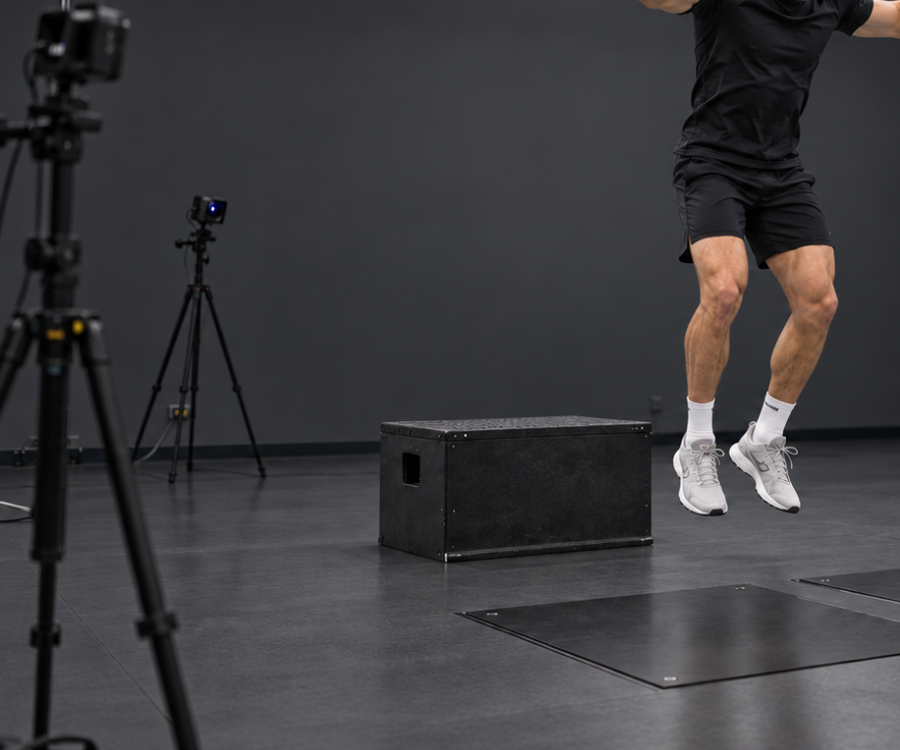
That process starts with synchronized video from multiple camera views. In Theia3D, those videos are used to reconstruct a three-dimensional skeletal model of the person. No markers, wearables, or special clothing are required. The software automatically identifies more than 120 anatomical landmarks on every visible person in the scene; it then fits them to a model of 17 rigid body segments.

Because the kinematic data is generated by the model from the recorded video rather than judged by eye, practitioners gain an objective layer of measurement they can compare across staff and across sessions. It doesn't score the assessment or replace the practitioner's observation; the scoring and interpretation remain with the qualified professional.
With nothing attached to the body, little can restrict or alter the movement, so the single leg squat that gets captured is the one the person would naturally perform. The same advantage applies to other movement assessments, including the lunge and the overhead squat.
Setup is flexible, too. Theia3D can be used wherever it's possible to mount multiple cameras, and data has been recorded in performance environments, strength training settings, and applied movement settings, not only in the laboratory. That flexibility also matters when teams need gait analysis software that can operate outside a traditional laboratory setup.
In a typical setup, Theia3D uses eight or more well-placed cameras to record fully synchronized video of the movement. The cameras can synchronize with one another and with external devices, including force plates, electromyography sensors, and instrumented treadmills, so the joint-angle data can be merged with the force data from the same repetition.
Calibration uses either a proprietary calibration board placed in the capture area or a short video of someone moving a standard wand, after which the person performs the single leg squat test as directed from the prescribed starting position.

One practical note: Theia3D is a post-processing software and doesn't provide real-time tracking.
Mapping Each Visual Judgment to a Measured Variable
In single leg squat assessment, a markerless 3D skeletal model can estimate lower-limb and trunk kinematics that correspond to common visual judgments. For example, knee valgus can be represented by frontal-plane knee deviation, squat depth by a combination of knee flexion, hip flexion, and ankle dorsiflexion, pelvic drop by pelvic obliquity, inward hip motion by hip adduction, and balance strategies by trunk lean and trunk rotation.
These outputs can be compared between limbs and summarized with asymmetry metrics, while recognizing that sagittal-plane measures are generally more reliable than frontal- or transverse-plane measures and that kinematics do not directly measure muscle activation.
These variables can be tracked frame by frame as continuous curves. The assessment can capture the whole descent and return, from the starting position onward, rather than the one moment the observer happened to focus on.
Turning Synchronized Video Into Analysis-Ready Kinematic Data
Behind that output is a deep-learning pipeline. Theia3D's models have been trained on more than 100 million images across over 1,000 distinct environments to locate anatomical landmarks in each frame. The detected landmarks are then fitted onto a three-dimensional skeleton built from user-specified joint constraints, which produces the 17-segment model used for measurement.
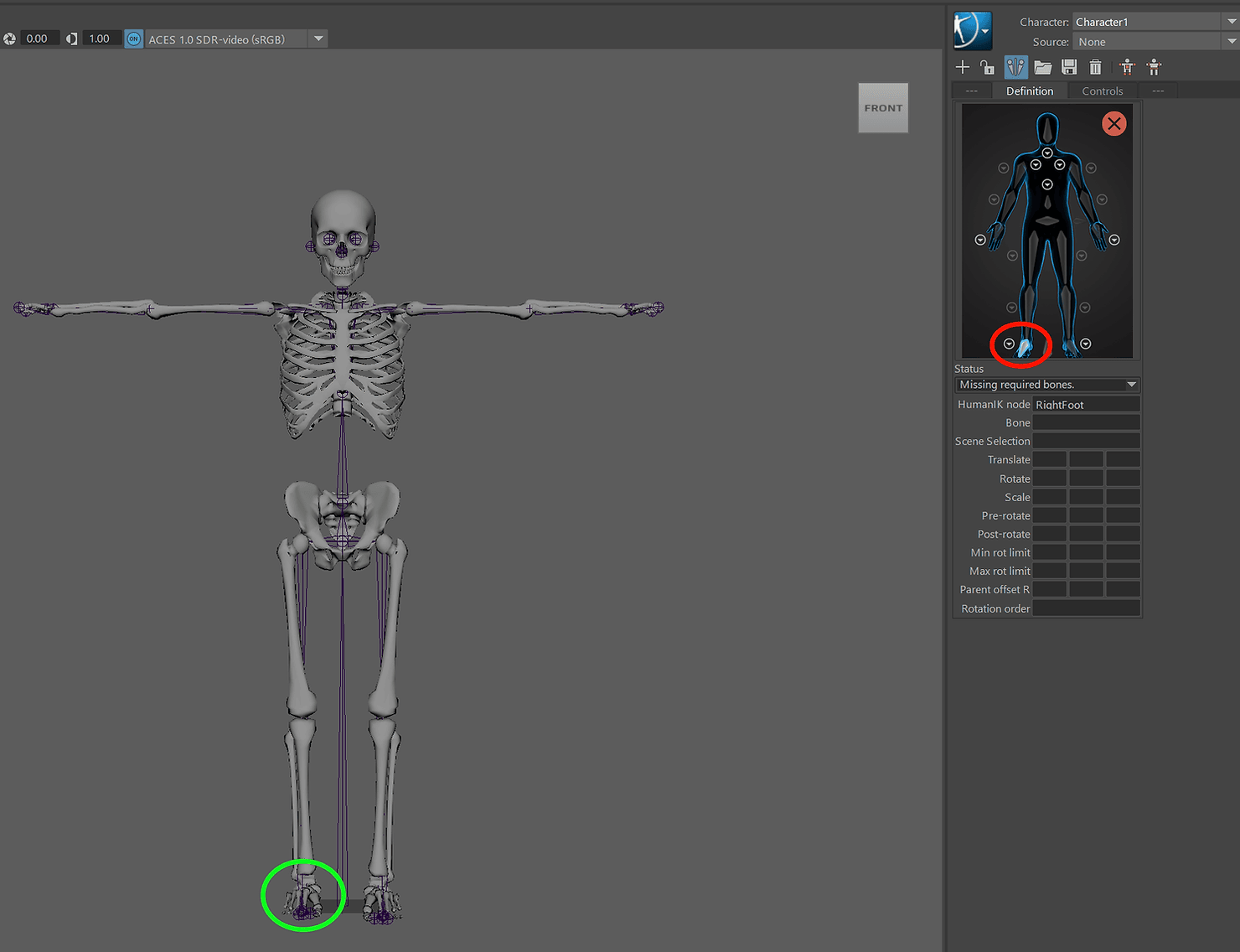
The result lets practitioners measure biomechanics variables such as segment positions, joint angles, and spatiotemporal parameters across the entire movement of the lower extremity. That can include variables such as ankle dorsiflexion during the descent and ascent.
As a motion analysis software that runs locally on consumer-grade NVIDIA GPUs, Theia3D doesn't require an internet connection, and no video, participant, or analysis data is transmitted to Theia or any external provider. This matters for teams handling athlete mechanics or participant data, where keeping information on local hardware is often a requirement rather than a preference.
Motion data can be saved in standard formats, including .C3D, .FBX, and .JSON, and the software can output both raw unfiltered poses and smoothed filtered poses. The same workflow can also be used to analyze movements such as the lunge, the overhead squat, or the drop jump.
From there, the data can be exported into downstream biomechanics analysis environments such as Visual3D, Vicon Nexus, Qualisys Track Manager, Python, MATLAB, and Excel.
What the Research Shows About Markerless Kinematic Data in Single Leg Tasks
Theia3D has been evaluated in more than 50 independent, peer-reviewed studies, several of which speak directly to single leg tasks.
One study examined the single leg squat and landing tasks in 19 recreational athletes across two sessions held a week apart. It reported low between-day measurement error for trunk and lower-limb joint angles, with a mean root-mean-square difference of 3.6 degrees for the single leg squat task. Reliability at key points in the movement, such as initial contact and peak knee flexion, was moderate to good, with low standard error of measurement.
The markerless measurement error was comparable to the marker-based protocol used in the same study. That matters for practitioners who want repeatable data for biomechanics work rather than observation alone.
The authors concluded that this level of measurement error supports regular monitoring of athletes during single leg tasks, including monitoring for movement deficits, which is the use case that repeated single leg squat assessment depends on.
A separate reliability study of six return-to-activity tasks across two sessions found moderate-to-excellent between-session reliability for joint angles and sagittal-plane moments. That session-to-session consistency is what lets practitioners track real change across return-to-activity stages rather than measurement noise.
And across single leg landing and related tasks, Theia3D has shown good agreement with marker-based systems for many lower-limb joint-angle measures, though accuracy can vary by joint, plane, and task, including measures related to ankle dorsiflexion or ankle mobility.
Using the Single Leg Squat as a Repeatable Baseline
The single leg squat test is often used more than once for a subject. Practitioners use it to establish a baseline, compare limbs, and track whether movement deficits have changed across a training block or a season. That only works well when each repetition begins from a consistent starting position.
Every one of those uses is a comparison over time, which raises the question the earlier sections lead to: when a later assessment looks different from the baseline, how do you know that difference is a real change and not just measurement variation?
A quantified margin of error is what makes that question answerable. The between-day measurement error for single leg tasks has been measured rather than assumed, with a mean root-mean-square difference of 3.6 degrees and low standard error of measurement in the study above.
Working from numbers like these, a qualified professional can decide, for their own setting, how much change to treat as meaningful and how much sits within the expected error of the measurement, instead of relying on whether movement deficits, a movement pattern, squat position, or ankle mobility happens to look different from one month to the next.
That is what turns the single leg squat into a movement pattern baseline worth trending across the lower extremity and the kinetic chain.
As biomechanical analysis software, Theia3D captures quantitative three-dimensional movement data that doesn't depend on who recorded the session, so an assessment captured today can be analyzed against one captured a week, a month, or a season earlier on the same terms, and a qualified professional can interpret that history within their existing workflow.
Evaluate Theia3D for Single Leg Squat Workflows
Theia3D can capture the single leg squat test and related single leg tasks, such as the lunge, as objective three-dimensional kinematic data, without markers, wearables, or special clothing.
If you're weighing how to make your single leg assessments more consistent and easier to repeat, talk to our team about research-grade motion analysis for biomechanics and movement pattern tracking across the lower extremity and the kinetic chain.
Disclaimer: This article summarizes motion analysis approaches for research and performance applications. Theia3D is a motion analysis software platform and is not intended to diagnose or treat medical conditions. Interpretation and application of results are the responsibility of the user.