




Summary
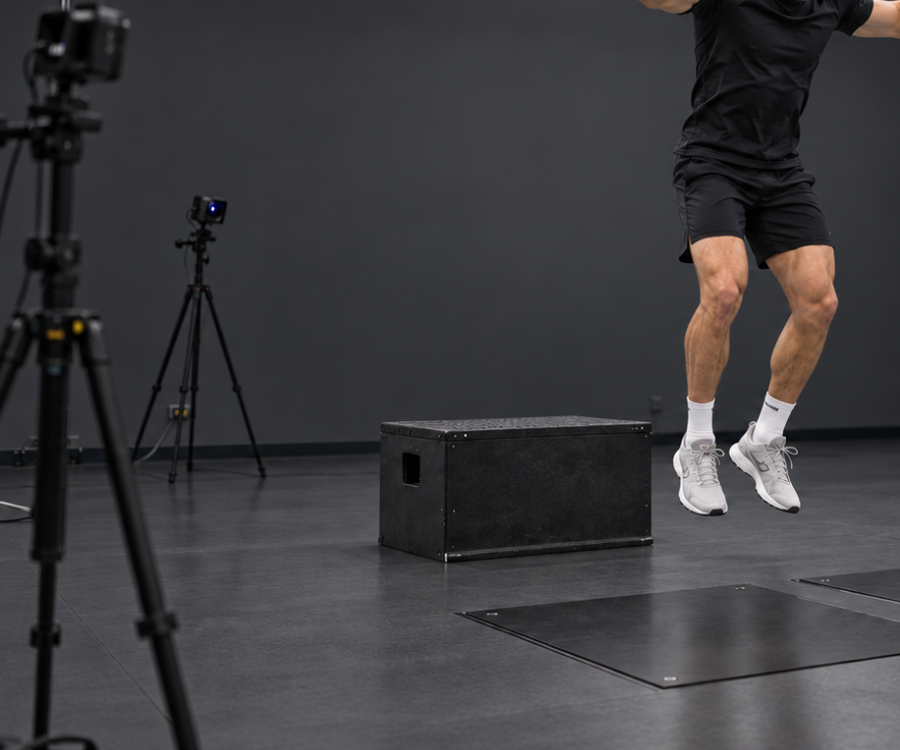
The drop jump test is a movement assessment in which a participant steps off a box, drops to the ground, and immediately does a maximal vertical jump on landing.
It looks simple but asks a complex question: can the athlete absorb force, control the landing, and turn that impact into a fast, explosive movement?
For this reason, it’s used in sports performance, applied movement, and biomechanics research settings to help practitioners examine two related but different outputs:
- The first is performance. How high did the athlete jump? How quickly did they leave the ground? What were their ground contact time and flight time? How efficiently did they use the stretch-shortening cycle to rebound from the landing?
- The second is landing strategy. What happened at the hips, knees, and ankles when the athlete hit the ground? Did the knees move inward? Did one limb absorb more load than the other? Did the athlete control the landing in a way that supports the next movement?
The test describes how a subject moves, but it doesn't explain on its own why a movement pattern looks the way it does, which still requires the judgment of the practitioner or researcher running the protocol.
Another problem is measurement. Many of the variables that matter during a drop jump happen quickly and must be judged by eye. Inward knee motion, joint angles, limb asymmetry, contact time, and landing strategy can all be affected by how the test is recorded, who is scoring it, and how consistently the protocol is repeated.
That creates a practical challenge for teams and labs that test many athletes across multiple staff members and repeated sessions: how do you make the drop jump consistent enough to trust over time?
In this article, we explain how the drop jump test works, what it can reveal about reactive strength and landing mechanics, and where conventional scoring methods can become unreliable. We also look at how markerless motion capture can turn the drop jump into objective, repeatable kinematic and kinetic data, and what peer-reviewed research says about measuring jumping and landing tasks this way.
How the Drop Jump Test Works
In a standard drop jump, the participant stands on a box, steps or drops off it without jumping upward first, lands on both feet, and then immediately performs a maximal vertical jump. The instruction matters as much as the movement: the person is told to spend as little time on the ground as possible while still jumping as high as possible. This is because the goal is to measure how quickly stored energy is absorbed and returned, rather than simply how high the athlete can jump.
Drop heights commonly sit around 30 cm, though protocols vary. Some testing batteries use several drop heights, such as 20 cm, 30 cm, and 40 cm, to see how the subject responds to increasing impact demands.
The test produces two primary performance outputs:
- Ground contact time, which is how long the feet stay in contact with the floor between landing and take-off
- Jump height, which is how high the subject rebounds
The landing itself is the phase that exposes movement quality. To rebound, the participant must rapidly decelerate body mass and stabilize the knees, hips, and ankles before entering the concentric phase of the jump, and how well they manage that deceleration is one of the key movement characteristics researchers may examine during the task.
Reactive Strength and the Reactive Strength Index
The drop jump is the most common way to measure reactive strength, which is the ability to rapidly switch from absorbing force on landing to producing force on take-off. Reactive strength is summarized by the Reactive Strength Index (RSI), which is commonly calculated as jump height divided by ground contact time.
RSI is used in performance settings to monitor how well an athlete uses the stretch-shortening cycle, to track training adaptations over time, and to compare an athlete against their own baseline. It's typically captured with a force plate, a jump mat, or a contact mat, which records the ground contact and flight time precisely.
These tools measure the timing and force of the jump well, but they don't describe how the joints move during the landing. They can't show whether the knees collapsed inward, how much each knee flexed, or whether one limb behaved differently from the other.
Landing Mechanics and Why the Frontal Plane Matters
The value of the drop jump as a movement assessment comes from the landing, because the rapid, high-impact deceleration reveals how well an athlete controls the knees, hips, and ankles under load.
The variable that draws the most attention is frontal-plane knee motion, often described as knee valgus or medial knee displacement, which is the inward collapse of the knee toward the midline on landing. Peer-reviewed research has examined inward knee motion on landing as a biomechanical variable of interest, with a widely cited prospective study reporting that greater knee abduction loading during landing was associated with anterior cruciate ligament injury in female athletes.
Left-right asymmetry is a second variable of interest, because a meaningful difference between how the two limbs absorb and produce force on landing is something performance and research teams track over time. Reduced knee and hip flexion on landing is also studied; a stiffer landing increases impact forces, which is one reason landing depth and other joint kinematics are recorded alongside the inward knee motion.
The practical difficulty is that these are exactly the variables that are hardest to measure consistently. Inward knee motion and limb asymmetry happen quickly, are small in magnitude, and occur partly out of the plane that a single camera or an observer can see clearly.
Why Conventional Methods Capture Only Part of the Picture
The most common field method for assessing landing quality is visual judgment, where a practitioner watches the landing in real time or on video and grades how the knees behave. With a structured scoring protocol, agreement between trained raters is reasonable, ranging from moderate at initial contact to excellent at the main landing in reliability studies of the drop vertical jump.
The harder limitation is what the eye and a single camera can resolve in the first place. Sagittal cues such as knee flexion are judged fairly well, but the inward knee motion and left-right asymmetry that matter most on landing are small, fast, and partly out of plane, and visual observation is less sensitive to them than three-dimensional measurement.
Contact mats and force plates solve the timing and force side of the drop jump, including ground contact time and flight time, and produce a reliable RSI. But they record nothing about joint angles, so they leave the landing-mechanics question unanswered.
Two-dimensional video adds a visual record, but it flattens three-dimensional motion, so it struggles with the frontal-plane and rotational motion that matters most on landing, and the result depends heavily on camera placement.
Marker-based three-dimensional motion capture is the laboratory reference standard, but it carries its own costs:
- It requires markers placed by a trained technician (which typically takes around 30 minutes per session).
- It's confined to the lab.
- The markers themselves can alter how the participant moves.
What performance and research teams need is a way to capture the drop jump's three-dimensional kinematics objectively and repeatably without instrumenting the athlete or confining the test to a lab, so specialists have richer movement data to bring into their own analysis.
What Markerless Motion Capture Adds to Drop Jump Measurement
This is the gap markerless motion capture is built to fill: three-dimensional movement data captured in the environments where athletes actually train, without markers or a lab. As a motion analysis software, Theia3D takes synchronized multi-camera video and turns it into a precise three-dimensional skeletal model of the individual, with no markers, wearables, or special clothing required.
The software lets teams measure the drop jump against objective joint-angle, segment-position, and asymmetry data captured at measured frame rates, providing a quantitative layer alongside the practitioner's own observation.
The system automatically and consistently identifies over 120 anatomical landmarks on every visible person in the scene and fits them to a skeletal model of 17 body segments.
Theia3D can be set up wherever it's possible to mount multiple cameras physically, and users have recorded data for analysis at indoor and outdoor tracks, courts, gymnastics centers, strength and conditioning spaces such as weight rooms, and other applied movement settings.
A capture uses at least eight well-placed cameras to record fully synchronized, high-quality video of the jump.
The cameras can synchronize their recording both with one another and with signals from external devices, including force plates, electromyography sensors, and instrumented treadmills used in gait analysis software workflows. The kinematic data can be merged with the force data from the same trial, including measurements such as contact time and flight time, for use across biomechanics and strength and conditioning workflows.
Calibration uses either a proprietary calibration board placed in the capture area or a short video of someone waving a standard active wand, after which the athlete performs the drop jump as directed.

One point to note is that Theia3D is a post-processing software and doesn't offer real-time person tracking.
Mapping the Drop Jump Assessment to Kinematic Variables
During a drop jump landing, the system estimates lower limb kinematics from the video and, when combined with force plate data, can also support landing time and jump performance metrics. In practice:
- Knee “collapse inward” is approximated by the peak frontal-plane knee valgus/adduction angle during landing, but this is typically less accurate than sagittal-plane measures.
- How much the knee bends is captured by peak knee flexion angle on each side.
- Side-to-side differences can be summarized with a derived asymmetry metric based on the left and right joint-angle outputs.
- Ground contact time and jump height, which can also be derived from flight time, come from force plate timing and jump performance calculations, and RSI is jump height divided by ground contact time across the landing and concentric take-off sequence.
Because the data is computed by the model rather than graded by an observer, it doesn't depend on which staff member runs the session, which reduces observer-driven variation in the captured data. There's no instrumentation attached to the athlete, so the awkwardness or restriction a marker setup can introduce is gone, and the movement being captured is the movement that actually occurs.
Theia3D provides an additional quantitative layer that complements, rather than replaces, the observation and judgment of the practitioner or researcher, who interprets the data within their own workflow.
Translating Synchronized Video Into Research-Grade Motion Data
Theia3D's deep-learning models have been trained on over 100 million images across more than 1,000 distinct environments to locate the anatomical landmarks in each frame.
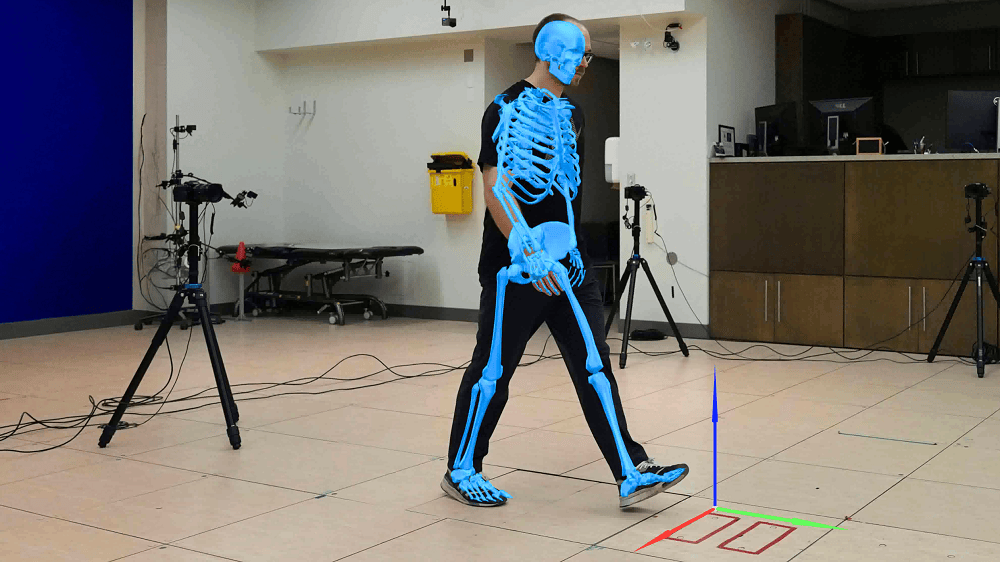
The detected landmarks are fitted onto a three-dimensional skeleton built from user-specified joint constraints, producing a model of 17 body segments. The result lets practitioners make precise measurements of segment positions, joint angles, joint moments, and spatiotemporal parameters across the full jump.
The system runs locally on consumer-grade NVIDIA GPUs and doesn't require an internet connection, and no video, participant, or analysis data is ever transmitted to Theia or any external provider. Practitioners can save Theia3D motion data in standard file formats, including .C3D, .FBX, and .JSON, and the software can save both raw unfiltered poses and smoothed filtered poses.
Data can be exported into downstream analysis environments such as Visual3D, Vicon Nexus, Qualisys Track Manager, Python, MATLAB, Excel, or an internal athlete management program.
Validated in Peer-Reviewed Research
Theia3D is backed by more than 50 independent, peer-reviewed studies. In a 2025 study published in Scientific Reports, researchers used Theia3D to measure 14 male Division I collegiate athletes performing squat jumps, drop jumps, and countermovement jumps, and compared the results with a Vicon marker-based system.
In that study, they found strong agreement for sagittal-plane knee and ankle joint angles, with differences of 3.5 degrees or less during most phases of the movement cycle, while hip angle estimates showed larger differences.
A 2025 Journal of Sports Sciences study examining inter-session reliability assessed 18 healthy participants performing six return-to-activity research tasks across two sessions. It found that Theia3D produced generally moderate-to-excellent reliability for lower-extremity joint kinematics, with low SEM values for joint angles, and showed potential for tracking lower-extremity dynamics across repeated sessions. Reliability was stronger for kinematics and sagittal-plane kinetics, while frontal-plane kinetic parameters at the hip and ankle were more limited.
The drop jump shares its key measured variables — namely knee and ankle flexion on landing, ground reaction forces, and between-session repeatability — with other jumping and landing tasks that have been validated with Theia3D. These include:
- Side box jump landings, where joint angles agreed with a marker-based system within 3.2 degrees.
- Countermovement jump take-off and landing, where the markerless prediction accounted for roughly 95 to 99 percent of the variance in peak ground reaction forces.
- Single-leg landing tasks, which showed low between-day measurement error across sessions.
As with any biomechanical system, Theia3D should be validated for the specific task, joint, and movement plane needed for a given application, rather than assumed to be equally accurate in every use case.
Measuring the Drop Jump at Team and League Scale
The drop jump and related jump-landing tasks are widely used across team sports, training programs, and research settings because they're quick to administer, place a high demand on the lower limbs, and produce comparable data across athletes.
In 2025, the NBA launched a league-wide biomechanics program, installing motion capture setups in the training facilities of all 30 teams within a single year, according to the collective bargaining agreement. The program is a multi-vendor partnership in which Qualisys provides the markerless cameras, Bertec provides the force plates, BreakAway Data provides the dashboards, and Theia3D is the analysis software that converts the synchronized multi-camera video into kinematic data.
The value of a markerless approach at this scale is standardization. Every session is processed through the same biomechanical analysis software, rather than relying on individual marker placement or manual setup, which supports consistent movement-data collection across sites and staff.
This consistency is what lets a multi-site program compare an athlete against their own baseline across sessions, and compare athletes against one another, on the basis of measurements that depend on the shared model rather than on an individual rater's judgment.
For a reactive-strength and landing assessment like the drop jump, that means a result recorded in one facility can be compared with a result recorded in another, because both are produced through the same standardized capture and analysis process and can be used more confidently to guide training programs.
Evaluate Theia3D for Your Drop Jump Workflow
Theia3D helps turn drop jump and jump-landing assessments into objective 3D motion data, so you can measure joint kinematics, landing strategy, and asymmetry without markers, wearables, or special clothing.
Talk to us about using markerless motion capture in your jumping and landing workflow.