


.png)

Summary
Basketball biomechanics examines how a player's body moves on the court. Every time a player shoots, jumps, lands, cuts, sprints, or stops short, biomechanics looks at what the joints, muscles, and body positions are doing.
It then links the physics behind the movement (the force, angles, balance, momentum, and timing) to what actually happens in a game. Rather than simply judging whether a player has good form, it measures exactly what the body is doing.
For example, when someone shoots, biomechanics can show a coach or a researcher the exact release angle and how much power the legs add. It can also track whether the arm motion stays the same from shot to shot, or if it breaks down when a player is tired or under pressure.
Biomechanics provides the same analytical framework for jumping and landing, measuring things like jump height, time in the air, how fast a player leaves the ground, and whether one leg does more work than the other. Together, these numbers show what a player already does well and where there's room to improve.
That kind of detail makes training a lot more specific. Players can shoot more consistently and produce better arcs, jump and land better, and move more efficiently, building a feel for their own movement that plain observation doesn’t always reveal.
This article explains the biomechanics of basketball's core movements, then turns to Theia3D to show how markerless motion capture measures them without asking athletes to wear reflective markers. That makes it possible to study shooting mechanics, jumping, landing, and change of direction movements in a natural training setting.
The Kinetic Chain of the Jump Shot
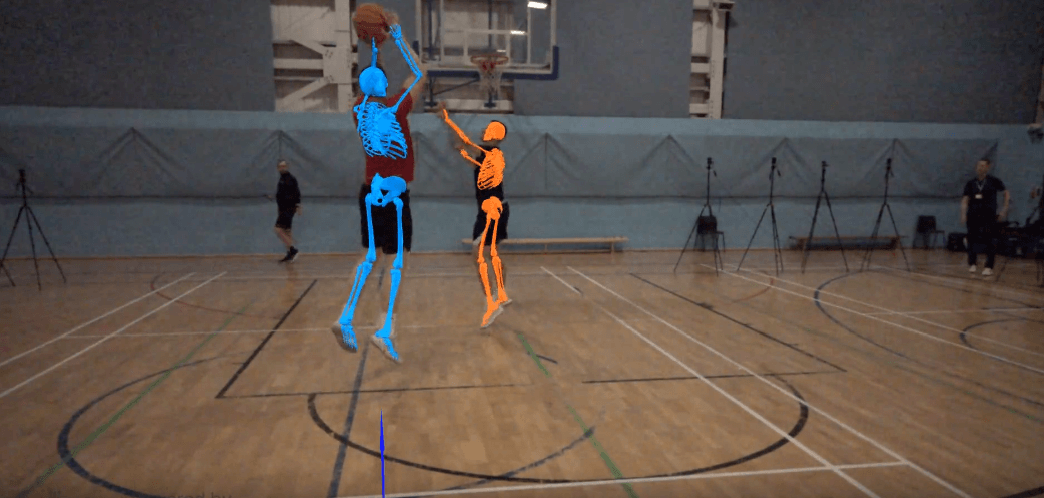
The jump shot is the most studied movement in basketball. It works like a kinetic chain where force is generated in the large muscles of the legs and lower body, then passed up through the trunk to the arm and hand.
That force transfers through the core to the shoulder and then the elbow, with each segment adding speed to the ball in sequence rather than all at once. The final release comes from the wrist and fingers, which snap forward to add backspin and control the ball's direction.
Because a good shot depends on your whole body working together, your mechanics have to change as you move farther from the basket. In professional male basketball players, research on shooting kinematics found that three-point shots need more bending at the knees and hips, a lower elbow, and a lower release angle than free throws and two-point shots do.
The same study didn't find large differences in mechanics between excellent shooters and good ones. This suggests that what makes a shot go in may come down to more than just the basic joint positions the researchers measured. The authors point to things like how fast the joints move and how well the body's movements are timed together as possible reasons why one shooter makes more shots than another.
Release angle also matters as much as the force behind the shot. In a study published in the Journal of Sports Sciences that ran hundreds of thousands of simulated free throws, the authors found that a launch angle near 52 degrees gives most shooters the best chance of making the shot, because it needs the lowest release speed, and shots are far more sensitive to speed errors than to angle errors.
Shooting flatter forces a faster release and lowers the odds. That 52-degree mark isn't the same for everyone, though; a shooter who stays consistent even at higher speeds can do slightly better shooting a bit steeper, while most players are best served near 52 degrees.
Repeating that motion shot after shot can be hard, though, especially with fatigue. Tired legs generate less force and shift more of the work onto the arm, which changes the release, the arc, and potentially the amount of backspin on the ball.
Vertical Jump Mechanics
Vertical jumping is the basis of rebounding, blocking, finishing at the rim, and contesting shots, and is a common way basketball programs assess lower-body neuromuscular performance. The jump is produced by coordinated lower-body force that projects it upward.
A common test of the movement is the countermovement vertical jump, which starts with a quick downward movement before the athlete pushes upward. In basketball settings, this makes the test useful because many sport-specific movements involve both lowering under control and then pushing upward or outward with force.
That downward dip before the jump helps the athlete load the legs before pushing off the ground. The player first lowers under control, then quickly changes direction and drives upward. The faster and better-timed that switch is, the more effectively the athlete can turn the dip into a strong takeoff.
Force plates can measure the jump through force-time metrics such as impulse, peak force, mean power, contraction time, jump height, and modified reactive strength index. In professional players, these metrics differ by playing position (guards, forwards, and centers), and whether a gap shows up often depends on whether the values are compared raw or adjusted for body mass, since larger players naturally post bigger raw force and power numbers.
Landing, Deceleration, and Change of Direction
The forces that build a jump have to be absorbed on the way down, and this is where the loads on the hips, knees, and ankles are highest.
Landing Mechanics
A safe landing spreads the impact across the hips, knees, and ankles by flexing all three, which lengthens the time over which force is absorbed and lowers the peak load on any single joint. A stiff landing, where the knees and hips barely bend, gives the body less time to absorb the impact, so more force travels up through the legs.
One movement that gets a lot of attention is knee valgus, which is when the knee caves inward toward the center of the body as the foot hits the floor. Landing also shows how evenly the two legs share the work. If one leg absorbs a lot more force than the other, that gap is something performance teams can measure and compare.
Deceleration and Change of Direction
Basketball is a stop-and-start sport, and the ability to decelerate is what makes a sharp cut, a pull-up, or a defensive slide possible. Changes in direction are built on braking. In a good cut, a lot of the braking happens before the final step that pushes the body in the new direction, where the foot pushes backward against the ground to slow the body down before the athlete changes direction.
Faster, sharper cuts tend to share a few characteristics: the foot plants wide out to the side, the upper body leans toward the direction the athlete wants to go, and the hip and knee straighten quickly to push off.
Leaning toward the direction of the cut, instead of away from it, puts less strain on the knee and makes for a better cut. This matters a lot, because basketball requires players to stop, land, and change direction at full speed.
Small differences in athletes' brakes, how they hold the upper body, and how the legs line up can add up to a real difference in how well a player controls their movement over the course of a game.
Dribbling and Ball-Handling
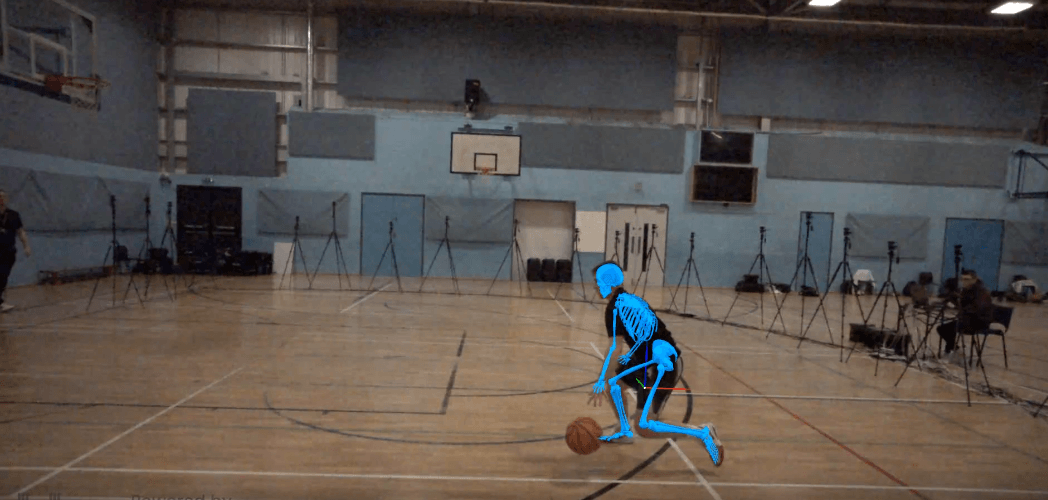
Dribbling uses the whole body, not just the hand and wrist. Skilled players move the trunk, hips, and legs together with the arm to protect the ball and change speed. The dribble itself comes from the wrist bending and straightening over and over, with the fingers spread out to push and steer the ball instead of slapping at it.
The lower body does more than it appears to. On dribble moves that require a change of direction, like a crossover, skilled players have been shown to keep speeding up their center of gravity right through the cut and to carry more speed into the move. That makes the direction change harder for a defender to read and follow.
Skilled ball handlers tend to step forward hard in the direction they’re going, instead of stepping wide to the side, which lets them speed up through the switch. That matters because the law of inertia means the player’s body resists changes in speed and direction.
This works because the same lower-body mechanics behind cutting also apply to dribbling. A crossover is really just a change of direction done while controlling the ball.
How Basketball Biomechanics Is Measured
The mechanics described above can be hard to track systematically because they sometimes happen in fractions of a second and in three dimensions, and often move toward or away from the viewer, along a depth a single camera can’t capture and that an observer struggles to judge.
That makes the law of acceleration hard to observe directly: coaches see the jump, cut, or shot, but not always the force and timing that produced the change in motion.
Measuring such movements is what kept biomechanics in the lab for a long time, and is also where advanced motion capture technology has changed the field the most.
Marker-Based Motion Capture: The Historical Standard
For a long time, the gold standard has been marker-based optical motion capture. A technician applies reflective markers to the body, and infrared cameras track exactly where those markers are at any given point in time.
Even so, the joint data you get still depends on where the markers are placed and how well markers stuck to the skin match the movement of the body underneath. The method is reasonably accurate, but placing the markers takes a trained technician up to thirty minutes per subject, and the system usually stays in a lab due to lighting requirements.
The markers themselves add some error. Skin and soft tissue shift around over the bone underneath, and the markers can slightly change the way an athlete moves. These limits are another reason why serious basketball biomechanics has remained inside research labs, and why it was used to measure one athlete at a time instead of a whole team.
The Shift to Markerless Motion Capture
Markerless motion capture removes the markers entirely and uses ordinary synchronized video to reconstruct a 3D model of the athlete. This paradigm shift enables analysis to take place on the practice court or in other places where players actually train.
For years, though, markerless technologies have been held back by accuracy, because early video-only approaches couldn't match the marker-based standard once movement became fast and complex. Occlusion, which happens when one part of the body passes in front of another (like an arm crossing the torso, or a leg passing the midline in a sprint), was a barrier as well.
That lack of robustness during the fast, overlapping movements basketball is built on is why early markerless tools weren't trusted for research-grade biomechanics.
Deep learning changed that. Theia3D uses that approach to turn synchronized multi-camera video into a precise three-dimensional model without markers, wearables, or sensors of any kind. Its deep-learning models were trained on more than 100 million images across over 1,000 environments, so the system recognizes anatomical landmarks directly in each frame no matter how the limbs are positioned.
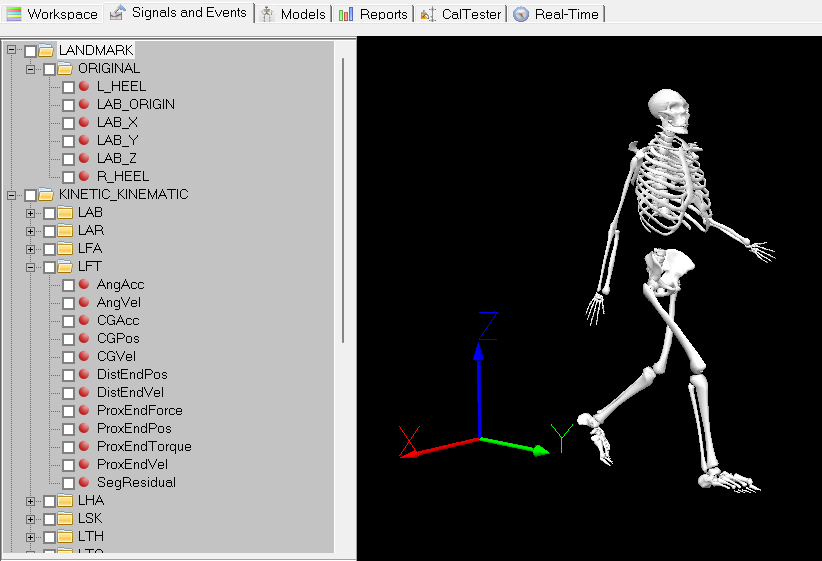
Theia3D’s overconstrained model allows tracking during high-occlusion movements that previously confused earlier systems. This approach also generalizes across different athletes, movements, clothing, and capture settings. Athletes can perform as they naturally would, rather than adapting their movement to accommodate markers. That matters when studying fast skills such as the jump shot, where subtle changes in release and spin can affect the result.
It also removes a major source of measurement error: with traditional marker-based systems, technicians may not place markers at exactly the same anatomical location over different sessions, which can introduce variability of up to a centimeter or more in joint angle measurements.
Using Theia3D, practitioners have reported cutting their collection and processing time by over 80% compared with traditional marker-based motion capture. In practice, our platform requires eight well-placed cameras to record fully synchronized, high-quality video. On every frame, Theia3D identifies more than 120 anatomical landmarks on each visible person and fits them to a skeletal model of 17 body segments, triangulating those landmarks across camera angles into 3D positions.
The output includes segment positions, joint angles, spatiotemporal measures commonly used in gait analysis software (the timing and spacing of steps), and more. That makes it possible to study whether a movement unfolds as a fluid motion across the body or breaks down at a specific joint or phase.
In basketball research, those data can be paired with shooting outcomes from the release phase, such as release angle or backspin. They can also help researchers study how the hips and glutes contribute to takeoff, landing control, and change of direction. For jump and landing tasks, that includes how the body works against the force of gravity and then absorbs it.
The cameras synchronize with force plates, electromyography (EMG) sensors, and instrumented treadmills, so the joint-angle data can be merged with the ground reaction forces from the same trial.
Theia3D also captures multiple subjects in a given volume, automatically identifying each person in the frame and maintaining an independent 3D skeletal model for each, as long as they remain visible across at least three camera views at the same time.
All processing runs locally on the user's own hardware, so no video or athlete data leaves the organization, and the results export in standard formats including .C3D, .FBX, and .JSON for analysis in Visual3D, Vicon Nexus, Qualisys Track Manager, Python, and MATLAB.
For labs that require a large number of trials, Theia3D Batch automates the work by running hundreds of trials in sequence without supervision; users compile a trial list, assign the correct calibration files, and choose the appropriate analysis setting.
The NBA's League-Wide Biomechanics Program
In January 2025, the NBA launched a league-wide biomechanics program, installing motion capture labs at the training facilities of all 30 teams within a year to standardize how players are screened. The program is written into the collective bargaining agreement, runs at least through the end of the current agreement in 2030, and calls for players to complete up to four assessments per season.
Four vendors won the league's request for proposals:
- Qualisys provides the video cameras
- Bertec provides the force plates
- BreakAway Data provides analytics dashboards
- Theia provides Theia3D as the analysis software
Each assessment takes about 15 minutes and follows a pre-scripted set of motions chosen for their relevance to the sport.
The league chose this approach because it standardizes capture across all 30 teams using the same model, rather than introducing variability of marker placement by a technician. That consistency is what lets a program compare a player against their own baseline over a season and compare players against one another.
It also builds one comparable dataset that speeds up the search for associations between how a player moves and the demands that movement places on the body. Over time, that kind of dataset can help teams study whether optimal technique differs by player role, body type, fatigue state, or movement task.
It can also help teams study how the law of acceleration plays out across different body sizes, positions, and movement demands.
In shooting tasks, that can include relationships between body mechanics, the contribution of the legs and glutes, and ball-flight variables such as arc or backspin. The release phase is where many of those variables become visible, because the ball’s launch angle, speed, and spin are set at the end of the shot.
Those relationships help show whether the shot is produced as one fluid motion or as disconnected pieces.
A result recorded in one team's facility can be compared with a result recorded in another, because both come from the same standardized capture and analysis process. That’s one reason motion analysis software matters in large-scale programs: it helps turn many separate captures into comparable data.
As Qualisys product manager for life sciences Nils Betzler said, "Having consistency in data collection over a long period of time on a big group of people is just something that I know our customers are looking for."
BreakAway Data CEO Dave Anderson, a former NFL receiver, sees basketball as a natural fit for biomechanics: "The game is played well above the rim in the NBA, so jumping and your ability to land are critical to your career."
How Accurate Is Markerless Motion Capture for Basketball?
Markerless capture has been tested directly against the marker-based standard for basketball, which gives performance staff a documented benchmark for how accurate the measurements are and where their limits lie. That kind of benchmark is useful when teams are deciding whether to do a functional movement screen, a 3D biomechanics assessment, or a standard strength and conditioning evaluation.
That benchmark also matters before teams use markerless data to study optimal technique across shooting mechanics, jumping, landing, or cutting.
A 2025 study in Acta of Bioengineering and Biomechanics compared Theia3D with a marker-based Vicon system while 12 basketball players performed three jumping tasks: a standing vertical jump, a standing long jump, and a running vertical jump. Each task required the athlete to push against the ground, leave the floor, and then absorb the force of gravity during landing.
For the knee and ankle, Theia3D matched the marker-based system very closely when measuring how much those joints bent and straightened during the jumps. The results were strongest for the knee and ankle, where the agreement between the two systems was very high.
Overall, Theia3D showed strong agreement for sagittal-plane knee and ankle measurement during basketball jumping tasks, while hip measurement, especially during faster or larger hip movements, still needs further validation.
This is part of a broader validation picture in which Theia3D's wider evidence base includes more than 50 independent, peer-reviewed studies that have evaluated the system across gait, running, jumping, balance, functional movement, and sport-specific tasks.
But any biomechanical system should be validated for the specific joint, plane, and movement a given application depends on, rather than assumed to be accurate everywhere.
Measure Basketball Movement Where It Happens
Talk to our team to see how Theia3D captures shooting, jumping, landing, and cutting mechanics as research-grade 3D data, without markers or wearables.
Disclaimer: This article summarizes motion analysis approaches for research and performance applications. Theia3D is a motion analysis software platform and is not intended to diagnose or treat medical conditions. Interpretation and application of results are the responsibility of the user.