

.png)

Summary
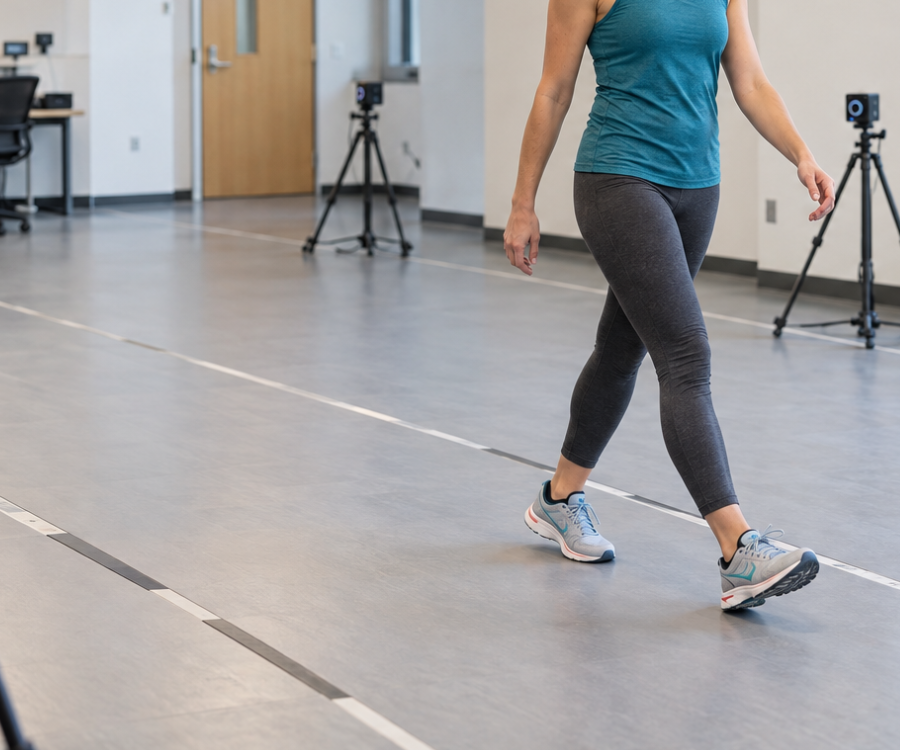
Video gait analysis uses camera footage to examine how a person moves. A common setup has the person walk or run on a treadmill while cameras film from the front, side, and back.
You can then slow the footage down and examine each phase of the stride, including the running mechanics that may be hard to notice in real time, like a foot landing well ahead of the body, a knee drifting inward, or the pelvis dropping on one side.
That’s the simplest form of video gait analysis, but it isn't the only one. For instance, you can:
- Attach markers to the joints so specific body points are easier to track, in order to sharpen 2D angle measurements.
- Pair video with force plate data, plantar pressure measurement, or electromyography (EMG) to connect what you see on screen to the forces going through the body.
This article explains what video gait analysis actually measures and how motion capture makes it accurate. We start with simple 2D video, then cover both marker-based and markerless motion capture and what the research shows about their accuracy and reliability. For markerless capture, we use Theia3D to show how this works in practice.
What You Can Measure with 2D Gait Analysis
Single-camera video is useful for coaching and basic movement review because you can examine it frame by frame and add notes. However, it records movement from only one viewpoint, so some motions may be hard to see or measure accurately.
The results also depend on how the person moves within the camera view. If they move closer to or farther from the camera, the image can become distorted and reduce the accuracy of on-screen measurements. Measuring joint angles by hand can also lead to differences between practitioners.
The main limitation is that 2D video flattens movement onto a single plane. It may show the knee bending from the side, for example, but miss rotation or side-to-side movement happening in other planes.
Motion capture addresses this limitation by combining video from several camera views to reconstruct movement in three dimensions. This makes it possible to measure joint and body-segment motion from different directions rather than relying on a single flat image.
How Motion Capture Improves Video Gait Analysis
3D motion capture comes in two main forms: marker-based and markerless. Both use cameras to track movement, but they differ in how they identify and follow parts of the body.
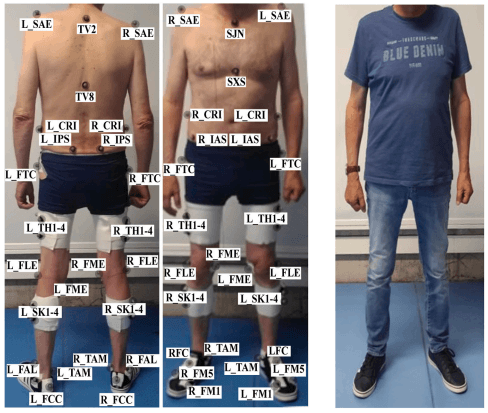
Marker-based motion capture uses infrared cameras to track reflective markers placed on anatomical landmarks on the skin, and has been the gold standard in biomechanics for decades with a record of accuracy.
However, the system usually requires a darkened, controlled lab so the cameras can detect the markers. A trained technician must also place 30 to 50 markers on each person, a process that can take up to an hour before the session begins. That placement introduces another source of error, since markers may be positioned slightly differently from one session to the next. These differences can create up to a centimeter of positional variability between sessions.
Markerless motion capture replaces the markers with a deep learning model that locates anatomical landmarks directly in standard video, so participants wear their own clothing. Because it works from ordinary video rather than infrared tracking of markers, markerless capture can operate outside the lab, and it removes the marker-placement step entirely.
Taking the markers away raises an obvious concern, which is whether it costs you accuracy. The research covered below answers that directly.
How Markerless Motion Capture Works
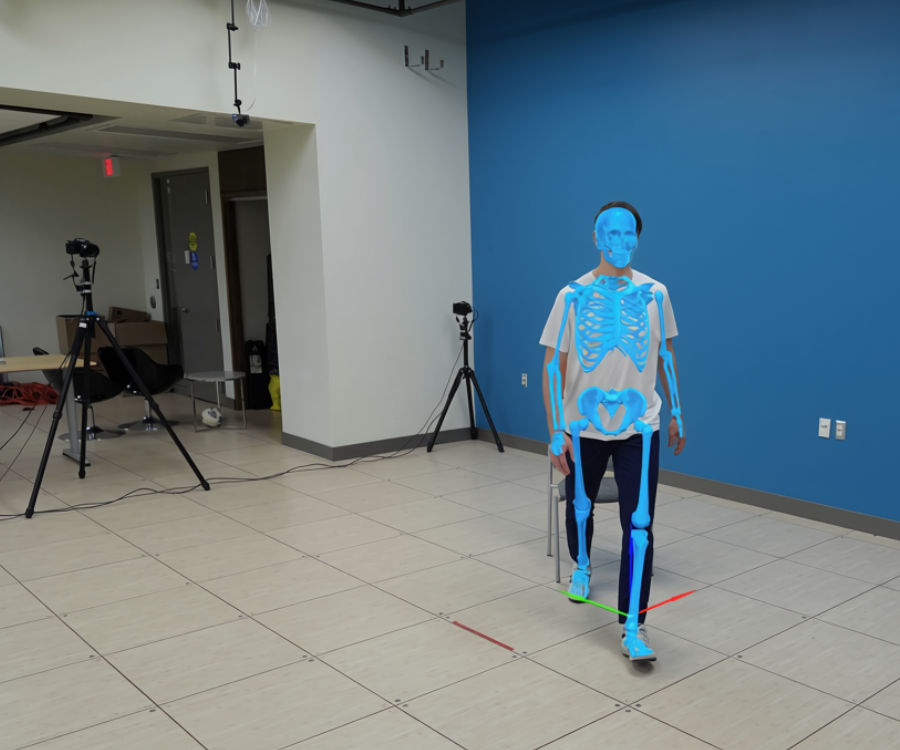
Markerless motion capture combines synchronized multi-camera video, deep learning, and inverse kinematics to reconstruct movement in three dimensions. The pipeline reveals both where the accuracy comes from and where the limits are, so this section walks through each stage.
We use Theia3D, our markerless motion capture system, as a practical example to show how each step is done in practice.
Capturing Movement From Multiple Synchronized Cameras
3D markerless gait analysis starts with several synchronized cameras placed around the capture space, so the participant is visible from multiple angles at the same time. For running gait analysis and sports performance applications, the camera arrangement must also provide sufficient coverage and image quality at the participant’s running speed.
These different views allow the system to reconstruct joint positions in three dimensions instead of estimating them from a single camera angle. It also makes it possible to compare movement on both sides of the body and examine gait symmetry across the full gait cycle.
Theia3D requires a minimum of eight cameras for most capture volumes.
Calibration establishes where each camera sits in space. In Theia3D, an operator records a short video of someone waving a calibration wand or board inside the capture volume, and the system then computes the position and orientation of every camera automatically.

Synchronizing the cameras with external devices such as force plates, EMG sensors, and instrumented treadmills aligns kinematic and kinetic data in a single session and coordinate system.
Detecting Anatomical Landmarks with Deep Learning
Instead of reflective markers, markerless motion analysis software uses deep learning algorithms to locate anatomical landmarks directly in each video frame. The model has to recognize those landmarks reliably across different lighting, clothing, and body positions, including when one limb passes in front of another.
Theia3D's models were trained on over 100 million images spanning more than 1,000 environments and identify over 120 anatomical landmarks on each visible person in every frame. Because the software finds these landmarks automatically, the results aren’t affected by a technician placing markers in different locations from one session to the next.
Reconstructing Movement in Three Dimensions
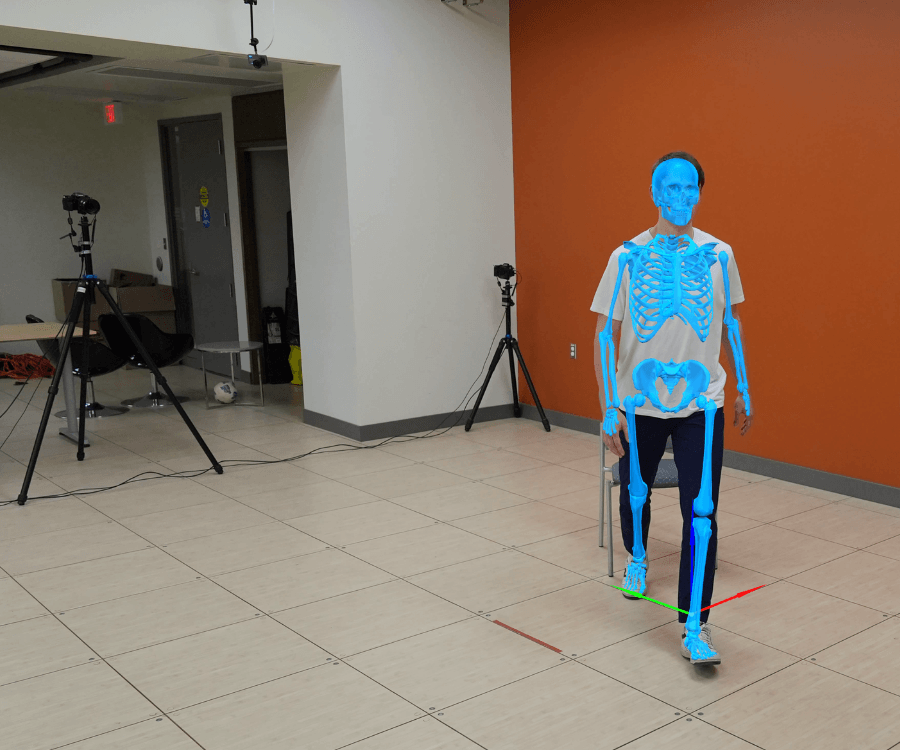
Theia3D’s gait analysis software uses triangulation algorithms to combine the 2D landmark detections from each camera with the calibration data to compute each landmark's position in 3D space. Inverse kinematics then fits a scaled skeletal model to those 3D positions, which produces joint angles and segment motions across the whole movement.
This produces a skeletal model of 17 body segments, from which you can measure joint angles, spatiotemporal parameters associated with walking or running, movement patterns, and events such as foot strike.
These measurements can also be used to examine symmetry between the left and right sides throughout the gait cycle and across successive steps or strides.
For filtering, Theia3D offers a Generalized Cross-Validation Spline (GCVSPL) method, which users can disable to work with raw output. A markerless system can also track more than one participant at once when each person is visible in enough camera views; Theia3D does this as long as each person is visible in at least three views.
Turning Results Into an Analysis-Ready Workflow
For the data to be useful, it has to move cleanly into whichever biomechanical analysis software or other tools researchers and performance staff already use. Standard biomechanics formats such as .C3D, .FBX, and .JSON let the output feed downstream environments including Visual3D, Vicon Nexus, Qualisys Track Manager, Python, and MATLAB.
Theia3D exports to these formats, and in .C3D it saves both raw unfiltered poses and smoothed filtered poses, so you can choose which to analyze.
Where the processing happens matters for data governance. This is because local processing keeps video and participant data within your organization, while cloud processing sends it to a third party. Theia3D runs locally on consumer-grade NVIDIA GPUs and transmits no video, participant, or analysis data to Theia or any external provider.
High-volume biomechanical assessments require automation to process many trials, and Theia3D Batch runs hundreds of trials sequentially without supervision, once you assemble a trial list, assign calibration files, and set the analysis parameters.
Accuracy and Reliability of Markerless Motion Capture for Gait
For many walking and running gait measurements, markerless motion capture can produce results that are close to those from established motion-capture systems.
However, accuracy isn’t the same for every measurement. It can vary depending on the joint, the direction of movement, the task being performed, and the testing environment.
The findings below come from a large body of independent research, including more than 50 independent, peer-reviewed studies that have evaluated Theia3D.
How Markerless Compares with Marker-Based Motion Capture
In a direct comparison of markerless and marker-based gait analysis published in the Journal of Biomechanics, the joint centers measured by the markerless system were usually within about 2.5 cm of the marker-based results. Most body-segment angles differed by less than 5.5°.
A second study covering eight movements, including walking and running, found that markerless ankle and knee angles were within about 5.9° of the marker-based measurements. Ankle and knee joint moments also showed close agreement.
A Scientific Reports study compared the two methods in 14 male Division I college athletes performing squats, drop jumps, and countermovement jumps. This study also examined kinetics, including joint moments and joint power, which describe the forces acting at a joint and how quickly the joint generates or absorbs energy.
The markerless estimates of knee and ankle angles, moments, and powers in the sagittal plane showed high agreement with the marker-based results. The largest reported joint-angle root mean square difference (RMSD) across these sagittal-plane measurements was 5.6°. During most parts of the movements, knee and ankle angle differences were generally within about 3.5°. Hip-angle measurements showed larger differences and still need more research.
Across these studies, the closest agreement is usually found in the sagittal plane, which covers forward-and-backward movements such as knee bending. Measurements outside this plane, such as hip rotation, tend to be less reliable.
Repeatability and Force Measurement
Researchers and performance staff need results that remain consistent across testing sessions.
In a study of treadmill running across separate testing sessions, markerless measurements showed excellent agreement with an instrumented treadmill for cadence, stance time, and step length. The reported intraclass correlation coefficient (ICC) values ranged from 0.982 to 1.0.
Differences in lower-body joint angles between sessions were also small. The average variation was 1.1° across the joints and movement planes studied. Average variation remained below 2° in the sagittal, frontal, and transverse planes.
These findings support the use of markerless motion capture for repeated running gait assessments, where researchers or performance staff need to track changes in running form while reducing setup differences between sessions.
Markerless motion capture can also be used as part of a kinetic analysis, as it doesn’t measure force on its own. Both marker-based and markerless systems mainly provide kinematic data, which describes how the body moves.
When either system is synchronized with force plates, researchers can combine the movement and force data. They can then use inverse dynamics to calculate joint moments and joint powers.
Some markerless methods can also estimate ground reaction forces from whole-body movement without using a force plate. This makes it possible to examine how estimated forces and load distribution change across the gait cycle.
One study reported an average RMSD of 0.75 newtons per kilogram across walking, running, jumping, and cutting tasks. The estimated peak forces showed very strong agreement with forces measured directly by force plates.
Together, these findings show that markerless motion capture can offer repeatable movement measurements and support the analysis of forces and load distribution. This allows it to provide more detailed biomechanical information than the visual movement review available from a single-camera system.
Taking Video Gait Analysis Out of the Lab
A community-based feasibility study across six public or participant-facing locations compared markerless gait measurements with results from a pressure-sensitive walkway. The two methods showed very strong agreement for cadence, walking speed, and step length.
The reported ICC values ranged from 0.997 to 0.999 during normal walking and from 0.997 to 0.999 during the participants’ fastest comfortable walking. In practical terms, the markerless system and the walkway produced almost identical results for these measurements.
The researchers also completed up to 8.5 full gait assessments per hour. They noted that this level of throughput would be difficult with a marker-based system unless the team had extra marker sets, trained staff, more preparation time, and clothing changes.
This matters because people may display different movement patterns in a laboratory than they do in everyday or training environments. For biomechanical assessments of running gait, this can mean measuring athletes on tracks, trails, or other surfaces that more closely represent their normal training conditions and examining how terrain, footwear, or speed affects foot strike, lower-limb mechanics, and running performance.
That coverage allows the system to examine running form and the movement factors associated with running performance throughout the stride, rather than relying on a single view or isolated frame.
Get Research-Grade Gait Data Without Markers
Talk to our team to see how markerless motion capture delivers walking and running gait data without markers, wearables, or a darkened lab, and how it fits into your research or performance workflow.
Disclaimer: This article summarizes video gait analysis approaches for research and performance applications. Theia3D is a motion analysis software platform and is not intended to diagnose or treat medical conditions. Interpretation and application of results are the responsibility of the user.