



Summary
Most baseball tracking systems were built to answer one question: where did the ball go? That technology has matured to the point that pro teams, college programs, private development labs, and university research groups all expect detailed pitch and hit data as a matter of course.
But these tools have a blind spot. Standard ball tracking measures outcomes. It tells you what the ball did at release or right after contact, but it doesn't show you the mechanical process behind that result. In practice, that mechanical process includes the sequence of joint motions, segment velocities, and timing that connect what an athlete does in training to what eventually shows up in performance.
That gap is part of the reason baseball tracking systems cover a wide range of products that measure very different things:
- Radar units and camera-based launch monitors built around ball flight
- Bat sensors or markerless camera systems that focus on the bat path
- Wearable devices that track athlete workload and pitch counts
- Full-body biomechanics platforms
- Fixed stadium installations that capture the ball and every player on the field at once
Each system is built to answer a different question, and most capture only one stream of data. A few capture two; almost none combine body, bat, and ball into a single synchronized dataset. Since no single tool captures everything, the right system depends on the question your program is trying to answer, and most serious programs end up using two or three systems in combination rather than picking a single option.
This article gives you a practical framework for evaluating baseball tracking systems, then walks through the leading options by category. We start with Theia3D and its Bat Tracking and Ball Tracking add-ons, a markerless system that captures body, bat, and ball in one synchronized coordinate system, before moving on to Hawk-Eye, Trackman, Rapsodo, Catapult Vector, and PitchLogic.
Considerations for Choosing a Baseball Tracking System
What Are You Actually Trying to Measure?
First, you should determine whether your program needs to evaluate the result of a play or the sequence of movements that caused it. For pitching development, ball-flight metrics are typically the priority. Programs working on pitch-shape design rely on release speed, spin rate, spin axis, movement, induced and horizontal vertical break, and seam-shifted wake to evaluate and refine arsenals. Radar units and launch monitors are well suited to this job and have become a baseline expectation for any program working on pitch-shape development.
For swing development and hitting mechanics, bat path matters as much as exit velocity. Standard launch monitors are very good at measuring ball-flight outcomes like exit velocity and launch angle, but for swing development they can be incomplete because many of them don’t directly measure bat-speed and swing-path data.
Capturing bat-tracking metrics like bat speed, swing length, attack angle, and swing plane requires high-resolution multi-camera optical systems, such as Hawk-Eye's 12-camera array. Measuring the bat itself adds the layer needed to understand why a hitter's exit velocity is increasing or decreasing.
For movement risk research, return-to-training readiness, and developmental work, athlete biomechanics is the relevant data layer. Load metrics and ball-flight outcomes don’t capture how a body produces or absorbs force. Programs working in this space generally need systems built to track the athlete:
- Wearable athlete monitoring, which independently tracks pitches, throws, and bat swings to objectively quantify daily workloads and manage physical demands.
- Motion capture platforms, which capture the exact kinematic sequence of the body, including how the hips rotate, the trunk follows, and the elbow extends, at full game speed; this is the data layer needed to analyze how specific movement patterns relate to arm stress.
For elite programs, the ultimate challenge is workflow friction caused by isolated data silos. Connecting mechanics to outcomes typically requires more than manually stitching together separate radar and motion-capture outputs: the underlying question is whether a platform supports an integrated tracking environment, where the athlete's body motion, the bat's movement, and the full 3D ball flight are simultaneously captured and mapped within one shared coordinate system.
Where Will the System Operate?
Many systems work perfectly in one environment but not in another, so the constraints of where you intend to deploy a tracking system matter as much as what it measures.
Hawk-Eye is the gold standard for MLB games and broadcasts and provides accurate, full-field coverage of pitches, batted balls, and player biomechanics, but it’s effectively an infrastructure project tied to its fixed venue. It’s also generally unavailable for off-site training facilities, indoor cages, or travel practice environments.
Some high-end consumer and professional baseball launch monitors are optimized for bullpen, batting cage, and mound deployment, but they often require strict mounting geometry and controlled indoor lighting, including exact setback distances, limited horizontal offset, and in some cases LED lighting with minimum brightness thresholds.
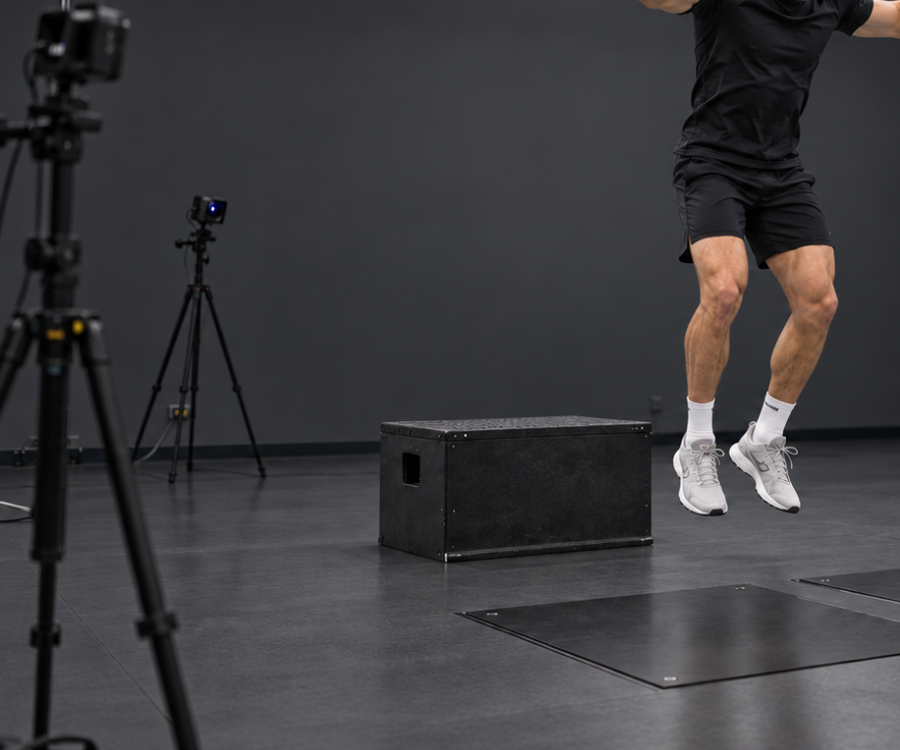
Multi-camera motion capture systems are highly adaptable because they work wherever cameras can be physically mounted and calibrated. These systems operate on video infrastructure that watches the entire scene rather than a narrow window behind the plate, so they can be deployed in controlled biomechanics labs, indoor cages, and outdoor practice fields.
The operating environment often depends on budget and the level of accuracy needed. Consumer apps can capture basic launch metrics in a garage for a low monthly subscription, while portable prosumer radar systems are field-ready hardware products that typically cost in the low-to-mid five figures.
How Much Setup, Hardware, and Operator Time Does It Demand?
For programs that need minimal friction, portable systems are built for immediate deployment. Single-unit launch monitors require only a basic tripod and correct placement behind the plate (typically 8 to 14 feet back), which means they demand very little hardware management. Coaches can set them up in a bullpen or cage and start pulling data almost instantly without eating into practice time.
Multi-camera motion capture systems trade instant setup for full environmental coverage. These systems triangulate data from multiple angles, so they require an array of cameras to be positioned correctly and calibrated so that the system understands the measurement space.
The initial setup is more involved and requires line-of-sight management to ensure the entire capture area is covered. The tradeoff is favorable for permanent or semi-permanent labs: once the initial calibration is established, the system is reusable across sessions, and coaches can continuously capture full 3D body, bat, and ball data without outfitting players in markers.
Athlete monitoring systems operate on a different logistical model. The hardware tracks the athlete rather than the environment, so these systems require zero stadium or cage infrastructure. The technology captures swings, pitches, and throws via a single wearable device worn by the player. The setup time shifts from the facility to the roster; coaches or sports science staff need to make sure the individual units are charged, fitted to each athlete before practice, and collected afterward to monitor workloads and manage movement risk.
The final consideration is the human operator. Portable radar units and launch monitors are designed to be intuitive, feeding data directly to user-friendly iPad apps and automated cloud dashboards, and they typically require minimal technical training to operate.
Biomechanics systems generate more complex data describing the kinematic sequence, including the exact timing of hip rotation, trunk movement, and elbow extension. Multi-camera systems capture this data automatically, but making actionable sense of why a specific movement pattern is causing a drop in velocity or an increase in arm stress benefits from a sports science professional or someone who understands joint kinematics.
Does the System Connect Outcomes to Athlete Mechanics, or Stop at Ball Flight?
The fundamental limitation most programs eventually hit is that standard ball tracking is built strictly to measure outcomes. Standard radar systems tell you exactly what the ball did at release or immediately after contact, but they can’t see the mechanical process or sequence of joint motions that produced that result. If a pitcher suddenly loses two miles per hour on their fastball, or a hitter alters their swing and gains exit velocity, ball flight data alone can’t explain the cause.
That’s the gap pitching analysis software has to close: connecting the result of the pitch to the mechanics that produced it.
Radar systems excel at capturing precise ball velocity and estimating spin, but their fatal flaw for holistic development is that they track the ball, not the athlete. They can’t observe the pitcher's arm path, hip sequence, or the hitter's swing plane.
Integrated camera-based tracking environments watch the entire scene. By capturing the athlete's body motion, the equipment (the bat), and the full 3D ball flight all at once, these systems can map every element into a single, synchronized coordinate system. That allows analysts to link specific events in a player's kinematic chain directly to the resulting batted-ball trajectory or pitch movement.
Where Does Your Data Live, and Who Owns It?
Before adopting any system, programs should get specific answers on where the raw data lives by default, who controls access to it and under what terms, and what happens to the data if you discontinue the service. The answers vary substantially across categories, and even across products within the same category.
Programs using fixed multi-camera stadium installations generally don’t handle the raw tracking data themselves. Captured video is processed by the vendor's proprietary software, transferred through cloud infrastructure, and returned to teams and broadcast partners as finalized metrics. Teams depend on the vendor's pipeline and have limited control over the raw capture environment, the processing methodology, and how long source data is retained.
Wearables and portable launch monitors typically push to vendor cloud dashboards. Athlete-monitoring wearables and most portable radar and camera-based launch monitors are built around proprietary cloud ecosystems.
Session data and video sync automatically to vendor-hosted portals where the data is stored, visualized, and shared. Some vendors describe this arrangement as customer-owned data, but in practice the data lives inside the vendor's infrastructure, which has implications for retention, access, account portability, and what happens if the vendor is acquired or sunset.
How Baseball Tracking Systems Compare
Systems That Connect Player, Bat, and Ball
These systems capture the player, bat, and ball together rather than treating each data stream separately. By tracking body motion, bat path, and ball trajectory in a shared measurement environment, they let performance staff connect outcomes like velocity, contact quality, and ball flight to the mechanics behind them.
Theia3D Bat and Ball Tracking

Theia3D is markerless motion capture software that uses deep learning and inverse kinematics to estimate 3D human pose from synchronized multi-camera video. It analyzes swing and batted-ball trajectories using two add-ons:
- Bat Tracking extends Theia3D so that the same multi-camera array captures the bat's 3D trajectory alongside the athlete's full-body kinematics, tracking the base and barrel tip frame by frame across the swing without instrumentation on the athlete or the bat.
- Ball Tracking brings pitch and batted-ball trajectory into the same synchronized capture space, so body, bat, and ball can be analyzed in one coordinate system.
Unlike radar units and launch monitors, which capture only ball flight, or wearable IMUs and bat sensors, which capture single streams of data and require equipment changes, Theia3D Bat and Ball Tracking captures and tracks all three streams within one synchronized coordinate system. That allows performance staff to move beyond simply describing what the ball did and instead explain why it happened, as we describe below.
Synchronized Body, Bat, and Ball in One Coordinate System
Capturing all three streams natively within a single, continuous optical tracking system eliminates the friction of manually stitching the data together, like aligning different coordinate systems, syncing timestamps, and merging multiple outputs to create a complete picture of a swing or pitch. Analysts can immediately access a synchronized 3D representation of the entire event, allowing them to measure exact release points and contact points with high spatial detail.
This enables high-performance development programs to better target their training. Programs running Driveline's Launchpad service, for example, use Theia3D-captured biomechanics alongside force plate and strength data to ask whether the gap between an athlete's current output and their potential ceiling is mechanical, physical, or both. Such unified capture enables performance staff to:
- Assess why a pitcher lost two miles per hour on the fastball by tracing the change to factors like hip-shoulder separation timing, elbow flexion at foot strike, late trunk rotation, or release-height shift.
- Explain why a hitter gained exit velocity after a swing change by mapping bat path, attack angle, and pelvic rotation timing against the resulting batted-ball outcome.
- Track return-to-play readiness against pre-event baseline mechanics rather than against ball-flight outcomes alone.
We believe the future of player development is integrated. It’s not just biomechanics and not just strength and conditioning in isolation, but understanding how those factors influence one another and using that integrated picture to guide training decisions.
Markerless Capture for Game-Speed Mechanics
Theia3D requires no markers on the athlete, no sensors or chips on the bat, and no instrumentation on the ball. Athletes pitch and swing at full competitive intent in their everyday training clothing, using their preferred bat, which means the captured movement is the movement that actually occurs in performance, not the adjusted movement that happens when markers, suits, or sensors are introduced.
Our biomechanical software system works with eight high-speed cameras placed around the hitter to cover the full swing from different viewpoints; the cameras are synchronized at 300 frames per second or higher to ensure both the hands and the bat's tip remain visible throughout the swing.

Bright, even lighting and fast shutter speeds are recommended to keep the bat from blurring during contact, given how quickly the bat travels through the contact zone.
To start the alignment, you calibrate the cameras by recording a short video of someone waving a standard active wand or Theia's custom calibration board in the capture area.

Theia3D's desktop application runs on consumer-grade NVIDIA GPUs and uses the parameters from the camera calibration to calculate where key points on the athlete's body, the baseball bat, and the ball are in 3D space.
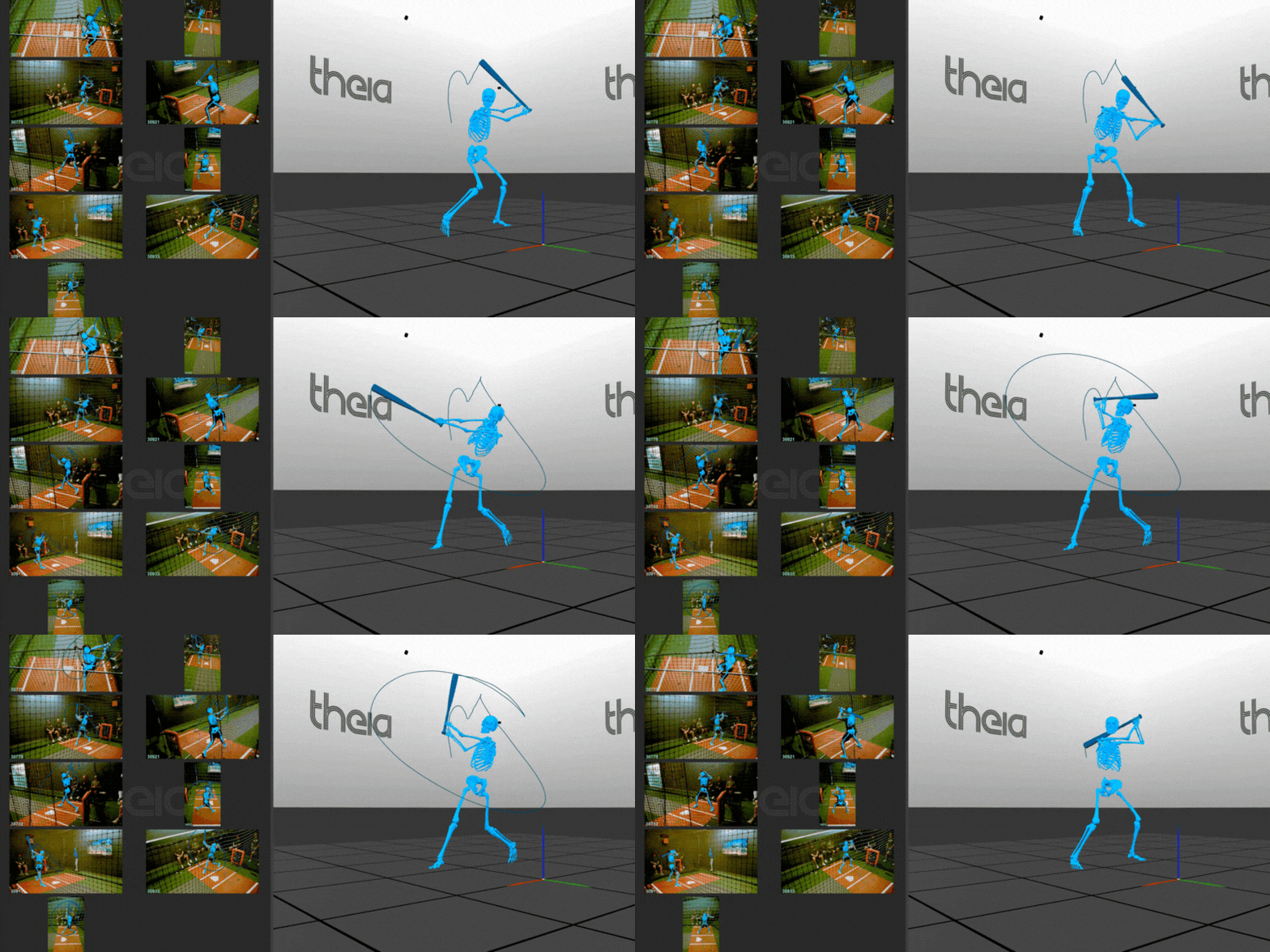
These points are then fit to a 3D skeleton based on user-specified joint constraints. The work is compute-intensive and depends on deep-learning models trained on more than 100 million images spanning more than 1,000 different environments, allowing the system to track 124 anatomical landmarks on every visible person in every video frame, plus the bat's base and tip on every frame the bat is visible.
The bat tracking algorithms are purpose-built for high-speed ballistic motions like a baseball swing, with separate filtering cutoff frequencies applied to the bat and to the athlete to maintain accuracy across the very different speed profiles of the two.
Theia3D records the ball's position frame by frame, combining the viewpoints of the multi-camera array to reconstruct the continuous 3D trajectory of the ball's flight. This camera-based approach calculates ball velocity accurately by tracking how the ball's position changes across successive video frames. Because the camera array records the entire environment rather than solely tracking the ball, the system directly captures the exact release point from the pitcher's hand and the point of contact with the bat, alongside the athletes themselves.
The result is a detailed, synchronized 3D swing profile that links the bat's complete trajectory (including metrics like bat speed, bat path, and timing) directly to the player's full-body biomechanics. As for the human body itself, a 3D skeleton is generated with 17 body segments, allowing users to measure joint angles, movement patterns, and other details about how the person is moving.
Once processing is finished, users can save the 3D motion data in standard file formats like .C3D, .FBX, or .JSON, which makes it easy to use the data in software like Visual3D and other downstream programs. When exporting to .C3D files, the software saves both raw unfiltered poses and smoothed filtered poses, giving users the option to work with either version in downstream analysis.
This approach is a significant departure from bat-mounted sensors (e.g., knob sensors, embedded smart bats), which rely on accelerometers and gyroscopes and have to backtrack from those signals to derive position and angle. Independent studies have found that wearable bat sensors can deviate by around 8 percent on swing speed, with lower agreement on swing angles than optical motion capture, particularly at higher swing speeds, and they’re also susceptible to signal drift over time.
Another difference is data access. With Theia3D, programs own the raw data (bat path, joint angles, and so on) and can integrate it into their analysis workflow immediately. All data processed by Theia3D is stored entirely locally; no video, participant, or analysis data is ever transmitted to Theia or any external provider, which is a requirement for sports programs that want to keep athlete performance data private.
Designed for Real Training Environments
Theia3D Bat and Ball Tracking operates wherever cameras can be physically mounted: batting cages, indoor and outdoor bullpens, mounds, performance labs, indoor and outdoor turf, on-field training spaces, and tunnels. No stadium infrastructure is required, which makes the system portable across a program's full training footprint rather than tied to a single fixed install.
Once the camera array is calibrated for a given capture space, athletes can rotate through a session with no setup or calibration between swings. The workflow allows roster-scale throughput rather than the single-athlete cycle most marker-based systems impose, given that more than 30 minutes of marker placement is typically required for marker-based capture.
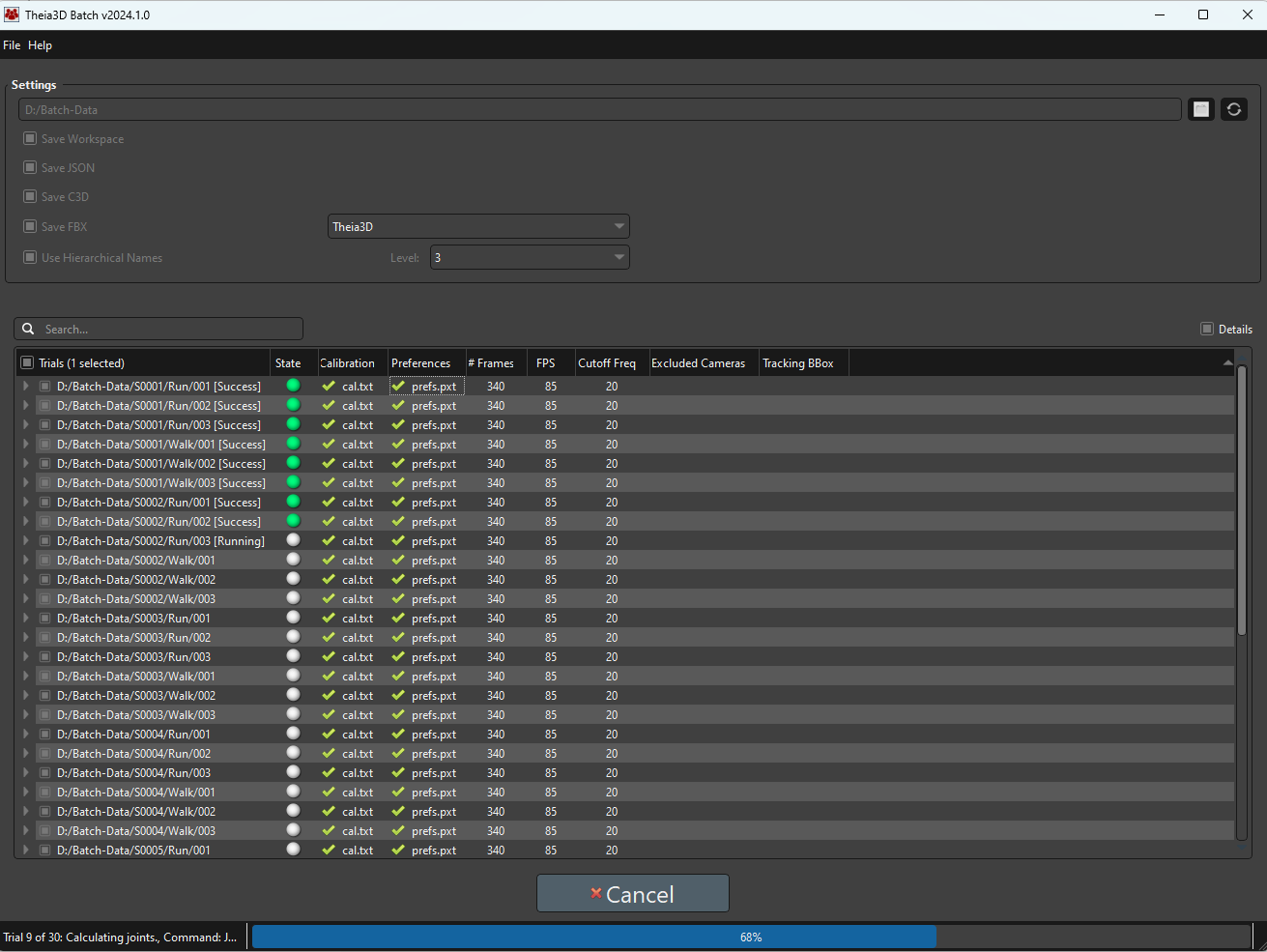
Theia3D Batch is a companion application that automates sequences of trials, letting users assemble a trial list, assign the correct calibration files, and choose the appropriate analysis settings. Once configured, it can process hundreds of trials without supervision.
Theia3D can also capture multiple players at once by automatically identifying and tracking each unique individual, as long as each person is clearly visible in at least three camera views, and users can specify a central person of interest within a group of people in the software’s settings.
Validation and Real-World Deployment
The core Theia3D platform has been evaluated in more than 50 independent, peer-reviewed validation studies covering gait research, sprint biomechanics, return-to-activity screening, pediatric movement, aging populations, occupational biomechanics, sports performance, and postural control. These independent validations consistently show full-body kinematics in agreement with marker-based references, resolving joint positions to within roughly a centimeter and joint angles within a few degrees of marker-based measurements. No other markerless motion capture system has been independently validated to this extent.
The Theia3D Bat Tracking add-on has been tested by leading partners in baseball biomechanics across more than 300 athletes and over 2,000 live swings in real-world trials, producing a median bat-plane error of less than 3 degrees and tight agreement with lab-grade reference systems. The bat tracking validation was performed using the same standard high-speed video pipeline (eight or more synchronized cameras at 300 fps or higher), capturing synchronized bat path and full-body mechanics in the same session without sensors, markers, or workflow interruption.
For pitching, a peer-reviewed study published in the Journal of Sports Sciences in November 2025 evaluated two multi-camera markerless systems, including Theia3D, against a marker-based reference during max-effort fastballs from 18 collegiate pitchers in an MLB stadium. Theia3D showed lower joint-position errors than the comparison system across most variables, smaller RMS errors on several high-value pitching measures, and strong agreement with the marker-based reference on stride length.
Theia3D and the Bat Tracking add-on are deployed across leading baseball biomechanics labs and player development programs, including Driveline Baseball, the PLNU × Padres Biomechanics Lab, Virginia Tech University, Ohio State University, and Florida State University, in addition to hundreds of professional teams and elite athletes across other sports at the highest levels of competition. These deployments span the full range of pitching and batting use cases.
One caveat with validation is that it should be specific. So a system validated for one task, say, controlled bullpen pitching mechanics, isn’t automatically validated for another, such as max‑effort, game‑speed pitching. These conditions differ in effort level, velocity, and contextual demands, so any markerless‑motion model should be explicitly evaluated for each use case.
Programs should compare Theia3D’s published validation evidence against the population, movement, and environment they plan to study, using the validation library as a starting point.
Talk to our team to see how Theia3D can help you connect body, bat, and ball data in one synchronized workflow without markers or wearables.
Hawk-Eye Innovations (Sony)
Hawk-Eye is a venue-level measurement system embedded in stadiums and observes pitches and plays from fixed camera positions so teams can analyze mechanics, fielding, and ball flight with consistent precision. It turns video from ballpark-mounted cameras into usable baseball data for MLB clubs, broadcasts, and Statcast-style analytics, supporting both on-field performance analysis and fan-facing data products.
Key features:
- 12 high-resolution, high-frame-rate cameras installed at each ballpark for full-field coverage.
- Live ball and player tracking with reported accuracy of about +/- 0.1 inch.
- Pitch tracking, including velocity, release angle, movement, and spin-related metrics.
- Batted-ball tracking, including launch angle, exit velocity, and trajectory.
- Player pose and motion analysis, with multiple body points measured about 30 times per second.
- Integration with MLB infrastructure and Google Cloud to power Statcast data products.
- Real-time or near-real-time outputs for coaches, broadcasters, and analysts.
Systems for Ball-Flight Metrics
These systems focus on measuring what the baseball does after release or contact, including velocity, spin, movement, launch angle, exit speed, and trajectory.
Trackman

Trackman is a dual-radar measurement platform that uses camera assistance to capture the entire trajectory of a baseball from release or contact through its flight and landing. By monitoring the ball's movement throughout its path, the system provides granular, real-time data for both pitchers and hitters that is widely used for performance analysis and player development.
Key features:
- For pitchers, the system measures release metrics such as velocity, release height, side, extension, and vertical or horizontal release angles.
- The system captures comprehensive flight data, including induced vertical break and horizontal break, to analyze how pitches move relative to a straight-line trajectory.
- For hitters, it tracks exit speed, launch angle, launch direction, and 3D contact position to evaluate the quality of batted ball contact.
- It provides precise strike zone information, including plate location height and side, as well as the vertical and horizontal approach angles of the ball as it crosses the plate.
- The platform offers both stadium-mounted units for full-field coverage and portable units that provide a more flexible, cost-effective option for practice and training environments.
Rapsodo

Rapsodo is a portable ball‑flight monitor that uses combined radar and optical tracking to capture key metrics for both pitching and hitting, and it’s designed to fit into training environments ranging from cages to bullpen mounds rather than requiring permanent stadium installation.
Key features:
- Captures essential ball‑flight metrics such as velocity, spin rate, spin direction, and movement for pitched and batted balls, providing a quantitative view of how each pitch or hit actually behaves in flight.
- Uses a combination of radar and high‑speed camera technology to measure the initial trajectory of the ball and then models its full flight path, including estimated distance, launch angle, and spin‑induced movement.
- Operates in both pitching and hitting modes, allowing the same unit to evaluate pitchers’ arsenals and hitters’ swing quality within a single session and training environment.
- Delivers data in near real time, with metrics typically available within seconds of each pitch or swing so that coaches can provide immediate feedback during practice.
- It’s designed to be placed just in front of home plate (around 14–20 feet depending on model and mode) and can be used indoors or outdoors, which makes it suitable for portable training setups rather than fixed stadium infrastructure.
- All data is streamed to a paired tablet or app, where coaches can store unlimited player profiles, review video‑linked metrics, generate progress reports, and export structured data for deeper analysis.
Wearable and Sensor-Based Tracking Tools
These tools measure performance through devices attached to the athlete or embedded in the equipment, rather than through radar or fixed camera systems.
Catapult Vector

Catapult Vector is an athlete‑worn GPS/LPS device that uses a combination of Global Navigation Satellite System (GNSS) and local positioning technology plus high‑frequency inertial sensors to capture field‑level movement, running demands, and sport‑specific baseball actions (pitches, throws, swings) in real time.
It feeds these metrics into a cloud‑linked platform so coaches can monitor workload, event counts, and biomechanical load across pitchers, position players, and catchers within a single system.
Key features:
- Used across multiple training and game settings, including bullpens, practice fields, and live stadium environments, while maintaining consistent metrics and event‑detection logic.
- Continuously records high‑rate inertial data (accelerometer, gyroscope, and magnetometer) to capture acceleration, rotation, and rapid directional changes characteristic of pitching, throwing, and batting.
- Automatically detects and classifies baseball‑specific events such as pitches, throws, and swings, and logs counts and timing for each event type during practice and games.
- Calculates metrics like maximum rotation, peak PlayerLoad, and cumulative load per pitch/throw/swing to help quantify physical stress on the athlete.
- Supports live‑streaming of positional and inertial data to sideline devices so coaches and staff can monitor workload and movement patterns in real time during training and competition.
- Incorporates built‑in heart‑rate‑monitoring capabilities, allowing heart‑rate time series to be aligned with movement and event data for a more complete picture of cardiovascular strain.
PitchLogic

Pitch Logic is a wearable, sensor-based tracking tool consisting of a smart baseball embedded with an Inertial Measurement Unit (IMU) and motion sensors, making it fully portable for pitchers to use anywhere without fixed installations or external cameras. It connects via Bluetooth to a mobile app for instant, real-time analytics on pitch performance, distinguishing it from stadium-bound optical systems.
Key features:
- Precision motion sensors inside the ball capture speed, spin rate, spin direction, release point, and movement profile on every throw.
- Data transmits instantly via Bluetooth Low Energy (BLE) to a mobile app, requiring no WiFi, calibration, or setup for pro-level metrics.
- The app delivers graphical visuals including 3D clock-face renderings, spin efficiency, horizontal/vertical movement, and fingerprint of finger release.
- Personalized feedback and recommendations help pitchers set goals, with metrics like arm slot, backspin, sidespin, rifle spin, and extensions.
- Includes automated video capture, pitch tunneling graphics, and machine learning predictions on pitch outcomes against MLB hitters.
- Validated against radar units like Rapsodo and Stalker for accuracy in velocity, spin, and efficiency, at a lower cost for data-driven development.
Connect Baseball Outcomes to Athlete Mechanics
Talk to our team about how Theia3D helps baseball programs capture markerless movement data and connect athlete mechanics to pitching, hitting, and performance outcomes.