




Summary
Tracking Model Updates
We understand how important it is for Theia3D users to have a clear idea of what can be expected from our markerless tracking algorithms from an accuracy, reliability, and consistency standpoint, especially when it comes to model updates and new generations of markerless tracking.
As with previous model changes, we have revisited and reprocessed our internal validation dataset to produce new results, comparing across all of our historical models, but particularly Theia3D Axiom v2025 and the new Theia3D Apex v2026. And in short, our new models continue to provide stable and reliable tracking of these standard movements, with minimal changes between versions.
In many respects, this similarity between versions is the main result. Across our standard validation movements, Theia3D Apex v2026 produces kinematic outputs that are highly consistent with Theia3D Axiom v2025, with no broad or systematic changes in the tracked movement patterns. For walking and running, most hip and knee joint angle differences between model versions were approximately 1–2 degrees, while most segment angle differences were similarly small, typically below 2 degrees.
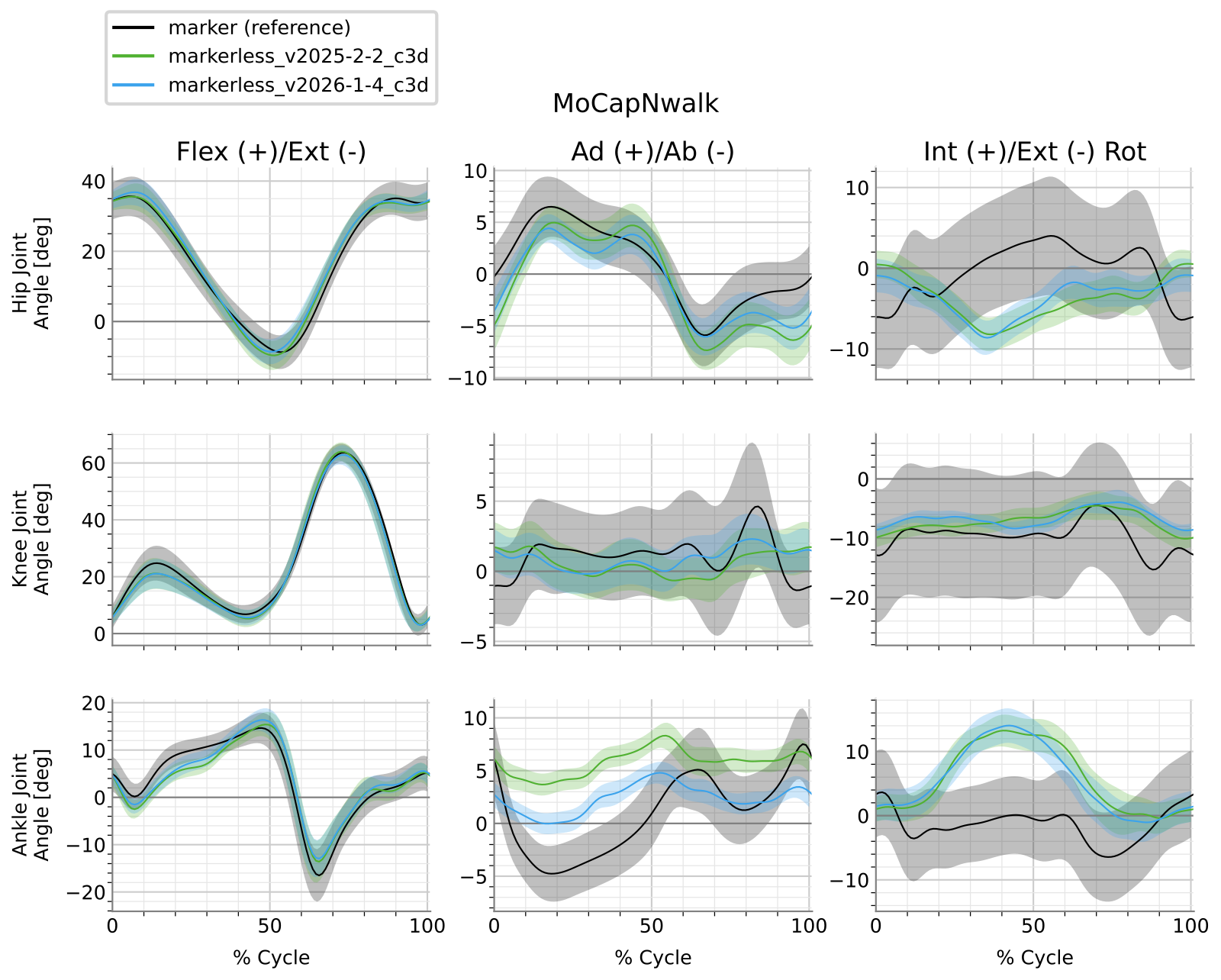
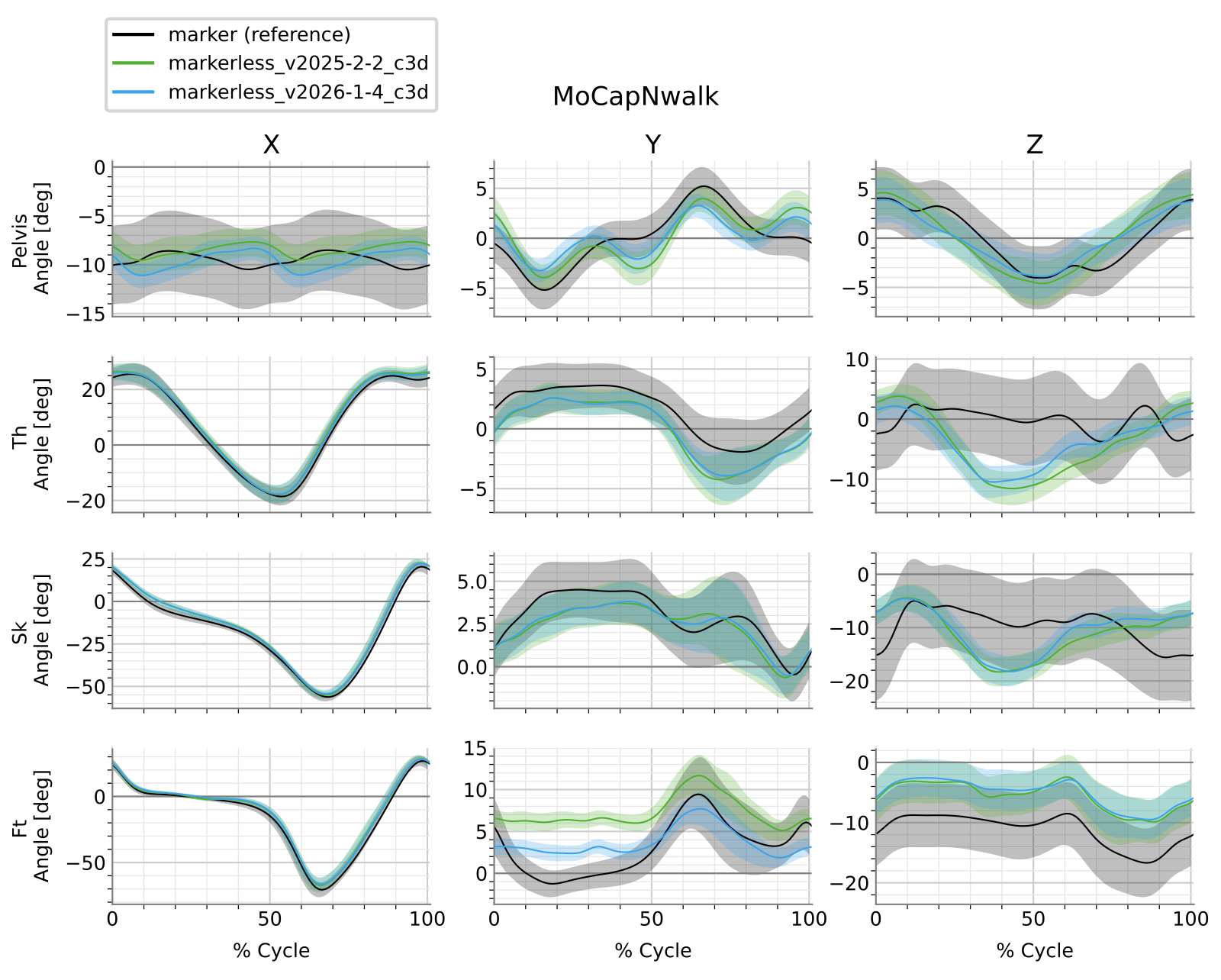
That being said, you may be wondering why this update matters if the results are relatively similar to previous models - and it’s a fair question to ask. Where these new models excel and build upon the strengths of previous models is their handling of more challenging movements, poses, and environmental scenarios. Theia3D is better than ever at accurately and reliably predicting its many keypoints, even in difficult and ambiguous images, resulting in improved tracking of ‘edge cases’ and of tracking challenging segments such as the pelvis and feet in more ordinary situations.
One notable change that we’ve been able to enact as a result of this improved foot keypoint precision is a tweak of the foot coordinate system to use more reliable and meaningful keypoints in its definition. We are now able to use the existing keypoints more effectively, improving foot tracking performance. While the overall coordinate system change is very minor, this reduces the previous bias towards supination, leading to a more neutral foot during typical planted poses - such as during the stance phase of walking. This adjustment also corresponds to improved agreement with marker-based data for this component of the foot segment pose.
Theia3D Baseball Tracking
Following the release of our Bat Tracking add-on feature, we have added more baseball-oriented features with Baseball Tracking in Theia3D Apex, available as a license add-on. This feature allows the trajectory of baseballs to be measured in 3D using state-of-the-art object identification and tracking models, based on the extremely solid foundation of our human pose tracking models. Collectively, these models now allow whole-body athlete biomechanics, bat trajectory, and ball trajectory to all be measured in real-world environments without the need for sensors or instrumentation, and easily scalable to whole-roster sessions.
As always, validation is important to us - how do we know that our models are performing as expected? To answer this question, our leading partners in baseball biomechanics helped us put our ball tracking models to the test by sharing pitching and hitting video datasets that include simultaneous measurements of task-specific metrics from other systems to enable cross-system comparisons. We break down those comparisons and results below, and - spoiler - tracking a ball is easy for a system that can track 124 keypoints on a human!
One of the challenges associated with comparing these disparate measurement systems is matching the coordinate systems or reference frames that each system uses to express the ball trajectory metrics, as offsets between these reference frames impact their measurements and agreement. These were adjusted for as best possible across the 38 pitches and 117 swings used for comparison, collectively captured in three unique environments. However, without a method for directly calibrating both systems to the same global coordinate system, some differences in alignment may exist and impact these results.
Pitching
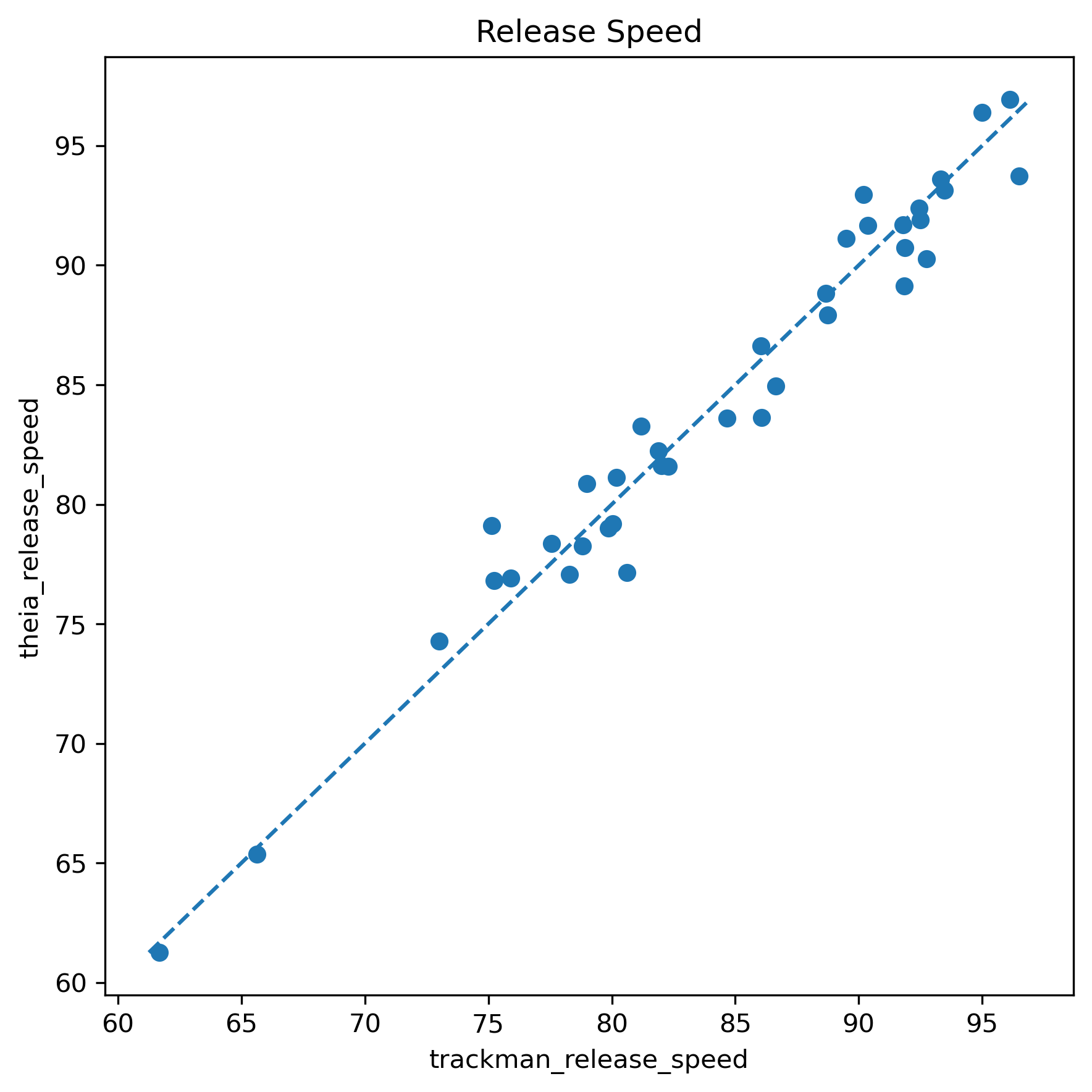
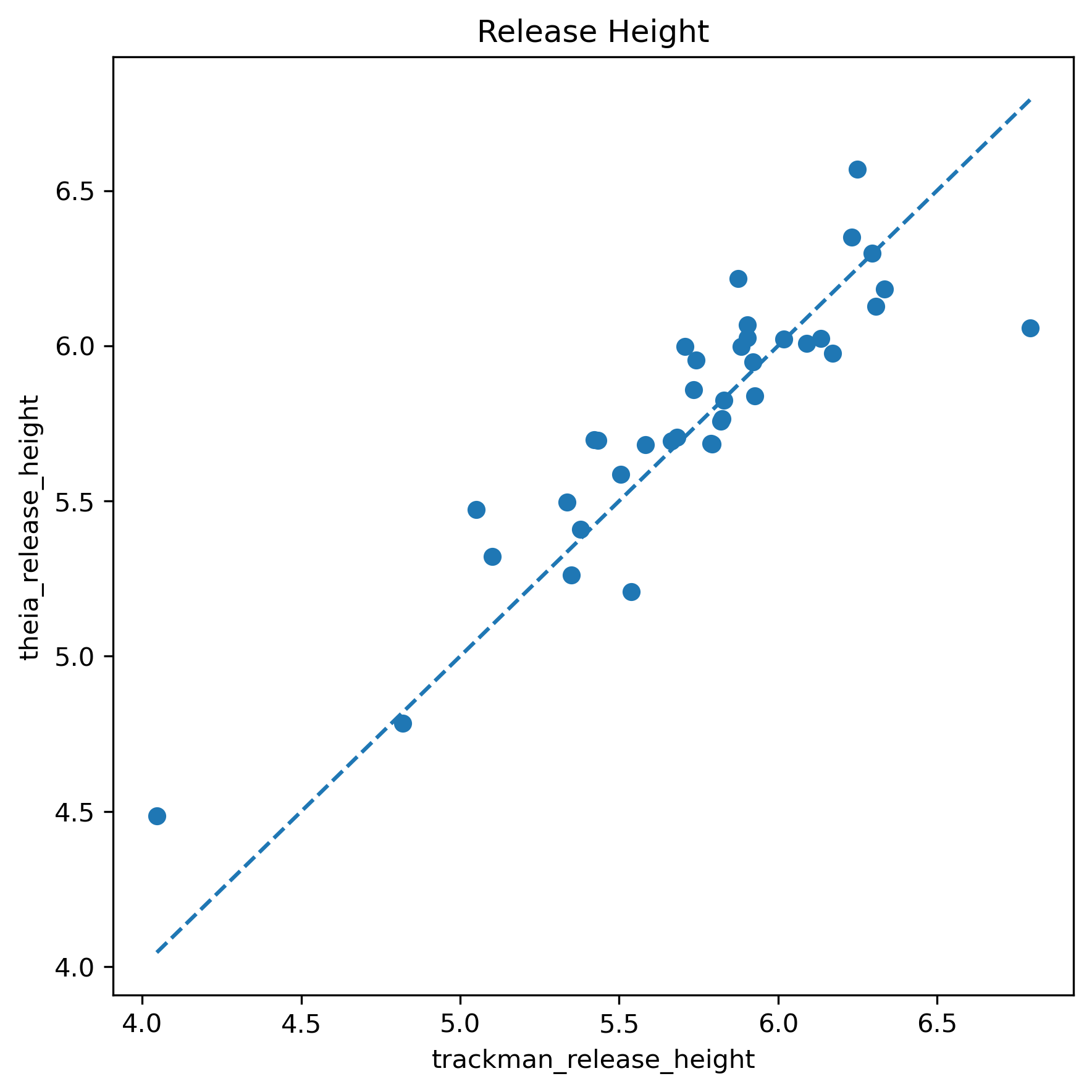
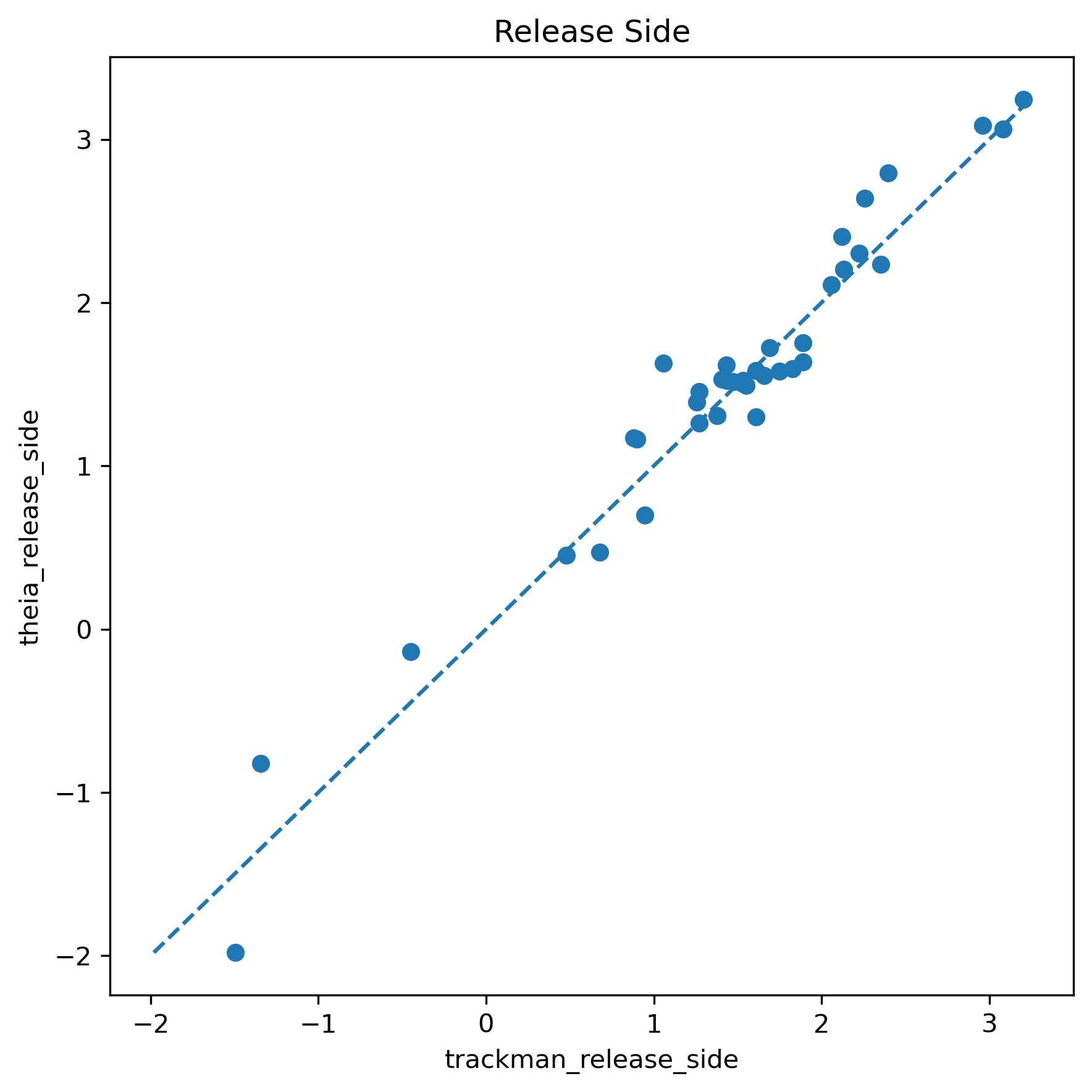
For pitching, our system for comparison was a TrackMan radar-based pitch tracking system, a widely used and respected method for tracking ball flight trajectories. TrackMan reports a variety of release and trajectory parameters, but because Theia3D data capture uses an athlete-centered approach for data capture, only a relatively short portion of the ball trajectory after release is captured within the video frames. As a result, our comparison focused on release metrics like release speed, release height, and release side (lateral release position). Ball release was automatically and reliably identified from the markerless data using the relative motion of the ball and throwing hand, allowing post-release trajectories to be isolated consistently across trials and for the release metrics to be obtained.
Pitches with a wide variety of speeds showed high levels of agreement between the release metrics from TrackMan and Theia3D, with a mean average error (MAE) of 1.25 mph for release speed, 0.18 ft for release height, and 0.16 ft for release side. Pearson correlation coefficients (r) indicated very high correlations of 0.981, 0.973, and 0.892 for release speed, release side, and release height, respectively.
Hitting
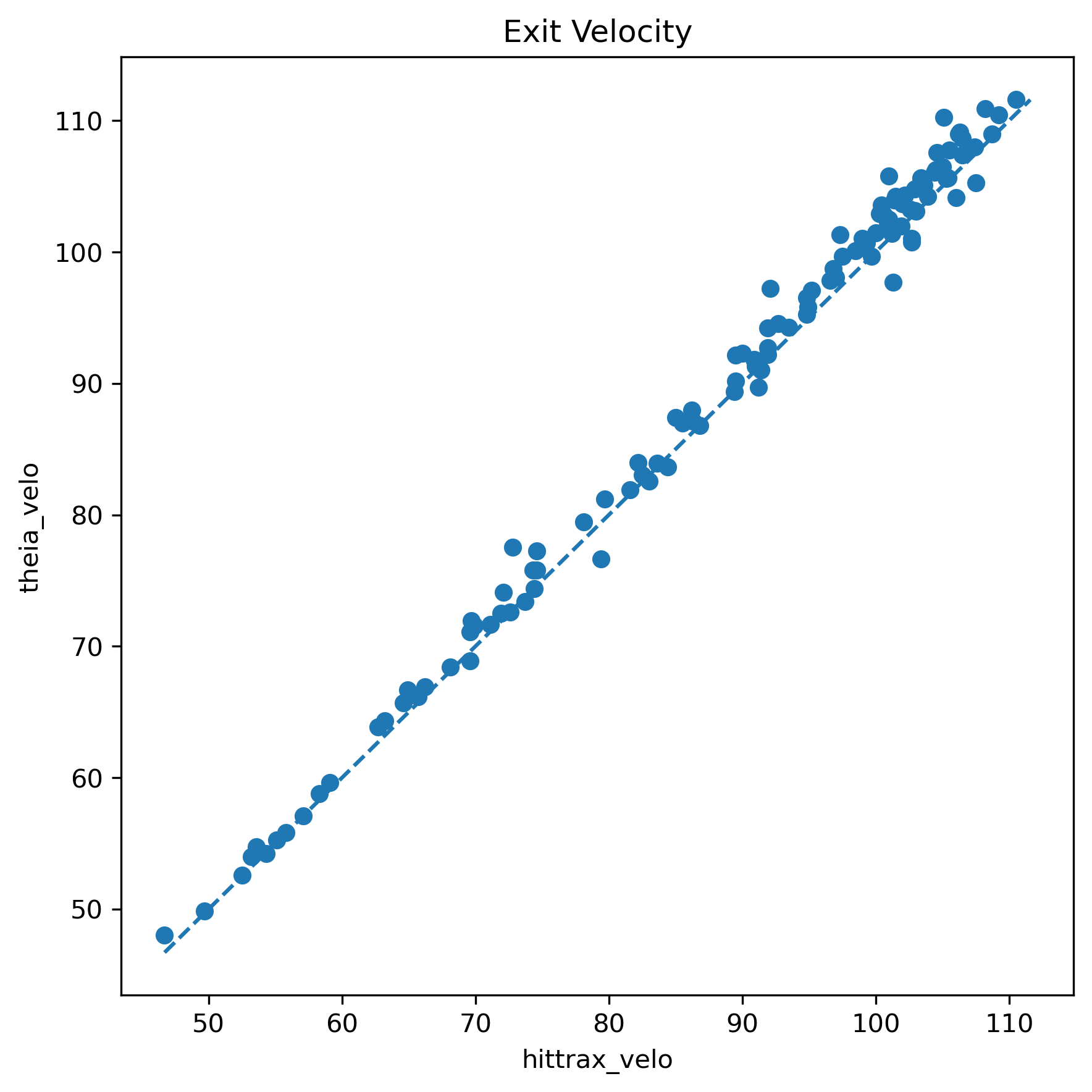
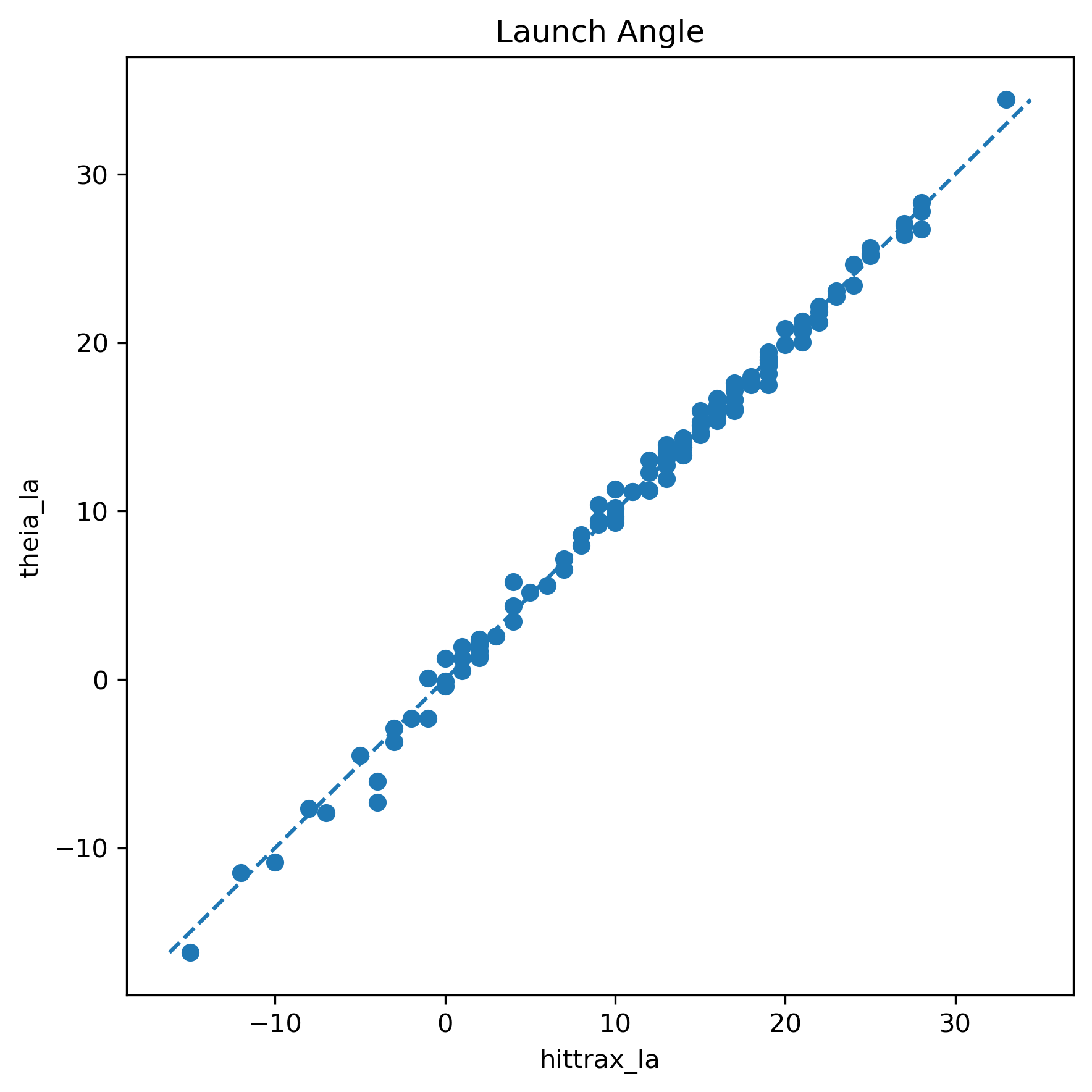
For hitting, our system for comparison was a HitTrax video-based hit tracking system, another widely used and respected method for tracking incoming pitch and outgoing batted ball characteristics and trajectories. For this comparison, we leveraged the availability of Theia3D ball tracking before and after bat-ball contact, allowing the direct calculation of batted-ball metrics that are also reported by HitTrax. Ball trajectories were used to estimate exit velocity, launch angle, and horizontal spray direction (bearing), which were then compared against the corresponding HitTrax outputs. Demonstrating the benefit of having both bat and ball tracking from Theia3D, the bat tracking data were incorporated to identify the bat-ball contact event and isolate the outgoing ball flight, ensuring that calculations were based on the same portion of the trajectory measured by HitTrax. Rather than attempting to reconstruct the full flight of the batted ball using estimations and assumptions, the analysis focused on the initial launch conditions, which are the primary metrics used by both systems to characterize hitting performance and are the most appropriate for this type of cross-system comparison.
Batted balls for 117 swings from three different locations were included in the analysis, from a variety of athletes and with varying launch trajectories. Across these swings, the comparison metrics showed a high level of agreement between systems with an RMSE of 1.43 mph for launch velocity, 0.5 degrees for launch angle, and 1.2 degrees for spray angle. Pearson correlation coefficients (r) indicated a very high correlation of 0.997 for all three metrics.

To add to these comparisons, we also find it useful to review Theia’s tracking of the bat and ball when re-projected onto the ground truth video data that serves as the input data. This is maybe the easiest and clearest confirmation of the ball tracking accuracy, which reliably shows that the tracked ball position lies squarely (or more accurately, roundly) on top of the ball in the video frames, even when the ball is a blur. Having the video data to fall back on as a reference is definitely an upside to video-based motion capture!

More Functional Than Ever
Besides the improved tracking model and addition of baseball object tracking, our engineering team has been busy adding new tools and features to make Theia3D and Theia3D Batch more functional than ever. Below are a short list of additions, changes, and improvements you can expect in Theia3D Apex v2026:
1. Small / Medium / Large person detector options, and Small / Large joint detector options
These new options in the startup window provide flexibility for how Theia3D builds its person and joint detectors, allowing you to select which end of the speed / accuracy tradeoff axis you would like Theia3D to operate on. If speed is the highest priority, select Small for both detectors and choose a Person Tracking Skip Frames value of 5 to maximize processing speed; if accuracy is the highest priority, choose Large for both and a Skip Frames value of 1.


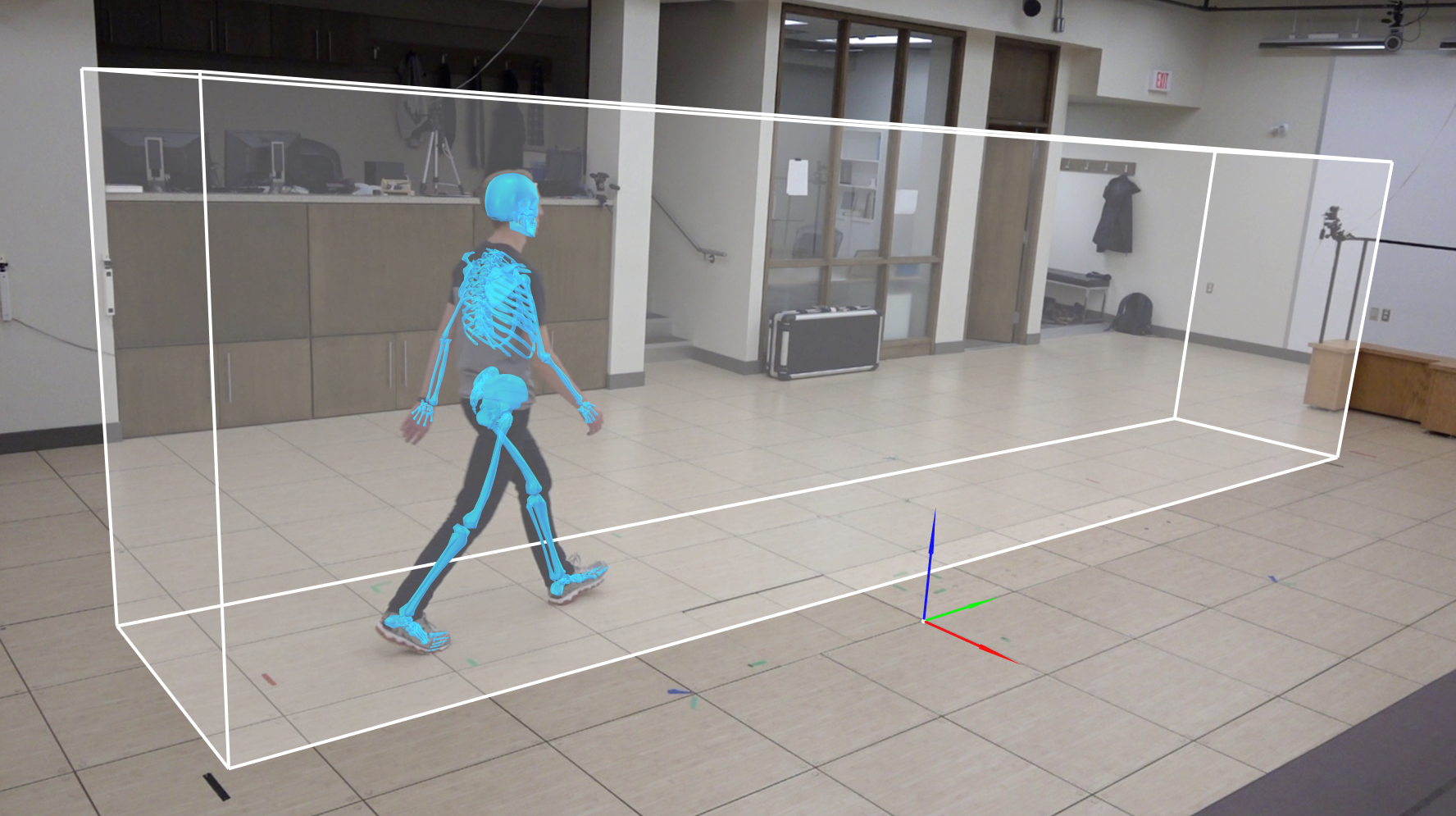
2. Analysis Bounding Box visualization
To help when defining your 3D Analysis Bounding Box, we’ve added the functionality to reproject the 3D analysis bounding box onto each 2D camera view, allowing you to clearly see the current bounding box definition and easily adjust it based on the visible physical environment.
3. New Theia3D Batch export options: 3D videos and results logs
We’ve heard your suggestions, and added more output options for visualization and quality assurance in Theia3D Batch. Now, you can automatically save a video of Theia’s 3D viewer space from a specific camera perspective with a few easy clicks in Theia3D Batch. And for batch processing transparency and bookkeeping, you can now choose to save a results log CSV file that records important information about the batch analysis, including the trials included, warnings or errors, analysis step outcomes, and analysis time.

We’re really excited about these changes and updates for Theia3D Apex, but we’re not done here. Look forward to updates coming soon with even more exciting features and improvements!
Learn more about Theia
For the latest updates on Theia3D, follow us on LinkedIn, X (Twitter), or send us an email at info@theiamarkerless.com.
To book a demo, contact us here.