



Summary
Disclaimer: The following summary details independent academic research. Theia3D is intended for research, sports performance, and educational use only. It is not cleared as a medical device and is not intended to be used for the diagnosis, treatment, mitigation, or prevention of any disease, injury, or medical condition.
Why This Matters
Mobility can be measured across three complementary domains:
- Perception: What patients believe they can do, captured through patient-reported outcome measures.
- Capacity: What patients can do under observation during an in-clinic assessment.
- Performance: What patients actually do during daily life.
These measures are often considered separately. A patient may perform well during a short walking assessment but remain relatively inactive outside the clinic. Conversely, self-reported limitations may not fully reflect observed movement capacity.
By integrating all three domains, the researchers sought to develop a more complete picture of pre-operative mobility in people with knee osteoarthritis.
Study Overview
The study included 56 patients with knee osteoarthritis who were assessed approximately two weeks before knee arthroplasty.
Participants completed:
- The Oxford Knee Score and measures of quality of life and depressive symptoms
- A 60-second preferred-pace walking task
- Up to seven days of free-living monitoring using shank-mounted inertial sensors
A subset of 37 participants also completed a 30-second fast-paced walking task and a five-repetition sit-to-stand test.
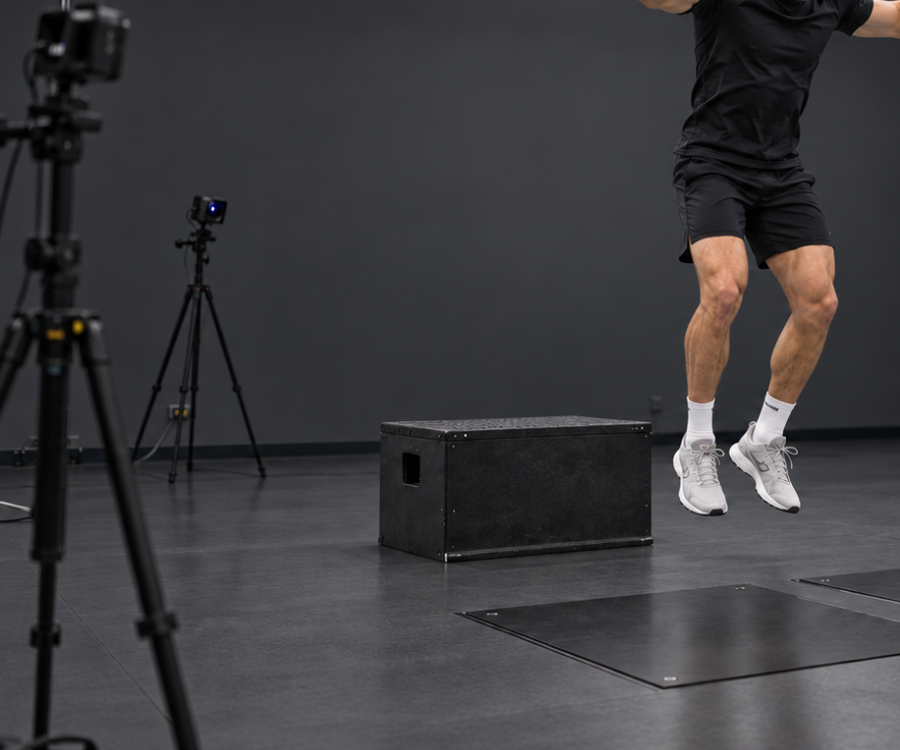
In-clinic movement was recorded in a research-dedicated hallway using a 10-camera markerless motion capture system operating at 60 Hz. Video data were processed in Theia3D and exported to Visual3D for the calculation of gait speed, stride characteristics, knee kinematics, and sit-to-stand measures.
The researchers then used hierarchical cluster analysis to identify groups of patients with similar mobility profiles. Two models were evaluated:
- Model 1 included all 56 participants.
- Model 2 included the 37 participants who successfully completed all in-clinic tasks, including the preferred-pace walk, fast-paced walk, and sit-to-stand assessment. Nineteen participants who were unable to complete the fast-paced walk and sit-to-stand were excluded from this model.
Key Findings
1. Two Mobility Profiles Emerged Across Both Models
Both analyses identified a smaller low-functioning cluster and a larger higher-functioning cluster.
In Model 1, the low-functioning cluster included 20 patients, compared with 36 in the higher-functioning group. Model 2 produced a similar result, with 10 and 27 patients in each cluster, respectively.
The low-functioning cluster generally reported poorer function and quality of life, walked more slowly during the in-clinic assessment, and demonstrated lower levels of free-living activity.
2. Differences Extended Beyond the Clinic
In Model 1, patients in the low-functioning cluster:
- Walked at an average preferred speed of 0.72 m/s, compared with 1.02 m/s in the higher-functioning group
- Accumulated approximately 2,779 daily steps, compared with 4,816
- Spent 88.7% of monitored time sedentary, compared with 82.2%
- Had longer free-living stride times
These findings show that the profiles reflected differences in both observed walking capacity and day-to-day mobility.
3. Markerless Motion Capture Revealed Differences Not Captured by Task Time Alone
The low-functioning cluster demonstrated lower knee-flexion magnitude and reduced knee-flexion range of motion during walking. The researchers interpreted this as a less-flexed or “stiff-knee” movement pattern.
The analysis also identified a knee-adduction pattern consistent with a varus-thrust-like strategy in the low-functioning cluster, although the strength and statistical significance of this finding varied between models and walking conditions.
During the sit-to-stand assessment, the low-functioning cluster used greater forward trunk flexion. However, the difference in total sit-to-stand time between clusters was not statistically significant.
This distinction illustrates the value of examining how a movement is performed rather than relying only on task duration or another single outcome.
4. “Higher Functioning” Did Not Mean Consistently High Function Across Every Domain
The researchers also examined whether patients in the higher-functioning cluster remained in the same performance tertile across self-reported function, in-clinic gait speed, and free-living stride time.
Only 11% of patients in Model 1 and approximately 15% in Model 2 remained in the same tertile across all three domains.
In practical terms, many patients who appeared higher functioning according to one measure did not rank similarly according to the others. Strong in-clinic performance did not necessarily correspond with greater daily activity or better perceived function.
What This Means for Biomechanics Researchers
The study demonstrates how markerless motion capture can be integrated with patient-reported outcomes and wearable-sensor data to investigate different dimensions of mobility.
For researchers, the findings reinforce several important considerations:
- A single mobility measure may not adequately characterize overall function.
- In-clinic performance should not automatically be treated as representative of daily activity.
- Joint-level kinematics can reveal movement strategies that may not be apparent from gait speed or task-completion time.
- Multidomain assessment may help researchers identify more nuanced participant subgroups and select outcomes that reflect the specific aspect of mobility being studied.
The study did not evaluate whether these mobility profiles predict surgical recovery or whether profile-based interventions improve outcomes. Longitudinal research is needed to determine how the identified profiles change following arthroplasty and whether they are associated with post-operative trajectories.
Study Considerations
The authors identified several limitations:
- The study was cross-sectional and cannot establish whether the mobility profiles predict future outcomes.
- All participants had moderate-to-severe knee osteoarthritis and were awaiting surgery, limiting generalizability to other populations.
- Model 2 included only 37 participants, with 10 in the low-functioning cluster. Clustering sample size guidance recommends 20-30 participants per cluster, which was therefore met in Model 1 but not Model 2.
- Differences in sex distribution and body mass index may have contributed to some of the mobility differences between groups.
- Several related mobility measures were included in the clustering models, which may have given some domains greater influence on the resulting profiles.
The clusters should therefore be understood as exploratory mobility profiles within this specific cohort rather than universal knee osteoarthritis classifications.
Read the Original Study
Di Bacco, V. E., Ruder, M. C., Madden, K., Adili, A., & Kobsar, D. (2026). Functional mobility profiles in pre-operative knee osteoarthritis patients: A cluster analysis of self-report, in-clinic, and free-living measures. Clinical Biomechanics, 136, 106821.
Bring Theia3D Into Your Research
This study demonstrates how Theia3D can be incorporated into a multidomain research protocol alongside patient-reported outcomes and wearable sensors.
Contact us today to discuss your study requirements and determine whether Theia3D is the right fit for your research.