



Summary
Warm-up programs must compete with technical, tactical, and physical training for limited practice time. This creates a practical incentive for programs that can address movement mechanics while also supporting sport-specific performance.
The Football+ program was developed with this dual purpose in mind. It combines dynamic mobility, strength and neuromuscular exercises with small-sided games, plyometrics, sprinting, and agility drills. In this study, researchers compared its effects with the established FIFA 11+ program and a traditional warm-up routine.
Importantly, the study evaluated biomechanical and performance outcomes, not injury incidence. Its findings should therefore not be interpreted as evidence that either program reduced the number of injuries.
Study Overview
The three-arm, cluster-allocated study initially enrolled 57 players from three German amateur women’s football teams. After exclusions and dropouts, the final analysis included 42 participants:
- Football+: 20 players
- FIFA 11+: 16 players
- Control: 6 players
Teams were allocated an intervention or lack thereof as a group rather than randomized individually for practical reasons. Both intervention groups completed their assigned 20- to 25-minute warm-up twice per week for 12 weeks, while the control team continued its usual warm-up routine. Biomechanical and performance assessments were completed before and immediately after the intervention. Performance was assessed again following a 10-week period without the assigned programs.
Biomechanical testing included:
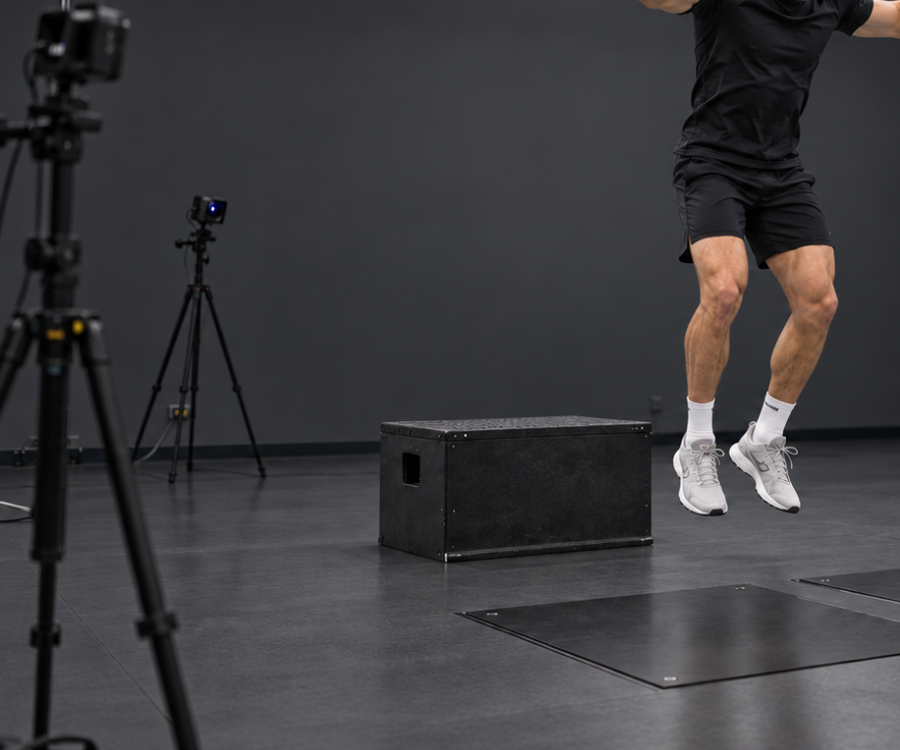
- Single-leg drop landings from a 30-centimetre box
- Approximately 45-degree cutting manoeuvres following a five-metre approach
- Three valid trials for each limb and task
The researchers captured the movements using 14 high-speed Qualisys video cameras operating at 200 Hz and two AMTI force plates operating at 1,000 Hz. QTM was used for calibration, synchronization, and export. Video recordings were processed with Theia3D, and subsequent biomechanical analyses completed in Visual3D.
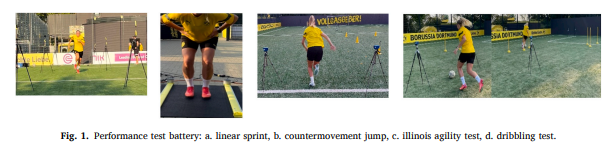
The primary measures included knee flexion and valgus angles, knee valgus moments, and vertical ground reaction force. Participants also completed tests of 20-metre sprinting, countermovement jump height, agility, and dribbling speed.
Key Findings
1. Football+ produced larger changes in several landing measures
During single-leg landing, Football+ generally produced larger changes than FIFA 11+, while the control group showed limited change.
Significant group-by-time effects included greater knee flexion at initial contact on the right side, movement toward a more neutral right knee valgus angle, and reduced vertical ground reaction forces on both sides. For example, right knee flexion at initial contact increased from 18.2° to 21.7° in the Football+ group, compared with 17.8° to 19.4° following FIFA 11+ and almost no change in the control group.
Not every measure changed significantly. Maximum knee flexion and several knee valgus moment outcomes remained relatively stable, demonstrating that the effects varied by variable and limb.
2. Cutting mechanics also changed following the interventions
During cutting, Football+ produced the largest changes across several frontal- and sagittal-plane measures.
These included increased knee flexion at initial contact, movement of knee valgus angles toward neutral, lower knee valgus moments at initial contact, and reduced vertical ground reaction forces. Changes were not uniform across every outcome or limb, highlighting the task- and side-specific nature of the intervention effects.
3. Football+ improved multiple performance outcomes
Significant group-by-time interactions favored Football+ for sprinting, agility, and dribbling:
- 20-metre sprint: 3.51 to 3.34 seconds
- Agility: 18.23 to 17.29 seconds
- Dribbling: 11.48 to 11.14 seconds
- Countermovement jump: 26.04 to 29.17 centimetres
Countermovement jump height improved in both intervention groups, although the difference between groups did not reach statistical significance. FIFA 11+ did not produce comparable improvements in sprinting, agility, or dribbling.
4. Performance gains were not maintained without continuation of the interventions
After the teams returned to their usual warm-up routines, the performance improvements were not statistically retained at the 10-week follow-up.
This suggests that the observed gains depended on continued exposure to the intervention rather than representing permanent adaptations after a single 12-week training period.
5. Both programs achieved high adherence
The Football+ and FIFA 11+ groups completed 96% of their scheduled intervention sessions. The researchers noted that warm-up activities represented approximately one-quarter of the teams’ total training exposure during the study.
This reinforces the practical importance of examining whether a warm-up can contribute to multiple training objectives within the same session.
What This Means for Biomechanics Researchers
This study demonstrates how markerless motion capture can be used to evaluate the effects of a training intervention across multiple tasks, limbs, and outcome types in real-world training environments.
The results also show why intervention studies should avoid relying on a single movement or metric. Changes varied between landing and cutting, between left and right limbs, and across individual kinetic and kinematic measures. Combining biomechanical outcomes with sport-specific performance testing provided a more complete view of how the programs affected the players.
Several limitations should be considered. The teams were not randomized, the control group was small, and the findings may not generalize beyond amateur female football players. The study also did not track injuries or establish whether the observed biomechanical changes translated into fewer injuries. Finally, the authors recommended caution when interpreting subtle differences in small joint angles and moments and called for further comparison with marker-based systems.
Read the Original Study
Asgari M, Hägglund M, Terschluse B, et al. “Alterations in knee biomechanics and motor performance following 3 months training with the Football+ and 11+ warm-up programs among amateur female players.” Journal of Exercise Science & Fitness. 2026;24:200463.
Interested in Using Markerless Motion Capture for Sports Biomechanics?
Learn how Theia3D can support synchronized, full-body biomechanical analysis across landing, cutting, running, and other sport-specific movements.
Contact our team to discuss your research.