


.png)

Summary
Disclaimer: The following summary details independent academic research. Theia3D is intended for research, sports performance and educational use only. It is not cleared as a medical device and is not intended to be used for the diagnosis, treatment, mitigation or prevention of any disease, injury or medical condition.
Editor’s note: The study was published in July 2026 and used Theia3D version 2023.1.0.3161. It did not evaluate the current Theia3D Apex release. The findings should therefore be interpreted as a comparison of the historical software versions tested, not as an assessment of current Theia3D performance.
Why This Matters
Most comparisons between partial knee arthroplasty (PKA) and total knee arthroplasty (TKA) have focused on patient-reported outcome measures or post-operative performance. Relatively few studies have examined joint-level biomechanics before surgery, making it difficult to determine whether the groups already move differently at baseline.
Preferred-speed walking may also be insufficiently demanding to reveal these differences. Asking participants to increase their walking speed requires them to adjust stride length and joint motion, potentially exposing differences in their capacity to adapt.
Understanding these pre-operative differences is important when interpreting post-operative outcomes. Without an objective baseline, movement patterns observed after surgery could be incorrectly attributed to the procedure alone.
Study Overview
The researchers conducted a secondary retrospective analysis involving 71 patients with end-stage knee osteoarthritis:
- 15 patients who received partial knee arthroplasty
- 56 patients who received total knee arthroplasty
Participants completed their assessments approximately one month before surgery. Patient-reported measures included the Oxford Knee Score, pain ratings, quality of life, and depression.
The biomechanical assessment included:
- 60 seconds of preferred-paced walking
- 30 seconds of fast-paced walking
- Five sit-to-stand repetitions
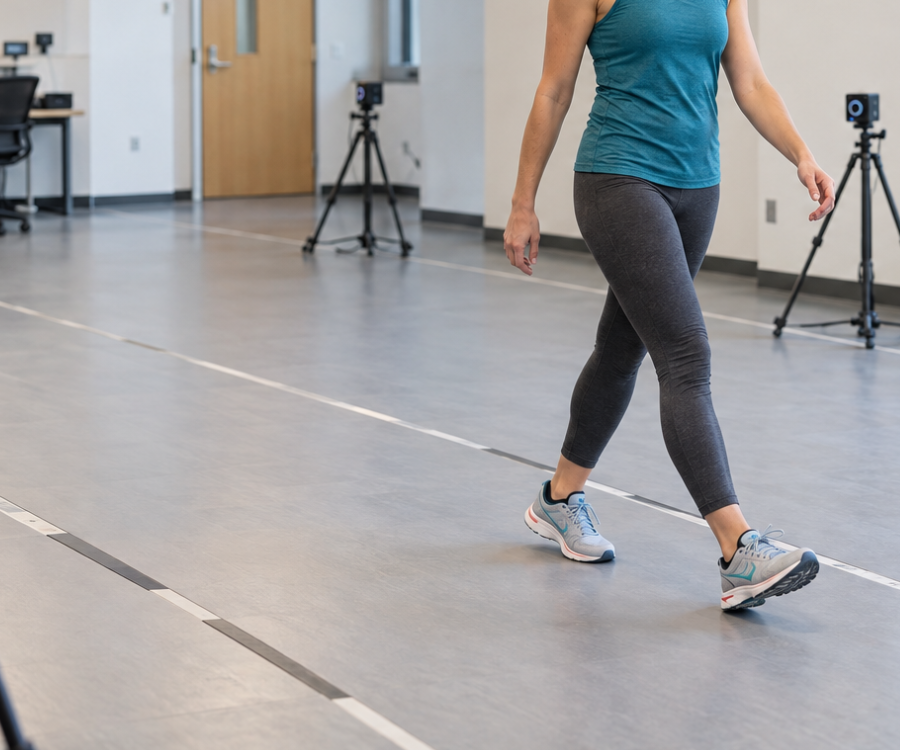
Walking trials took place along a 7.6-metre section of a hospital hallway. Movement was recorded using ten synchronized Sony RX0 II cameras and processed with Theia3D. Joint-level kinematics and spatiotemporal measures were then analyzed in Visual3D.
The researchers evaluated movement on the side scheduled for surgery, including gait speed, stride length, and sagittal-plane knee, hip, and ankle kinematics.
Key Findings
1. Patient-reported outcomes did not distinguish the groups
The PKA and TKA cohorts did not differ significantly in Oxford Knee Scores, pain ratings, quality of life, or depression.
This reinforces the study’s central premise: patients can report similar symptoms and function while still responding differently to increased movement demands.
2. Single-speed gait measures were similar
When preferred- and fast-paced walking conditions were considered individually, surgery type was not associated with significant differences in the measured spatiotemporal or joint-level gait variables.
Preferred-speed walking alone therefore did not identify clear biomechanical differences between the cohorts.
3. Differences emerged when walking speed increased
Both groups walked faster and increased their stride length during the fast-paced condition. However, the PKA group demonstrated significantly greater changes between preferred- and fast-paced walking in:
- Stride length
- Peak knee flexion during stance
- Peak knee flexion during swing
- Knee excursion
- Peak hip flexion during stance
- Overall hip range of motion
The PKA group also showed a greater increase in gait speed, although the difference did not reach statistical significance.
These results suggest that the PKA cohort may have a greater capacity to modify certain aspects of gait as walking speed increased. However, the study does not establish causality or define clinical thresholds for selecting an arthroplasty procedure.
4. Sit-to-stand performance did not differ
The researchers found no significant differences between groups in the time required to complete five repetitions, peak or minimum knee flexion, or peak trunk flexion.
In this cohort, sit-to-stand performance did not provide the same differentiation as the change between walking speeds.
What This Means for Biomechanics Researchers
The findings support evaluating how participants respond to changing task demands, rather than relying exclusively on performance under one standardized condition.
For knee osteoarthritis research, multi-speed gait assessment may help researchers:
- Establish more detailed pre-operative baselines
- Identify movement differences that remain hidden at habitual walking speeds
- Interpret post-operative changes relative to each patient’s starting point
- Examine adaptability alongside conventional patient-reported outcomes
The study also highlights the importance of task selection. A more demanding task is not automatically more informative: fast-paced walking distinguished the cohorts in several measures, while sit-to-stand did not.
The Role of Theia3D in Movement Analysis
Theia3D enabled the researchers to collect objective, joint-level kinematics during multiple functional tasks in a hospital hallway without attaching physical markers to participants.
This approach allowed preferred- and fast-paced walking to be assessed within a clinical environment while capturing changes at the knee, hip, and ankle across the gait cycle. Combining these measurements with patient-reported outcomes provided a more complete view of each cohort’s pre-operative function.
Study Limitations and Future Directions
The findings should be interpreted in the context of several limitations. The PKA group was smaller and significantly younger than the TKA group, although statistical models accounting for age, BMI, preferred gait speed, and change in gait speed did not meaningfully alter the results.
The analysis also grouped different forms of partial arthroplasty together, could not fully separate surgeon-related factors from procedure-related factors, and did not include all clinical measures used in surgical decision-making. Only pre-operative data was examined, and the analysis focused on discrete measures rather than full kinematic waveforms.
Future research could build on these findings by following patients after surgery, examining partial arthroplasty subtypes separately, incorporating detailed clinical selection criteria, and evaluating whether pre-operative adaptability is associated with post-operative changes.
Full Study and Further Reading
Shishis, M. R., Gafoor, F., Ruder, M. C., Di Bacco, V. E., Madden, K., Adili, A., & Kobsar, D. (2026). Investigating pre-operative joint-level biomechanics in partial versus total knee arthroplasty. Clinical Biomechanics, 137, 106877.
Read the full peer-reviewed study
Bring Theia3D Into Your Research
Interested in measuring joint-level biomechanics across walking speeds and other functional tasks? Contact our team to discuss your next study.