


.png)

Summary
Why This Matters
Jumping performance is central to basketball, influencing rebounding, shot blocking, layups, and overall athletic explosiveness.
Biomechanics researchers and performance teams rely on motion capture to understand:
- Joint angles during takeoff and landing
- Force production and joint torque
- Energy generation and transfer across the lower limbs
Traditional marker-based motion capture systems remain the gold standard, but these require reflective markers, lab environments, and extensive setup times.
Markerless motion capture offers a potential alternative by using synchronized video cameras and deep learning models to estimate 3D human movement without markers. If markerless systems can achieve comparable accuracy, they would enable biomechanical analysis in real-world sports environments, with larger athlete populations and reduced impact on athletes.
Study Overview
Researchers recruited 12 professional basketball players and captured three types of jumps:
- Standing Vertical Jump (SVJ)
- Standing Long Jump (SLJ)
- Running Vertical Jump (RVJ)
Athletes were recorded simultaneously using:
- Marker-based motion capture:
- 10 infrared cameras tracking reflective markers (Vicon system)
- Markerless motion capture:
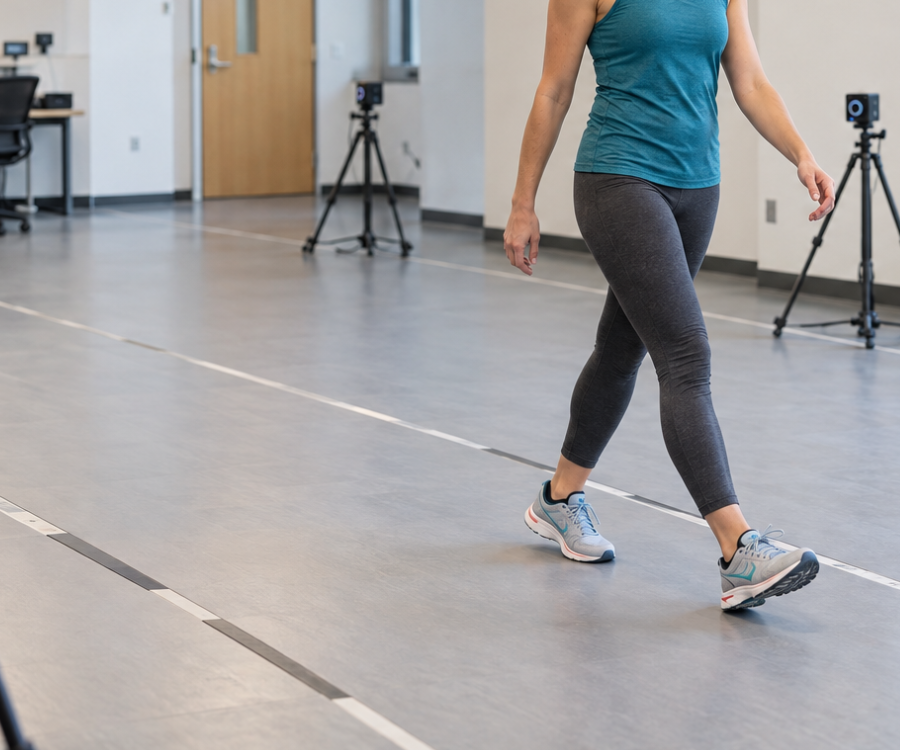
- 6 high-resolution video cameras (Teledyne FLIR), processed using Theia3D
Both systems were synchronized with force plates to measure ground reaction forces.
Researchers then calculated lower-limb biomechanics using Visual3D, including:
- Joint angles
- Joint torque
- Joint power
Statistical comparisons evaluated agreement between the two systems using:
- Pearson correlation coefficients (r)
- Root mean square difference (RMSD)
- Statistical parametric mapping (SPM) across movement phases
Key Findings
1. Strong agreement for knee and ankle biomechanics
Across all jumping movements, markerless and marker-based systems showed very strong correlations for knee and ankle measurements.
Typical agreement levels included:
- Knee and ankle joint angle, torque, and power correlations were all ≥ 0.92 (except knee torque during SLJ of 0.83)
- Small RMSD angle differences (approximately 2.6°–4.3°)
These results indicate that markerless motion capture can reliably estimate lower-limb biomechanics during explosive athletic movements.
2. Larger differences observed at the hip joint
While agreement remained high overall, the hip joint showed greater variability between systems.
Researchers reported:
- Hip joint RMSD up to 8.2°
- Statistically significant differences during certain phases of the jump
The study suggests this discrepancy may be related to:
- Soft-tissue movement around the pelvis
- Rapid hip flexion during jumping
- Challenges in estimating hip joint centers in biomechanical models
3. Joint torque and power estimates were also comparable
Markerless systems produced similar estimates for joint kinetics, including torque and power.
For example:
- Joint torque RMSD was generally ≤ 0.41 N·m/kg
- Joint power RMSD remained ≤ 1.76 W/kg
The ankle joint showed the highest agreement, while hip torque and power estimates displayed slightly larger variability during fast movements.
4. Most differences occurred during rapid hip motion
Researchers observed that differences between systems increased during high-speed hip movements, particularly at peak flexion.
These differences may stem from:
- Skin-to-bone motion artifacts
- Motion blur in video capture
- Model assumptions used to estimate hip joint centers
What This Means for Sports Biomechanics
This study reinforces a growing body of research showing that markerless motion capture can achieve research-grade biomechanical analysis for many movement tasks.
For sports science and performance teams, this has several important implications.
1. More realistic athlete testing
Markerless systems allow motion capture outside traditional biomechanics labs, enabling analysis in training facilities, practice environments, and sport-specific settings.
2. Faster data collection
Markerless capture eliminates the need for reflective markers and complex setup, making it easier to analyze larger athlete populations.
3. Reliable lower-limb analysis
For movements such as jumping, markerless systems can accurately capture key metrics at the knee and ankle joints, which are critical for performance and injury analysis.
4. Continued research needed for hip dynamics
The hip joint remains the most challenging segment to model accurately. Future research may use advanced imaging techniques to further validate hip measurements.
Overall, the findings suggest markerless motion capture is a promising tool for large-scale biomechanical analysis in sports environments.
Read the full study here.
Interested in Markerless Motion Capture for Sports Biomechanics?
Contact us today to learn how Theia3D enables accurate 3D biomechanical analysis without markers.