

.png)

Summary
Editor’s Note: Theia3D is intended for research and human performance analysis and is not cleared as a medical device.
Why This Matters
Static postural control is commonly evaluated using center-of-mass (COM) and force plate measurements. However, the equipment, installation and personnel requirements associated with traditional systems can make them difficult to deploy outside dedicated laboratory environments.
This study examined whether Theia3D could estimate center-of-mass movement from video with sufficient validity and repeatability for postural control research. It also tested a realistic challenge for markerless systems: partial occlusion caused by a second person standing nearby to provide simulated clinical supervision.
Study Overview

The study included 53 healthy adults who completed two testing sessions approximately one week apart.
Participants performed three quiet-standing tasks adapted from the Berg Balance Scale:
- Feet apart with eyes open for 30 seconds
- Feet apart with eyes closed for 10 seconds
- Feet together with eyes open for 60 seconds
Each task was completed alone and with another person standing nearby in a position that simulated standby supervision.
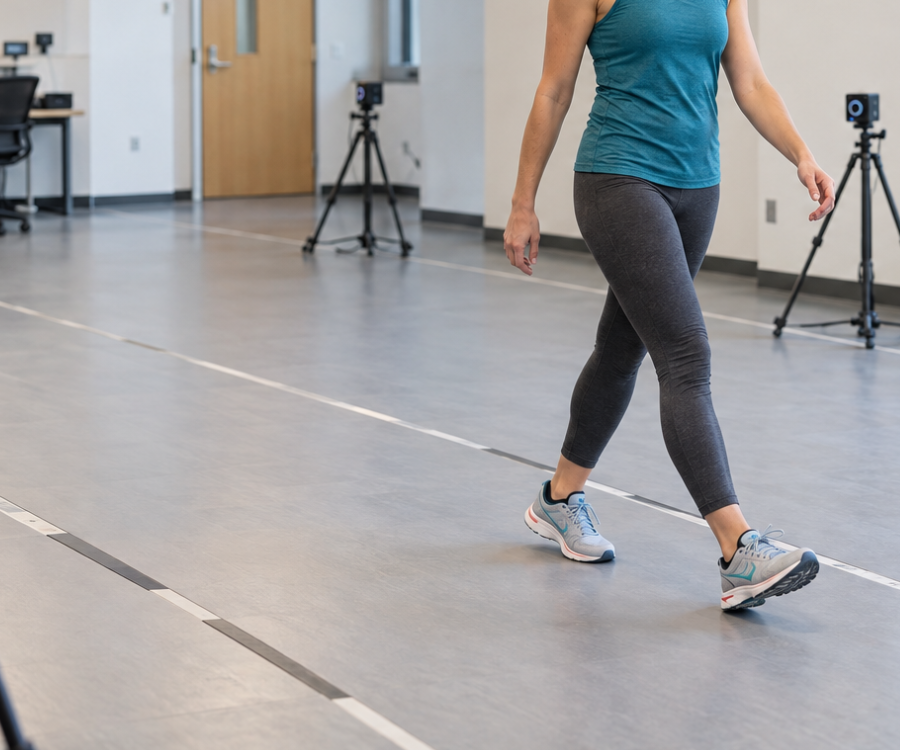
Movement was recorded using eight synchronized Sony RX0 II cameras and processed in Theia3D. The researchers compared the center of mass of the pelvis segment estimated by Theia3D against the gravity line projection (GLP) calculated from force plate data.
Key Findings
Strong agreement with force plate measurements
Theia3D and force plate signals demonstrated good-to-excellent agreement across every task, direction and supervision condition.
- Mean correlations ranged from 0.94 to 0.99 when participants stood alone
- Mean correlations ranged from 0.89 to 0.99 with another person nearby
- Differences between the positional signals remained below 0.13 cm across conditions
These findings indicate that Theia3D accurately captured the small center-of-mass movements associated with quiet standing.
Several measures demonstrated strong repeatability
Test–retest reliability was strongest when participants completed the tasks alone. The most reliable measures were:
- 95% confidence ellipse area: ICCs of 0.75–0.89
- Mediolateral path length: ICCs of 0.63–0.84
These parameters describe the area and distance covered by the center of mass as a participant sways during quiet standing.
Supervision affected reliability more than validity
Signal agreement with the force plate remained strong when another person stood nearby. However, test–retest reliability declined for most discrete center-of-mass parameters under the ‘accompanied’ condition.
The researchers noted that partial occlusion due to the secondary person may have introduced additional COM measurement variability. Interestingly, reliability also declined in several force plate-derived parameters, suggesting that the presence of another person may have subtly changed how participants controlled their posture, not simply how Theia3D tracked them.
Most measures remained associated across conditions
Most center-of-mass parameters were positively correlated between the unaccompanied and accompanied conditions. Path-length measures demonstrated the strongest associations, with correlations reaching 0.81. This suggests that Theia3D continued to capture meaningful differences between participants even when simulated supervision was present.
What This Means for Researchers
The results support Theia3D as a valid tool for measuring center-of-mass movement during static postural control tasks.
For longitudinal or repeated-measures studies, researchers should carefully standardize whether another person is present, along with their position relative to the participant. Measures such as confidence ellipse area and mediolateral path length may be especially useful when repeatability is a priority.
By estimating full-body kinematics from synchronized video, Theia3D may also allow researchers to examine postural control alongside broader movement strategies within the same collection environment.
Limitations and Next Steps
The study primarily included healthy, university-aged adults, so the results should not yet be assumed to generalize to older adults or clinical populations. The researchers also used the pelvis segment center of mass as a surrogate for total-body center of mass because it was more robust to occlusion, and they found strong correlations and minimal differences between the two signals.
Future studies should evaluate validity and reliability directly within clinical populations and across dynamic, proactive and reactive postural control tasks.
Full Study and Further Reading
Read the full study:
Wijekoon et al., Journal of Biomechanics, 2026. DOI: 10.1016/j.jbiomech.2026.113371.
Interested in Markerless Motion Capture for Postural Control Research?
Contact us to discuss your study requirements and see whether Theia3D is the right fit for your research protocol.