Summary
Why This Matters
Markerless motion capture makes it possible to collect biomechanical data more easily and more frequently during tasks associated with injury risk, such as single-leg squats and landings. However, for this data to be useful in practice, measurements must be reliable across testing sessions.
Between-day reliability is especially important for athlete monitoring and rehabilitation, where practitioners need to distinguish true biomechanical change from normal measurement error. Without reliable measurements, it becomes difficult to interpret whether changes in movement patterns reflect adaptation, recovery,or simply noise in the data.
This study directly addresses a critical question for sports scientists and clinicians: Can markerless motion capture reliably quantify trunk and lower-limb kinematics during single-leg tasks across multiple days?
Study Overview
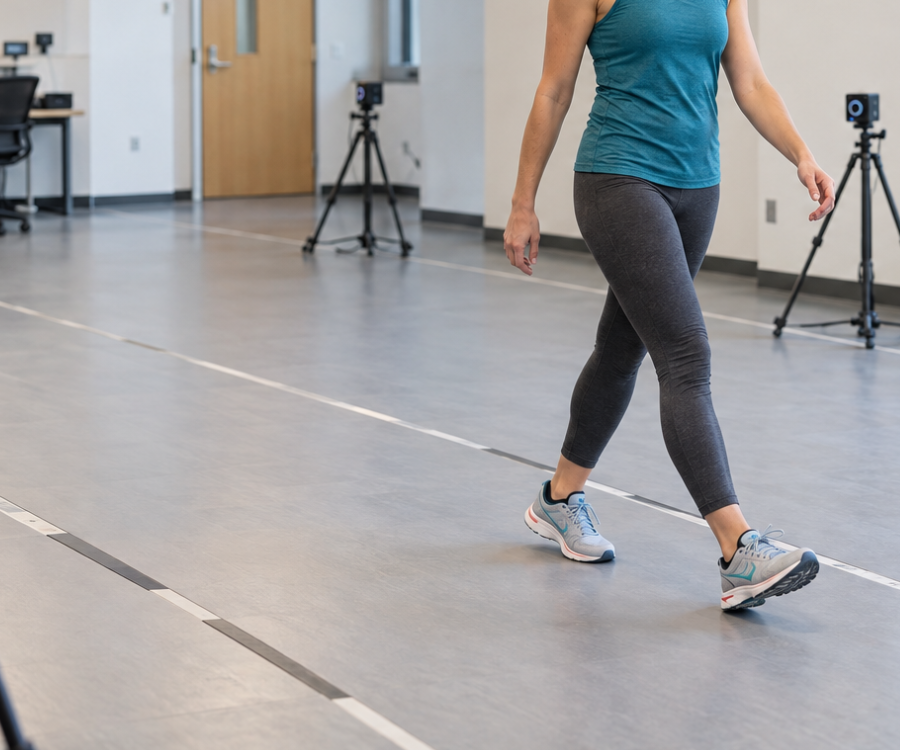
This study assessed the between-day reliability of trunk and lower-limb kinematics during single-leg squat and single-leg landing tasks using markerless motion capture with Theia3D (v2022.1.0.2309). A secondary, independent study evaluated the same protocol using a traditional marker-based motion capture system.
Markerless Motion Capture
- Participants: 19 recreational athletes
- Testing sessions: Two sessions, one week apart
- System: 8-camera Qualisys Miqus video setup
- Sampling rate: 100 Hz
Marker-Based Motion Capture
- Participants: 10 different recreational athletes
- Testing protocol: Identical tasks and procedures
- System: 10-camera Qualisys Oqus motion capture system
- Sampling rate: 100 Hz
Importantly, the markerless and marker-based systems were evaluated independently using different participant groups, providing a fair comparison of each technology’s ability to reliably measure biomechanical variables relevant to athlete monitoring.
Tasks Assessed
- Single-leg squat (SLS)
- Forward single-leg landing
- Medial single-leg landing
Analysis Approach
- Full-curve analysis using root mean square difference (RMSD)
- Discrete-point analysis at clinically relevant events (initial contact and peak knee flexion)
- Reliability quantified using intraclass correlation coefficients (ICC), standard error of measurement (SEM), and minimal detectable change (MDC)
- Statistical parametric mapping (SPM) used to identify systematic differences across movement curves
Key Findings
Low Measurement Error Across Most Variables
Markerless motion capture using Theia3D demonstrated acceptable absolute reliability, with RMSD and SEM values below 5° for most joints and planes across both single-leg squat and landing tasks.
Hip flexion was the notable exception, showing higher between-day error (approximately 5–7°). Importantly, this pattern was observed across both markerless and marker-based systems, indicating a task and joint-specific challenge rather than a limitation unique to markerless motion capture.
Moderate to Good Relative Reliability
Relative reliability for markerless motion capture was moderate to good across tasks:
- Single-leg squat: mean ICC = 0.77
- Forward landing: mean ICC = 0.83
- Medial landing: mean ICC = 0.80
Most kinematic variables met or exceeded accepted thresholds for clinical and sports science applications. Hip rotation in the transverse plane during single-leg squat showed lower ICC values, a finding the authors note should be interpreted alongside absolute reliability metrics such as SEM.
Strong Reliability During Landing Tasks
Landing tasks, which are closely associated with non-contact injury mechanisms, showed particularly strong results. Markerless motion capture demonstrated low SEM and MDC values for key variables such as knee flexion and knee abduction at initial contact and peak knee flexion.
Compared to other literature that examined the reliability of kinematics during single-leg landing tasks from alternative markerless motion capture solutions, the authors found the current results from Theia3D to have lower SEM and MDC values.
Comparable Performance to Marker-Based Motion Capture
When the same protocol was applied, markerless motion capture showed similar or slightly lower between-day measurement error compared to the marker-based system, with 57 out of 80 discrete variables included across all movements and discrete timepoints showing lower SEM and MDC values. Marker-based motion capture exhibited comparable reliability overall, with hip flexion again showing the greatest error across both technologies.
These findings suggest that markerless motion capture can achieve reliability on par with or better than traditional lab-based systems, while avoiding errors associated with marker placement and reducing setup burden.
What This Means for Sports Scientists, Clinicians, and Researchers
This study demonstrates that Theia3D can reliably capture trunk and lower-limb kinematics during single-leg tasks commonly used for screening, rehabilitation, and return-to-play monitoring. The low measurement error supports regular, repeat testing, where detecting meaningful biomechanical change over time is critical.
Because reliability was comparable to a marker-based system, despite being evaluated independently with different participants, these results support the use of markerless motion capture as a practical solution for athlete monitoring workflows, particularly in settings where speed, scalability, and reduced setup complexity matter.
Study Limitations
- Data were collected in a controlled laboratory environment, not in field-based settings
- Only squatting and landing tasks were assessed; movements such as running and cutting were not included
- Findings are specific to Theia3D v2022 and should not be generalized to all markerless motion capture systems
These limitations highlight important areas for future research particularly the ecological validity of markerless motion capture in real-world sports environments.
Read the full study here.
Interested in Reliable Markerless Athlete Monitoring?
If you’re evaluating motion capture tools for injury screening, rehabilitation tracking, or performance monitoring, Theia3D provides validated, repeatable biomechanics data without markers or wearables.
Contact us today to learn how markerless motion capture can fit into your workflow.
