


Summary
Disclaimer: The following summary details independent academic research. Theia3D is intended for research, sports performance and educational use only. It is not cleared as a medical device and is not intended to be used for the diagnosis, treatment, mitigation or prevention of any disease, injury or medical condition.
Editor’s Note: This study was published in December 2025 and evaluated Theia3D software versions released in 2020 and 2023. It did not evaluate the current Theia3D Apex release. The findings should therefore be interpreted as a comparison of the historical software versions tested, not as an assessment of current Theia3D performance.
Why This Matters
To date, most comparisons between markerless and marker-based motion capture have focused on walking, running or other primarily lower-limb movements. Throwing presents a different challenge: it combines rapid, coordinated motion across the lower body, trunk and upper extremities, with the shoulder, elbow and wrist being the segments of primary interest during the movement sequence.
This study extends the evidence base into a more complex sports task - simulated basketball shooting. It also compares two generations of Theia3D software, demonstrating the differences and improvements to pose estimation that can be achieved over time.
This study provides a clear examination of the kinematic measurements from both systems, their differences, and the changes seen in those differences between two software versions. Inherent to many of these comparisons are challenges in interpreting the differences, as there are known issues associated with both of the unique measurement modalities. The study should therefore not be interpreted as evidence that the two systems are interchangeable. Instead, it helps identify where agreement improved, where meaningful differences remained and why software versions must be documented for transparent reporting of motion capture results.
Study Overview
Researchers from TU Dortmund University recruited 13 healthy adults. No previous experience was required:
- Six female and seven male participants
- Mean age of approximately 30 years
- Forty-seven (47) retroreflective markers attached, based on a Cleveland marker set
- Five simulated basketball throws per participant, for 65 total trials
Participants performed five trials of a simulated basketball throwing motion (i.e. without a ball) because the laboratory could not accommodate full ball trajectories. Removing the ball also reduced variability and avoided marker occlusion, although it may have affected the natural coordination and timing of the movement.
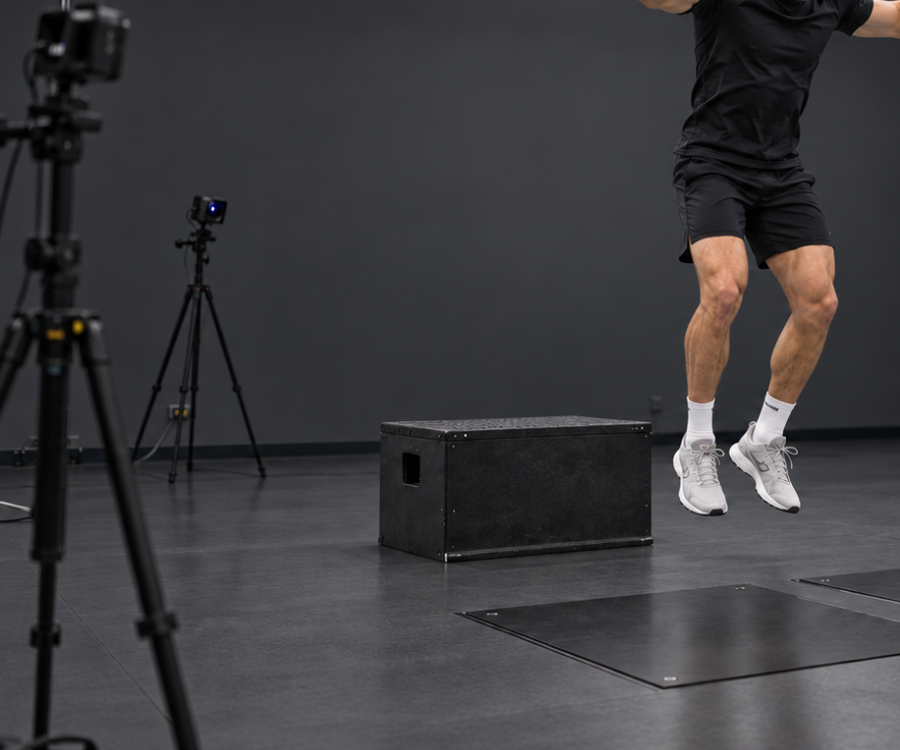
Motion was recorded simultaneously using:
- Marker-based: A 12-camera Qualisys Oqus infrared system
- Markerless: Ten Qualisys Miqus video cameras processed separately using Theia3D 2020.6.0.1106 and Theia3D v2023.1.0
- Sampling rate: Both systems recorded at120 Hz
- Analysis: Visual3D using separate skeletal models with corresponding segment definitions
The researchers examined knee, hip, shoulder, elbow and wrist flexion in the sagittal plane. Each throw was analyzed from initial ball elevation, defined as maximum elbow flexion, through the simulated release and 10 subsequent frames.
System differences were evaluated using root mean square distance (RMSD) across the joint-angle trajectories. Intraclass correlation coefficients (ICC) were also calculated for maximum flexion angles.
Key Findings
1. The newer software version reduced differences for several joints
Compared with Theia v2020, Theia v2023 produced lower RMSD values relative to the marker-based system for three of the five joints examined:
- Hip flexion: RMSD decreased from 13.24° to 8.17°
- Elbow flexion: RMSD decreased from 22.22° to 16.68°
- Wrist flexion: RMSD decreased from 26.66° to 18.05° after outlier removal. Including all 65 trials produced an RMSD of 19.58° for Theia v2023.
These results indicate that the version used can materially affect the magnitude of agreement between marker-based and markerless motion capture observed in a comparison study.
2. Knee flexion showed the closest agreement
Knee flexion produced the lowest RMSD values in the study, with nearly identical results for the two markerless versions:
- Theia v2020 versus marker-based: 7.17° ± 3.88°
- Theia v2023 versus marker-based: 7.20° ± 5.79°
Maximum knee flexion also showed high agreement, with ICC values of 0.914 for Theia v2020 and 0.920 for Theia v2023 compared with the marker-based system.
3. Improvements were not consistent across every joint
Shoulder flexion did not follow the same RMSD pattern. Theia v2020 produced an RMSD of 10.13° ± 5.04°, compared with 13.51° ± 6.19° for Theia v2023. The authors noted that the newer-version shoulder values required a correction and further validation.
Agreement in maximum shoulder flexion improved modestly from an ICC of 0.693 to 0.714. This illustrates why performance should be evaluated joint by joint and metric by metric rather than summarized as a single system-wide result.
4. Upper-extremity differences remained substantial
The largest differences between systems occurred at the elbow and wrist. Although elbow RMSD improved with Theia v2023, it remained 16.68°. Wrist maximum flexion showed poor agreement for both markerless versions, with ICC values below 0.3.
The authors concluded that the differences were too large to support direct comparison of subtle upper-extremity joint-angle differences between the systems for the simulated throwing task studied. They recommended avoiding direct comparisons of absolute kinematic values across systems and placing greater emphasis on relative changes measured within a consistent system and workflow.
5. Differences cannot be attributed to one system alone
The marker-based and markerless pipelines used separate skeletal models and different approaches to estimating segment and joint positions. Marker-based data can also be affected by marker placement, soft-tissue movement and joint-center definitions.
As a result, the observed RMSD values do not isolate error in either system. They reflect the combined effects of the measurement technology, biomechanical model, processing choices and individual movement strategy.
6. Software version is an important reporting detail
The authors specifically recommended documenting the software version used in publications. This is especially important for AI-based markerless systems, where pose-estimation and biomechanical-processing methods can change and improve substantially between releases.
Because this study analyzed Theia v2020 and v2023, its numerical results describe those historical versions and should not be treated as a performance evaluation of the current Theia3D Apex v2026 release.
What This Means for Biomechanics Researchers
For researchers planning complex sports-movement studies, this work reinforces several practical considerations:
- Validate the specific joints, planes and outcome measures required for the intended task
- Avoid assuming that performance demonstrated during gait will generalize to rapid upper-extremity movement
- Use the same software version and analysis pipeline when comparing participants, sessions or conditions
- Exercise caution when comparing absolute joint-angle values across different motion capture systems
- Report the software version, biomechanical model and processing choices clearly to support reproducibility
The study also demonstrates why validation is not a one-time exercise. As markerless systems evolve, updated research using current software versions and sport-specific movements is needed to understand how performance changes.
Study Considerations
- The study included 13 healthy adults rather than trained basketball players.
- Participants performed simulated throws without a basketball, which standardized the task but may have changed natural coordination and timing.
- The analysis was limited to sagittal-plane flexion at five joints and does not describe performance across all movement planes or throwing variables.
- The marker-based and markerless pipelines did not use identical biomechanical models, limiting attribution of differences to either measurement system.
- The study evaluated Theia3D software released in 2020 and 2023, not the current Theia3D Apex release.
Read the Original Study
Thomas, C., Nolte, K., Schmidt, M., & Jaitner, T. (2025). Comparison of Marker-Based and Markerless Motion Capture Systems for Measuring Throwing Kinematics. Biomechanics, 5(4), 100. https://doi.org/10.3390/biomechanics5040100
Bring Theia3D Into Your Sports Research
Planning a sports-biomechanics study involving complex movement? Theia3D supports synchronized, multi-camera capture without reflective markers or specialized suits.
Contact our team to discuss your movement, camera setup and analysis requirements.