



Summary
Sports organizations adopting markerless motion capture for real-world use often face two practical questions before they trust it: does camera placement have to match a lab-perfect setup, and is an experienced operator required to obtain high quality data? A team at Emory Sports Performance and Research Center, funded by the National Basketball Association, tested both questions directly, recording 11 competitive athletes performing four common jumping and cutting tasks with three simultaneous camera systems: an industry-standard marker-based system, and two identical Theia3D markerless setups mounted at different heights.
Disclaimer: The following summary details independent academic research. Theia3D is intended for research, sports performance and educational use only. It is not cleared as a medical device and is not intended to be used for the diagnosis, treatment, mitigation or prevention of any disease, injury or medical condition.
Editor’s Note: This study used Theia3D version 2023.2.0.4205.
Why This Matters
Markerless motion capture is frequently praised for removing the marker-placement step that adds time and human error to traditional systems, but camera setup itself has stayed a less-examined variable. Facilities vary widely in ceiling height, room size, and available mounting points, and staff running these assessments range from strength and conditioning coaches with no motion capture background to PhD biomechanists. This study is among the first to directly test whether markerless kinematic data holds up when camera height changes substantially, and whether inexperienced users can produce reliable results without significant dedicated training.
Study Overview
Design
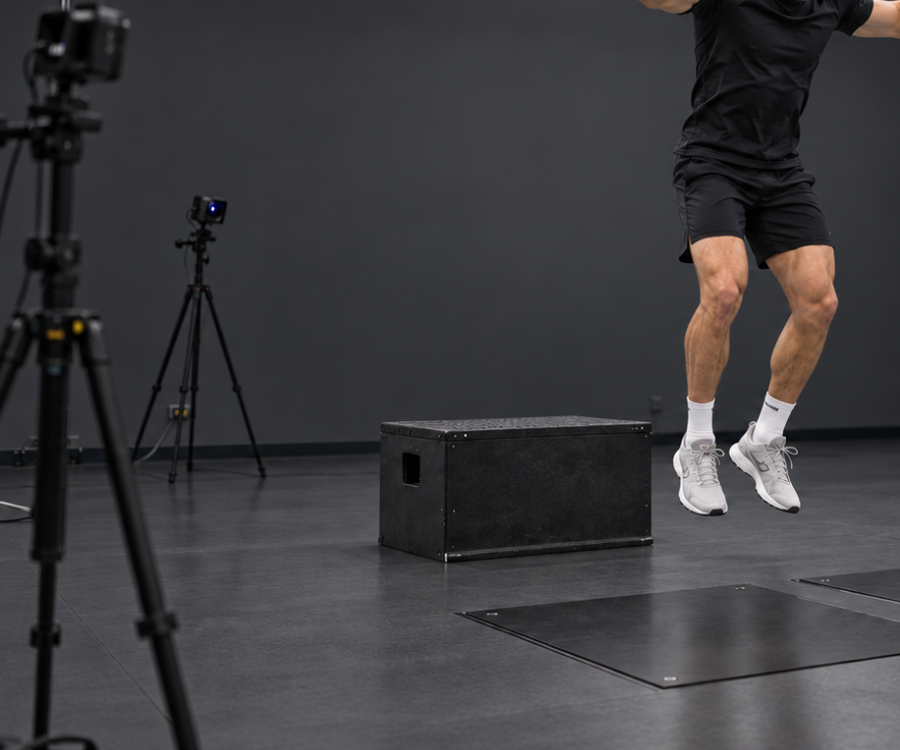
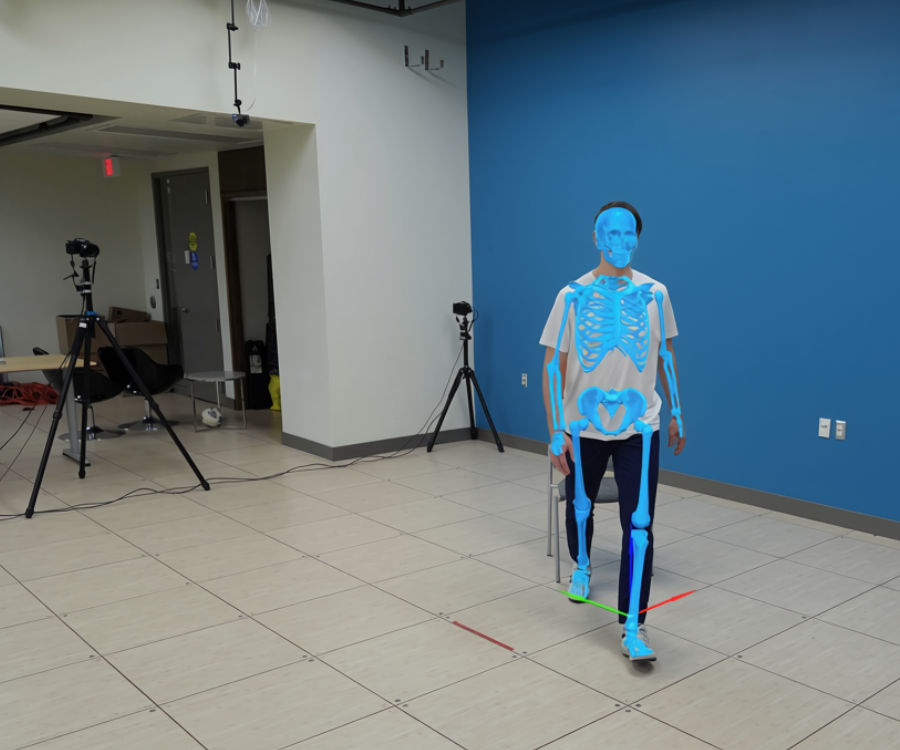
Three motion capture systems recorded each movement simultaneously and were synchronized to floor-embedded force plates: a marker-based system using 20 truss-mounted cameras and 41 reflective markers, one markerless system mounted on the same trusses (approximately 3 meters high), and a second identical markerless system mounted on tripods (1.4 meters high). All markerless video was processed through Theia3D v2023.2.0.4205.
Participants
11 competitive athletes (6 male, 5 female; mean age 22.2 years) were intentionally recruited to represent a wide range of height (1.55 to 2.08 meters) and skin tone across the Fitzpatrick scale, reflecting the diversity of athletes in professional sports settings.
Movement Tasks
Each participant completed five repetitions of four tasks commonly used for athlete profiling and injury-risk screening: squat jump, single-leg squat jump, 45-degree side-step cut, and drop vertical jump.
Usability Testing
Two novice and two experienced motion capture users operated the markerless system and rated it on ease of use and confidence.
Key Findings
Camera height did not meaningfully affect markerless data quality. Comparing the tripod-mounted and truss-mounted markerless systems against each other, the study found excellent agreement (mean ICC of 0.94) with a mean error of under 2 degrees across all joint angles and tasks. The 1.6-meter difference in mounting height did not significantly change reliability or error.
Markerless kinematics showed moderate-to-good accuracy against the marker-based gold standard. Both markerless configurations produced comparable results relative to the marker-based system, with a mean correlation (Pearson's r) of about 0.74 and error that dropped to roughly 3 degrees per joint after accounting for known systematic bias between systems.
The largest source of error was hip flexion angle, not the markerless technology's tracking itself. The authors attribute most of this discrepancy to differing methods for defining the hip joint center and pelvis orientation between systems, a known modeling difference in the field rather than a limitation specific to markerless motion capture.
Editor’s note: Modelling changes were implemented in Theia3D Apollo v2024 that partially aimed to address these known pelvis differences - see further discussion of these changes in our blog post from that software update.
Camera mounting position had no significant effect on accuracy relative to the marker-based system. Whether markerless cameras were placed at 1.4 or 3 meters, accuracy against the industry-standard system stayed consistent.
Both novice and experienced users rated the system highly for ease of use and confidence. Participants without prior motion capture experience were able to operate the system with relative ease, a notable finding for organizations without a dedicated biomechanics staff.
What This Means for Sports Performance and Athlete Assessment
For teams and facilities considering markerless motion capture for jump-landing or cutting-task assessments, this study offers a practical reassurance: camera placement does not need to match a rigid, lab-specific configuration to produce reliable data, and staff do not need prior motion capture expertise to run the system competently and produce high quality data. That combination lowers two of the most common adoption barriers, physical space constraints and specialized staffing, for programs looking to add objective movement screening to athlete health and performance monitoring.
The Role of Theia3D in Movement Analysis
This study is a direct test of one of markerless motion capture's core promises: flexibility in real-world deployment. By comparing camera systems mounted at two different heights and processing all trials through Theia3D, the authors showed that the technology tolerates meaningful variation in setup without sacrificing the precision needed for athlete assessment. Combined with the usability findings, the results support markerless motion capture as a practical option for professional and collegiate sports settings where dedicated lab space, lab-grade camera rigs and dedicated technicians are not always available.
Study Limitations and Future Directions
The authors note several constraints worth keeping in mind. The sample was small (11 athletes), and while it was intentionally diverse in height and skin tone, broader validation across larger and more varied cohorts is still needed. Hip and pelvis joint center definitions differ between markerless and marker-based systems, which the authors flag as an ongoing challenge for the field rather than something specific to this study. The authors also caution that results are tied to the specific Theia3D software version used, and that accuracy findings from earlier studies may not transfer directly to current or future versions as the software continues to be updated.
Full Study and Further Reading
Citation: Kwak, S.T., Riehm, C.D., Anand, M., Raphael, N., DiCesare, C.A., Schille, A., Hulburt, T.C., Zendler, J.M., Hybart, R.L., Buria, K.N., Trotter, N., & Myer, G.D. (2026). Assessing agreement and usability of kinematic measures between markerless and marker-based motion capture systems during jumping activities. Journal of Biomechanics, 194, 113065.
Link: Read the full study
Building a Jump-Landing or Injury-Risk Screening Program?
This study shows that flexible camera placement and ease of use do not come at the cost of accuracy. If you're evaluating markerless motion capture for athlete profiling or injury-risk assessment, talk to our team about what a setup looks like in your facility.