



Summary
Disclaimer: The following summary details independent academic research. Theia3D is intended for research, sports performance and educational use only. It is not cleared as a medical device and is not intended to be used for the diagnosis, treatment, mitigation or prevention of any disease, injury or medical condition.
Editor’s Note: This study used Theia3D version 2022.0.2309.p20.
Why This Matters
Ski jumping research has generally compared athletes by skill level or looked for a single best technique during the critical early flight window. But prior studies have also noted that jumpers with similar skill levels can show meaningfully different movement patterns, and treating continuous movement data as a single average risks flattening that variation rather than explaining it. This study set out to classify movement strategies directly from the kinematic data itself, rather than assuming everyone should move the same way.
It also matters for a more practical reason. Ski jumping is a difficult environment for any motion capture system: athletes wear helmets and loose-fitting suits that obscure landmarks, skis interfere with lower-body tracking, and outdoor field conditions don't allow the controlled camera angles a lab provides. This is one of the first studies to apply markerless capture to ski jumping's early flight phase under real, outdoor field conditions rather than in a lab.
Study Overview
Design
A field-based observational study conducted at the Miyanomori Ski Jumping Stadium in Sapporo, Japan, a K-point 90 meter, Hill Size 100 meter competition hill. Data were collected across six sessions between October 2022 and July 2024, using a ceramic in-run track for summer training conditions.
Participants
30 ski jumpers (23 male, 7 female; mean age 21.5 years), spanning junior (18 and under) and senior categories, and national and international competitive levels.
Data Collection
Ten synchronized cameras recorded each jump at 120 frames per second, covering roughly a 10-meter section of the hill around the takeoff table. Video was processed through Theia3D and exported to Visual3D for analysis. The study focused on three variables during the early flight phase (from takeoff to 0.2 seconds after): trunk anterior-posterior tilt, hip flexion-extension, and knee flexion-extension, measured on the right leg under an assumption of bilateral symmetry. Only jumps that reached at least the K-point were included.
Analysis
The team applied a combination of statistical methods on the biomechanical signals in Sift, including principal component analysis to reduce each joint's movement waveform to its dominant patterns, then applied hierarchical clustering to group athletes by shared coordination characteristics. Statistical parametric mapping was used to confirm which parts of the movement genuinely differed between the resulting groups, rather than relying on single-point comparisons.
Key Findings
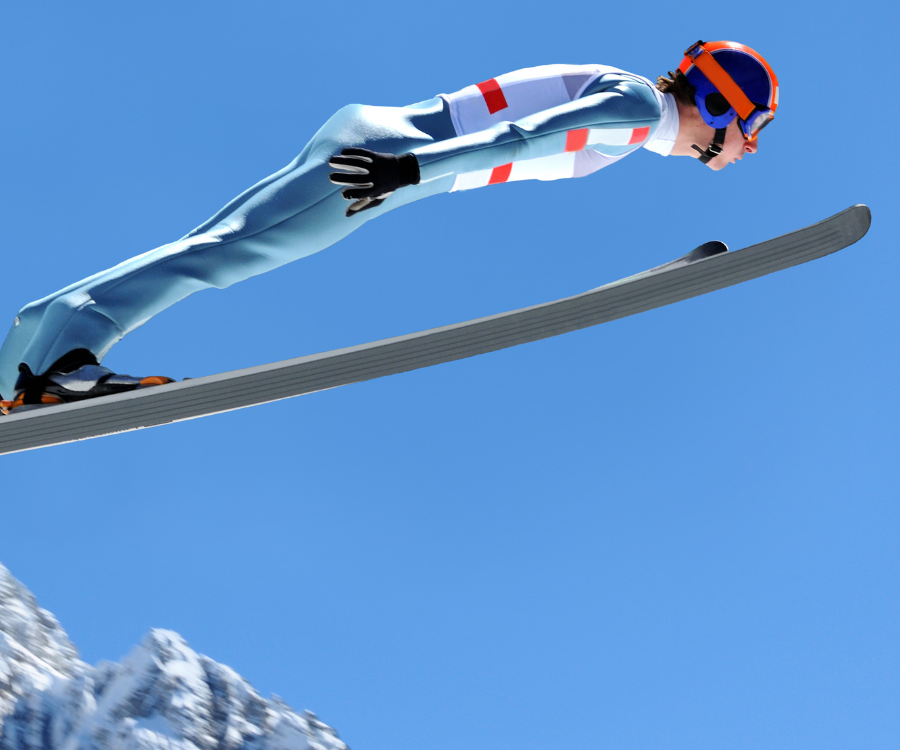
Three early flight strategies emerged, with distinct biomechanical patterns. Clustering split the 30 jumps (i.e. 30 athletes) into three groups of 8, 9 and 13 athletes with clearly different coordination patterns across the trunk, hip, and knee.
Cluster 2 prioritized a fast, extended posture. These athletes (all senior males) started from a shallower flexed position and extended their trunk, hip, and knee quickly, reaching an extended whole-body configuration earlier in the flight window. This pattern lines up with prior aerodynamic research showing that a rapid extension right after takeoff can produce a sharp early rise in lift.
Cluster 3 prioritized a compact, gradual posture. These athletes held a flatter trunk position and extended more slowly from deeper flexion, consistent with a strategy aimed at a streamlined body shape and stable airflow rather than a quick transition to full extension.
Cluster 1 combined elements of both, distinguished mainly by hip movement. This group's trunk and knee kinematics closely resembled Cluster 2's rising, quick-extension pattern, but its hip movement followed its own distinct path rather than simply sitting between the other two clusters. This group also included the widest mix of junior and senior, national and international athletes.
All three strategies were associated with jumps that reached the K-point. Because every analyzed trial met the same distance threshold, the study frames these as three different, viable coordination patterns rather than a ranking from worse to better technique.
Differences between clusters were not explained by approach speed. In-run speed did not differ significantly between the three groups, and the cluster differences held up even after statistically accounting for speed, supporting the conclusion that these are genuine coordination differences rather than an artifact of how fast athletes were going into the jump.
What This Means for Coaches and Researchers
For coaching and technique evaluation, the core takeaway is that there isn't a single correct early flight posture to train toward. Instead, this kind of data-driven classification gives coaches a way to describe which strategy an athlete is actually using, track how it evolves over a season, and have more specific technical conversations than "extend more" or "get flatter." For researchers, the study is also a demonstration of a method for extracting distinct, interpretable combinations of biomechanical patterns that contribute to the overall coordination of a movement: combining waveform-level PCA with clustering and statistical parametric mapping to classify movement strategies objectively, without collapsing rich time-series data down to single numbers too early in the analysis.
The Role of Theia3D in Movement Analysis
This study is a useful test case for markerless capture outside the lab. Ski jumping introduces numerous challenges that would normally preclude motion capture: athletes are in helmets and bulky suits, skis obscure lower-body landmarks, and there's no way to surround the subject with cameras on a live competition hill. Working within those constraints, the team used ten field-mounted cameras and Theia3D to extract usable trunk, hip, and knee kinematics across 30 athletes and multiple data collection sessions over nearly two years. The authors note that they intentionally excluded ankle and upper-limb tracking due to tracking consistency limits in this environment, a reasonable methodological choice given the conditions, and one that points to where field-based markerless capture still has room to grow in this sport specifically.
Study Limitations and Future Directions
The authors are direct about where this study's conclusions should be limited. Wind and other environmental conditions were not measured or controlled, so some of the observed variation may reflect factors beyond technique. The analysis covered only the right leg and excluded ankle and upper-limb motion, and the 0.2 second analysis window was fixed rather than tied to each athlete's individual movement timing. The sample was primarily Japanese athletes, which may limit how broadly the specific clusters generalize to other populations and coaching systems. The authors also note that validation evidence for Theia3D specifically in ski jumping remains limited compared to more established applications like gait and running, and recommend further field-specific validation work alongside broader kinematic analyses that include more joints and both limbs.
Full Study and Further Reading
Citation: Ueno, T., Ishihara, T., & Yamamoto, K. (2026). Identification and classification of kinematically effective early flight postures in ski jumping. Sports Biomechanics. Advance online publication.
Link: Read the full study
Studying Technique in Outdoor or Field Conditions?
This study shows markerless capture holding up in one of the more difficult field environments in sport, helmets, loose suits, and an uncontrolled outdoor hill included. If you're working on technique classification or movement strategy research outside a traditional lab setting, talk to our team about what a field deployment could look like for your sport.