

Summary
Disclaimer: The following summary details independent academic research. Theia3D is intended for research, sports performance, and educational use only. It is not cleared as a medical device and is not intended to be used for the diagnosis, treatment, mitigation, or prevention of any disease, injury, or medical condition.
Why This Matters
Applied biomechanics environments do not always offer unlimited space or the ability to install a large number of cameras. Researchers may need to adapt their setup to an existing laboratory, training facility or field-based environment while still collecting consistent kinematic data.
This study provides evidence about how Theia3D outputs respond to changes in camera configuration during movements relevant to both gait and sport-performance research.
Importantly, the findings do not establish a universal minimum number of cameras. Instead, they demonstrate why researchers must consider how cameras are distributed around the capture space and whether each body segment remains visible from multiple angles throughout the movement.
Study Overview
Researchers from Liverpool John Moores University, Queen’s University and Theia Markerless recruited 10 healthy adults:
- Seven male and three female participants
- Mean age of 31.0 ± 5.1 years
- Mean height of 1.8 ± 0.1 m
- Mean body mass of 73.3 ± 14.3 kg
Each participant completed five trials of:
- Walking at a self-selected speed
- Running at a self-selected speed
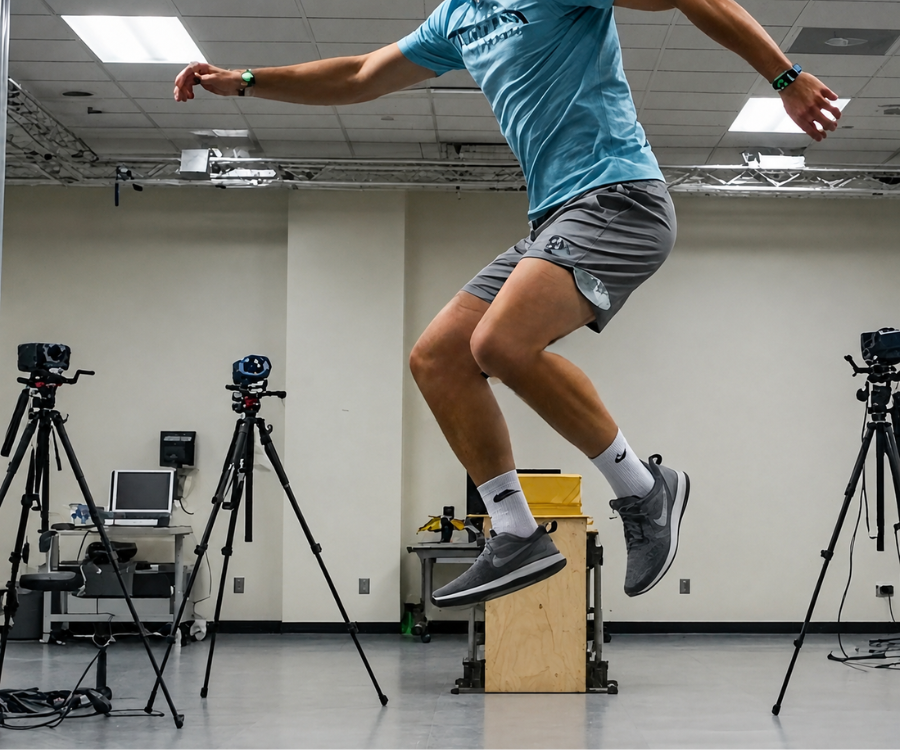
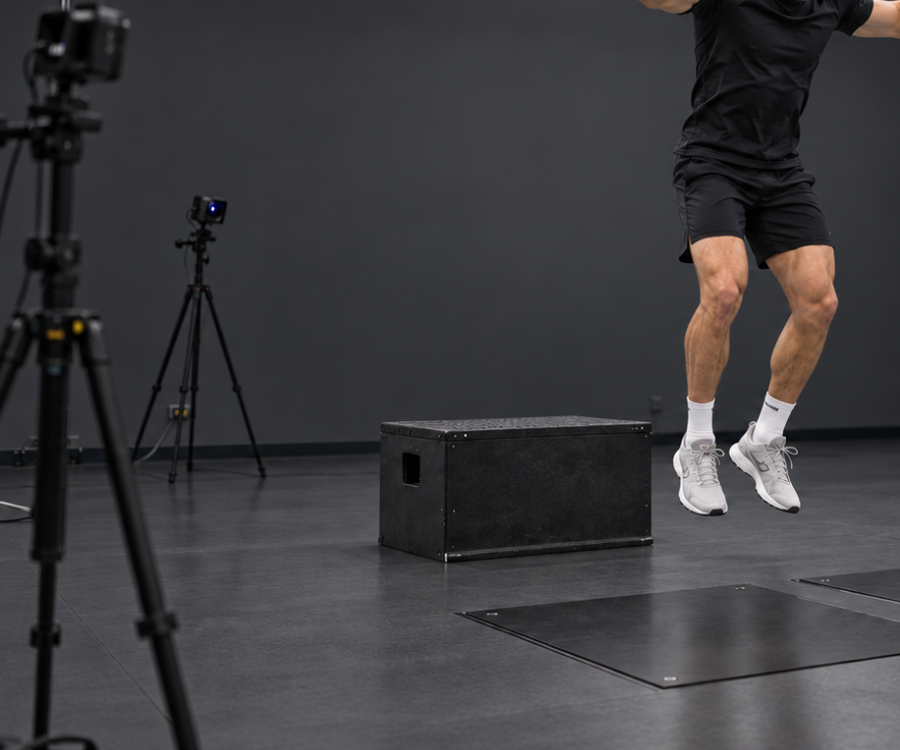
- Countermovement jumping with hands positioned on the hips
The movements were performed in capture volumes measuring 10 × 8 metres and 6 × 4 metres.
Data were recorded at 120 Hz using 18 synchronized Sony RX0 II cameras. The researchers systematically removed camera views during processing to generate 18-, 12- and 6-camera configurations. Video was processed using Theia3D version 2024.1.17, with subsequent analysis completed in Visual3D.
The researchers compared trunk, pelvis, hip, knee and ankle kinematics across the sagittal, frontal and transverse planes.
Key Findings
1. Kinematic differences were generally small across camera configurations
Statistically significant differences were identified between configurations, but their average magnitudes remained relatively small across the movements studied:
- Less than 1.7° during walking
- Less than 4.1° during running
- Less than 2.6° during countermovement jumping
These findings indicate that Theia3D-derived kinematics were generally consistent when camera numbers were reduced within the tested conditions and sufficient views of the participant were maintained.
2. Countermovement jumping produced the smallest differences in the smaller capture volume
In the 6 × 4 metre capture volume, the 18- and 12-camera configurations produced mean differences below 1.3° during countermovement jumping.
The jumps were performed near the centre of the capture space, where cameras maintained consistent views of the participant throughout the movement. This may have contributed to the relatively small differences between configurations.
3. The six-camera configuration was not viable in the smaller space without repositioning
The six-camera configuration could not consistently track every segment during movements performed in the 6 × 4 metre volume. As a result, this condition was excluded from the statistical comparison.
The cameras had been selected from positions established for the complete 18-camera setup. The authors noted that repositioning those cameras may have improved coverage.
This finding does not establish that six-camera collections are inherently unsuitable. It shows that substantially reducing camera numbers without adjusting their positions can compromise segment visibility.
Note: We typically recommend that camera systems should consist of eight or more cameras to provide some redundancy and ensure consistent segment visibility, with six cameras being the enforced minimum when analyzing movement data trials in Theia3D. The six-camera system here represents the minimum supported setup.
4. Camera geometry may matter more than camera count alone
The largest differences in the 10 × 8 metre volume were not always found between the configurations with the greatest difference in camera count.
The 12-camera configuration used a different relative distribution of viewpoints than the more evenly spaced 18- and 6-camera configurations. The researchers suggest this change in camera geometry may have contributed to some of the observed differences.
Running near the boundaries of the capture volume also created greater challenges than jumping near its centre, likely due to reduced visibility at the edges compared to the centre of the volume. Together, these results indicate that consistent multi-angle visibility is an important consideration when designing a markerless motion-capture setup.
What This Means for Biomechanics Researchers
The study provides practical evidence that reducing camera numbers may be feasible for walking, running and jumping analyses, but only when the remaining cameras preserve sufficient coverage throughout the movement.
For researchers planning a collection, the findings reinforce the importance of:
- Evaluating camera number alongside placement and capture-volume size
- Maintaining multiple views of each body segment throughout the task
- Testing movements across the full area participants will use
- Paying particular attention to movements performed near capture-volume boundaries
- Reporting camera placement, configuration and capture-volume dimensions to support reproducibility
The results are especially relevant when designing protocols for dynamic sport movements such as running and countermovement jumping. However, configurations should still be tested using the specific movements, participants and environments included in the intended research.
Study Considerations
This study compared Theia3D outputs between camera configurations but did not include a marker-based reference system. The findings therefore describe configuration-related consistency, not the absolute accuracy of any individual setup relative to any external baseline measurements from other systems.
The study included 10 healthy adults performing three movement types. Additional research is needed across more diverse participants and sport-specific movements.
Reduced configurations were generated from a complete 18-camera configuration and used the calibration parameters for the retained cameras from the full 18-camera setup. Independent calibrations of these reduced camera configurations could introduce additional variability in applied settings, as higher calibration residuals were observed for each reduction in camera configuration.
Read the Original Study
Walker, R., Robinson, M.A., Outerleys, J., et al. (2026). The effect of camera configuration on multi-camera markerless motion capture for biomechanical analysis. Journal of Biomechanics, 206, 113522.
Bring Theia3D Into Your Research
Planning a laboratory, performance or field-based motion-capture study? Theia3D supports synchronized, multi-camera analysis of walking, running, jumping and other dynamic movements.
Contact our team to discuss your research and data-collection requirements.